The similar phrase 'Worldly Christianity' is one used by Bonhoeffer. It's J Gresham Machen that I want to line up most closely with. See his Christianity and culture here. Having done commentaries on Proverbs (Heavenly Wisdom) and Song of Songs (Heavenly Love), a matching title for Ecclesiastes would be Heavenly Worldliness. For my stance on worldliness, see 3 posts here.

Affinity Panel


Greg, Stephen, Carl, Peter Milsom, Dan, Peter, Hywel
The very helpful conference came to an end with an opportunity to hear all the speakers answer questions. We discussed inerrancy and the current scene to some profit I trust. Good time. Foundations, we were told, is now to be a free online product. That's good too.

Kimyal New Testament


The Kimyal People Receive the New Testament from UFM Worldwide on Vimeo.
(We were shown this moving video in the final session here at Affinity).

Hodge Word and Spirit

Hywel Jones drew our attention to a letter of Charles Hodge (to a Dr Watt) preserved in the recently republished biography by Archibald Alexander.
DR. HODGE TO DR. WATTS
Princeton, October 5th, 1865,

My Dear Sir : —
Wistar has handed me your letter relating to the question raised among your brethren concerning the Witness of the Spirit. As you request an immediate answer, it is impossible for me to do more than state in a few words the view which I have been led to take on the subject, without any attempt to sustain that view either historically or exegetically. I write for you alone, as I have no idea that anything I say will be worthy of the attention of your committee.
We must, of course, renounce all hope to understand the mode of the divine operation either in nature or in grace; as we have no idea how mind operates on matter, or matter on mind, we cannot understand how God produces the effects which in the Scriptures are attributed to his agency. The fact is all we can expect to know.
1. It seems to be plainly taught in the Bible, and to be the commonly received doctrine, that in the external world God operates constantly through, with, and without second causes. Whatever in the external world, as in plants and animals, is indicative of design is to be referred to the present agency of mind, ie, to God. Matter cannot produce life, much less an immaterial, intelligent substance. Such substances, however, are constantly produced under the providential agency of God. The human soul operates in like manner through, with and independently of the functions of the body. Every time we speak or write, this threefold mode of exercise is evinced.
2. It is no less plain from Scripture and universally believed in the Church that the Spirit of God operates immediately on the soul. In the regeneration of infants this must be assumed.
3. It seems also clear that in the dealings of the Spirit with the souls of believers there is a constant exercise of His power in connection with and independent of the truth. We know not how one spirit operates on another; how evil spirits controlled the thoughts and feelings of the demoniacs, and of course we cannot pretend to know how the Holy Spirit controls the action of our minds, how He
excites our affections or gives the truth a greater power over them at one time than at another. But He is more immediately present with our souls than the soul is with the body, and constantly controls them in a way consistent with the nature of mind and the laws of spiritual intercourse.
4. We are clearly taught that saving faith rests on the witness of the Spirit and with the truth. This is represented in Scripture as something different from the evidence which the word itself contains of its own truth. It is "an unction from the Holy One." It is "the demonstration of the Spirit." The Spirit produces in our minds the infallible conviction that the Bible is true. This conviction is not the product of a process of reasoning, nor a conclusion from the facts of our own consciousness. If it were it would not be infallible, and our faith after all would rest in something human and not in the power of God.
5. In like manner the Spirit witnesses to the believer that he is a child of God. The assurance of his adoption the Apostle refers to two sources; first, the conscious filial exercises of the soul towards God, and, secondly, the witness of the Spirit, who bears witness together (summarture) with our spirits that we are the sons of God. Although compound words are frequently used in the same sense with the simple forms, this is only to be assumed under the stress of the context.
When the context admits of the full and proper force of the word it should be retained; much more when that force is required by the connection. The passage simply teaches that the Spirit produces in the mind of a believer the assurance of his adoption: as in Rom 5:5, He is said to produce the assurance that we are the objects of God's love.
There is no real ground for the charge of enthusiasm or fanaticism against this view of the subject,
(1). Because it attributes to the Spirit nothing out of analogy with the constant operations of God in the external world and on the minds of men in his providence.
(2). Because it is consistent with the constant representations of the Scriptures relating to the intercourse of the soul with God. We not only address Him and reveal or rather express to Him our thoughts and feelings, but He manifests Himself to us. We not only aver our love to Him, but He also reveals His love to us. The soul of the believer lives, or should live, in constant fellowship or intercourse with the Father of our spirits. He is at no loss for means and modes of communiating with his children.
(3). When our Confession attributes saving faith to the witness of God not only by or through but with the truth, it does not teach that God makes any new revelations. The word is true. It declares itself objectively to the reason, the conscience, and the affections to be true, and God by His Spirit affirms it to be true. There is no new revelation there. Neither is there in the witness of the Spirit to the believer's adoption. He is a child of God. He has all the filial affections of a child. The Spirit produces assurance that what is true is true. The soul is not left to deductions from its own imperfectly nderstood or partially interpreted consciousness. God gives it a peace which passes understanding.
The fanatics at the Reformation and in all times have abused the doctrine of the inward teaching of the Spirit. So they abuse the doctrine that He witnesses to the adoption of believers. But in neither case have they any just reason for their perversions. And the Reformers as you know gave up their doctrines on neither point from fear that the truth would be abused.
I fear these few remarks will not be of much service to you, but I am not able to write more.
Your friend, very truly, Charles Hodge.

Affinity Conference 6

Hywel Jones with Stephen Clark in the chair
The final paper of the conference was from Hywel Jones on that old chestnut Word and Spirit. Hywel is always avuncular and now in his seventies increasingly statesmanlike. Dealing with the views of Hodge, Bavinck and John Woodhouse, we were given the typical non-Lutheran, anti-Prc Trust, pro-Lloyd-Jones line that wants to avoid an ex opere operato view of  Scripture and preaching and emphasise the work of the Spirit. Always worth discussing.

Affinity Conference 3-5

Greg Beale


Dan Strange
So another day of it yesterday. We began with Greg Beale's paper which was a development of previous work on hermeneutics and the question of whether the NT use of the old is legitimate and to be followed. He made a good and scholarly contribution on this, focusing in the latter half of his paper on the use of Hosea 11:1 in Matthew 2. We found it difficult to discuss the paper in our group but were glad to hear someone setting out what I think most of us agreed with.
Stephen Clark spoke next (and I chaired). This was a more practical paper on the use of the Bible in church life (originally Martin Downes was to have done a paper on use and abuse so this was a different paper to the one intended). So we said various useful things about reading the Word, preaching, personal Bible study, etc.
The third paper of the day was from Dan Strange who outlined the contrasting views held within the Reformed world over involvement in public life. On one hand, there is the more Lutheran seeming two kingdoms approach and, on the other, what Dan called a transformational approach (chiefly growing out of Van Til), the view he himself favoured. We had a lively discussion on the question of how we argue in the public sphere - from natural law or straight from the Bible. We did not come to any firm conclusions and there was some disagreement, for example, on how Christians should deal with the challenges we are currently facing in the public sphere.
Another good day then.

Affinity Conference 01/02

Carl Trueman                                           Peter Naylor
So here we are once again in High Leigh Conference Centre for the Affinity Theological Conference. The numbers are smaller than last time and the subject, hopefully, less controversial (though no doubt prompted by the Enns and McGowan books that have caused such a stir). We followed the usual format of hearing a summary of the already received paper then discussing it first in small groups and then in plenary session. We began with Carl Trueman's historical paper which had the limited aim of demonstrating that the Princetonian view of Warfield et al was not a historical novelty, which he seemed to be able to do. We discussed modes of inspiration found in Scripture among other things. The second paper by Peter Naylor looked at literary genres and evangelical hermeneutics focusing on recent commentaries on Jonah, Daniel, etc, that argue against miracles on grounds of genre. Again useful discussion followed.
Ken Brownell chaired the first session and David Green the second. The group I am in was chaired by Colin Jones from Crawley. We had Carl Trueman in the group, 2 LTS students, one of the only women here and mostly ministers.
A good start.

Past Diary Jan 31 1974

The last day of January 1974 was a Thursday. I had a headache all day but managed to keep going. I began and ended with the next bit of Matthew and could report at the day's end "I have continued to keep busy, I have not borrowed, and I have kept my temper". The next day I was planning to train my guns on dishonesty (where again I had plenty to confess). I think, prompted by something I read or heard, I must have made a list of my main sins and tried to work through them putting them to death. Sadly, victory is not the easy thing I seem to have expected. We had a CPBSU meeting that night and my friend Stephen Price led us in a Bible Study from Zechariah 1. The Banner of Truth Trust had just republished T V Moore's commentary on the last three books of the Old Testament I recall. We had a rather fruitless discussion about what a vision was. After a little homework I went to bed.

Past Diary Jan 30 1974

This day I was working through my sins again. Did I have a list or something? I seem to have done well with the temper. With a little irony I say that "tomorrow I intend to refrain especially from laziness" (to be fair I was writing at the end of the day). It was an evening of homework but at some point earlier on I was either out buying the Focus album Moving Waves or (more likely) I bought it off a friend. That surprises me as I would have thought that I bought that album before Focus 3. I'd certainly listened to it before then. I describe the experience somewhere (On first listening to Moving Waves). The day began and ended with Matthew 21:33-46 and I give six lines of commentary. I had a headache at the end of the day and seemed to be going down with something.

Past Diary Jan 29 1974

Bit behind with this. I rarely quote as the entries are so utterly cringeworthy (a fair bit of bad grammar too). Perhaps I can cope with this. "My mother finished knitting my tank top, which I wore to the prayer-meeting". Only 13 words but there's a lot in there, hey? At prayer meeting we were finishing 2 Corinthians and one point Mr Garwood made was not to be afraid to say "grace be with you" rather than us. I've remembered that, though I couldn't have told you where I first learned it. I was still working through my sins and wondering about restitution. There is a curious note about temper where I claim to rarely lose it but to be tempted to hold small grudges. I would have thought it was the other way round. I was quite tired when I went to bed as I'd been up until 11.15 the night before. I seem to have been getting to bed 10-10.30 those days but would often be up late on a Monday night and always went to bed at midnight Saturdays.

Childhood Songs 4 Mr Froggy


This is another Singing Together memory. I particularly used to like hearing this Burl Ives on the radio as a kid. Ives had such asweet voice and I now see was no mean guitar player.

Proofs of Holy Writ

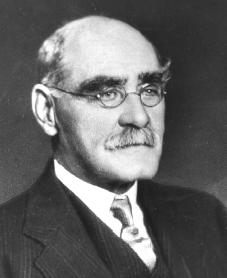
Rudyard Kipling's very last story was called "Proofs of Holy Writ". You can find it here. It was completed too late for inclusion in Limits and Renewals, his last collection, published in London in April 1932 but was published in The Strand magazine in April 1934, and reprinted there in 1947 with an introduction by Hilton Brown. It is also in volume 30 of the Sussex Edition.

It was said to have arisen from a dinner table conversation between Kipling and John Buchan about the process by which the splendidly poetic language of the KJV miraculously emerged from a committee of 47 learned men. Might they, Buchan wondered, have consulted the great creative writers of the day, like Will Shakespeare or Ben Jonson ? 'That's an idea', said Kipling, and went away to turn it into a tale. The story is prefaced by these words from Isaiah 60

ARISE, shine: for thy light is come, and the glory of the Lord is risen upon thee.
2 For, behold, the darkness shall cover the earth, and gross darkness the people: but the Lord shall arise upon thee, and his glory shall be seen upon thee.
3 And the Gentiles shall come to thy light, and kings to the brightness of thy rising. ...
19 The sun shall be no more thy light by day; neither for brightness shall the moon give light unto thee: but the Lord shall be unto thee an everlasting light, and thy God thy glory.
20 Thy sun shall no more go down; neither shall thy moon withdraw itself: for the Lord shall be thine everlasting light, and the days of thy mourning shall be ended.

Psalm 46 Shakespeare Coincidence

Reading about the AV one or two things have come to light or I have been reminded of. The connection between Shakespeare and Psalm 46 in the KJV is initeresting and goes to prove what I long ago learned - that coincidences are common. Another example of this sort of thing would be the coincidences between the assasinated US presidents Lincoln and Kennedy. A more recent thing like this is the observation that one of the planes that hit the twin towers on 9/11 had the number Q33NY which when converted to wingdings is this:


Past Diary Jan 28 1974

My Monday entry is very brief. I say something typically banal about my daily reading (Matthew 21-12-20), bemoan my failure to witness though I mention that my sister is reading her Bible still (I guess she was converted somewhere around this period) and bewail what I call the "many sinful vices creeping upon me lately". The only example of this that I give is (shock, horror) BORROWING! I tend not to name things that really did trouble me as a teenager but as someone who had been brought up not to borrow things I can see how this would have been on my conscience. I spent the evening, unusually, doing homework. I was also listening to Focus, of course. Probably on the old radiogram. I don't think I got my Philips 303 until the following May.

Past Diary Jan 27 1974

January 27 1974 was a Sunday so I heard two sermons (on John 14:20 and Acts 5:42). In the afternoon the Bible Class was on John 8:33-59. I preserve a quote from the morning sermon "The water of heaven fills the shape of the vessel it is poured into" which at this distance seems a little inane but obviously struck me then. The evening sermon prompted a confession of lack of witness. I felt that the previous year (I had been baptised the previous June) I had been witnessing all the time but not now to my shame. I also attended a prayer meeting (a new thing it seems) before the evening meeting and prayed and went to the YPF where we had a quiz followed by news of missionaries in Romania and China. I also had my own reading from Matthew and read from the book of sermons by Whyte again (which I have now discovered was first published in 1922 - see here). It had een a wet weekend.

Van Gogh Vergeten 05

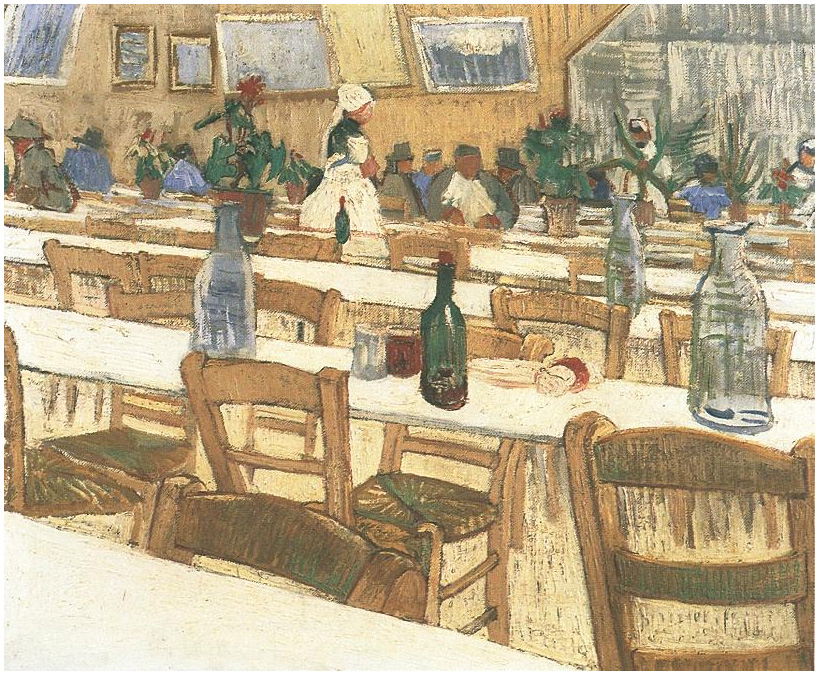
Painting, Oil on Canvas Arles: August, 1888 Location unknown