The similar phrase 'Worldly Christianity' is one used by Bonhoeffer. It's J Gresham Machen that I want to line up most closely with. See his Christianity and culture here. Having done commentaries on Proverbs (Heavenly Wisdom) and Song of Songs (Heavenly Love), a matching title for Ecclesiastes would be Heavenly Worldliness. For my stance on worldliness, see 3 posts here.
Showing posts with label suffering. Show all posts

C S Lewis Quote

“We are, not metaphorically but in very truth, a Divine work of art, something that God is making, and therefore something with which He will not be satisfied until it has a certain character. Here again we come up against what I have called the “intolerable compliment.” Over a sketch made idly to amuse a child, an artist may not take much trouble: he may be content to let it go even though it is not exactly as he meant it to be. But over the great picture of his life - the work which he loves, though in a different fashion, as intensely as a man loves a woman or a mother a child - he will take endless trouble—and would doubtless, thereby give endless trouble to the picture if it were sentient. One can imagine a sentient picture, after being rubbed and scraped and re-commenced for the tenth time, wishing that it were only a thumb-nail sketch whose making was over in a minute. In the same way, it is natural for us to wish that God had designed for us a less glorious and less arduous destiny; but then we are wishing not for more love but for less.”
C.S. Lewis, The Problem of Pain

Calvin all the way


No-one can argue that Calvin's five hundredth birthday has not been well and truly marked in this year. Another three Calvin things for you to digest.
1. Last Sunday we were invited to join Andrew Hill and the folk over the hill at Highgate Road Chapel to hear Garry Williams on the subject "Is the world out of control?". I think we were about twenty. With consummate skill Garry eschewed and academic consideration of suffering and ploughed a practical apologetic furrow, drawing on Calvin's life (being a refugee, an oft hated man, a widower, at death's door, etc) and labours as well as his writings (about the sovereign God who is also a Father to all in need adn who is seen best in Jesus Christ) to say that God is in control although it does not seem so at times. An excellent time of questions followed. We were only sorry not to be able to stay for tea. (Garry drew partly on his paper at the Banner this year. See here).

2. On Monday we were at the Westminster Fellowship where Hywel Jones, recently returned from the USA, was the speaker. He preached first and then spoke on Calvin and his preaching - especially whether he preached Christ enough. After lunch we spent the time in discussion of the paper. The sermon was on John 16:23, 24 and specifically Christian prayer, prayer in Christ's name. Dr Jones's preaching does have a certain Chinese food quality (in that when he speaks he seems to open up vistas but when you try to describe what he has said it can sound rather ordinary).
The paper and the discussion was stimulating. He suggested that Calvin often didn't preach Christ as much as we would have expected. The factors here he suggested (I think) were
1. Human factors - he preached as appropriate to the situation
2. Use of terms - we can't assume a failure to mention the word Christ means not preaching him
3. The covenantal structure of Scripture so that when preaching on the Old Testament the mention of Christ is minimised
4. The very fact that he preached Old Testament sermons to a more convionced audience
5. The reality of there beuibf but one olive tree
He also had interesting things to say about Calvin preaching the Vox Dei as well as the Verbum Dei and the actual tones of God's voice. Also, declaring a trinitarian authroite, vivacite, familiere. He used an interesting quotation from T H L Parker who suggests that Calvin's commentaries are charactarised by abrupt moves from one end of the exegetical continuum to the other:
"For page after page he can look like Calvinus Judaeus (something he was called not long after his death) and then suddenly show that, in his voluntary exile among the men of the Old Covenant, living with them in shades and shadows, he has not forgotten the Sun of righteousness who, as he himself already knows, will in their future rise with healing in his wings."
(Calvin's Old Testament Commentaries, 1986).

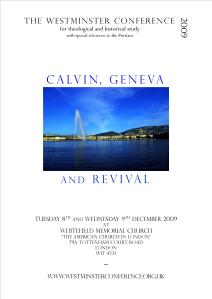
3. The third thing I want to do is to draw attention to what may be the last conference of the year with dose of Calvin (from Garry Williams again and Don Carson) - The Westminster Conference here in London in December. More here.

52 JC No 17

This extract from the letter to the French Brethren was also quoted by Garry Williams

I am aware what reflections may here present themselves to our minds; that in the meantime the servants of God do nevertheless suffer, and that the wicked from the impunity with which they commit their acts of cruelty, break out more and more into all sorts of excesses. But since it is our duty to suffer, we ought humbly to submit; as it is the will of God that his church be subjected to such conditions that even as the plough passes over the field, so should the ungodly have leave to pass their sword over us all from the least to the greatest. According then to what is said in the psalm, we should prepare our back for stripes. If that condition is hard and painful, let us be satisfied that our heavenly Father in exposing us to death, turns it to our eternal welfare. And indeed it is better for us to suffer for his name, without flinching, than to possess his word without being visited by affliction. For in prosperity we do not experience the worth of his assistance and the power of his Spirit, as when we are oppressed by men. That seems strange to us; but he who sees more clearly than we, knows far better what is advantageous for us. Now when he permits his children to be afflicted, there is no doubt but that it is for their good. Thus we are forced to conclude that whatever he orders, is the best thing we could desire.

Matheson Quote

This thoughtful quotation is from George Matheson's Moments on the Mount published in 1884. Someone read my previous piece on Matheson here and asked about these words, which with a little difficulty I have been able to track down.

My God, I have never thanked Thee for my thorn. I have thanked Thee a thousand times for my roses, but not once for my thorn. I have been looking forward to a world where I shall get compensation for my cross; but I have never thought of my cross as itself a present glory.
Teach me the glory of my cross; teach me the value of my thorn. Show me that I have climbed to Thee by the path of pain. Show me that my tears have made my rainbows.
Reveal to me that my strength was the product of that hour when I wrestled until the breaking of the day. Then shall I know that my thorn was blessed by Thee, then shall I know that my cross was a gift from Thee, and I shall raise a monument to the hour of my sorrow, and the words which I shall write upon it will be these : "It was good for me to have been afflicted."

Suffering and resurrection

After his suffering, he showed himself to these men and gave many convincing proofs that he was alive. He appeared to them over a period of forty days and spoke about the kingdom of God. Acts 1:2 The opening of Luke's second, less obvious, book about Jesus begins by summarising the 'period of 40 days' between 'his suffering' and ascension. There is, then, the period of suffering then the 40 days, in which he proved he had risen and spoke of God's kingdom.
Jesus, the Second Person of the Trinity, was always with the Father before his incarnation. He has now ascended again to God's right hand. Between these two points are his years of suffering and the 40 days of showing himself to his disciples and teaching them.
The suffering began with his birth, circumcision and flight from Herod. Next came poverty and obscurity in Nazareth then constant opposition and attempts to take his life culminating in his arrest and the cruelty and indignity of flogging, crucifixion, death and burial. Many things happened over the 33 years before resurrection but Luke sums them up as 'his suffering', enduring the penalty for sin to save his people.
His death and burial were not the end of the story. After three days he arose. He remained on earth in a resurrection body some six weeks to do two things. First, to show himself - not to everyone but to the Apostles, chosen in the time of suffering. He gave them 'many convincing proofs that he was alive' - eating; allowing them to touch him, perhaps. It was important they be convinced that he who suffered and died then rose again.
He also spoke about God's kingdom. There were things they could not understand in the time of suffering and that could only be clarified after his resurrection. They are reflected in the New Testament, which, though not always speaking in such terms, is concerned with God's rule and its extension.
We know Christ suffered to save his people and triumphed over death to rise again. We know he taught about God's Kingdom - that entrance is by new birth, is through many hardships and is a matter not of eating and drinking, but righteousness, peace and joy in the Holy Spirit (Rom 14:17). We must live in light of these truths.