The similar phrase 'Worldly Christianity' is one used by Bonhoeffer. It's J Gresham Machen that I want to line up most closely with. See his Christianity and culture here. Having done commentaries on Proverbs (Heavenly Wisdom) and Song of Songs (Heavenly Love), a matching title for Ecclesiastes would be Heavenly Worldliness. For my stance on worldliness, see 3 posts here.

An evening with John Newton


Getting on for 200 were in attendance last night for an evening with John Newton, organised by The Banner of Truth. It was held in St Mary Woolnoth in the City of London where Newton latterly ministered. Mark Johnston chaired and Brian Edwards spoke first in his usually succinct style giving an overview of Newton's life and saying a little about his slavery and anti-slavery connections. He closed with two fair questions about slavery and worker exploitation and about abortion today.
After a 10 minute break Anglican George Curry spoke on Newton's Anglicanism and ministry. I don't tend to think of Newton as an Anglican although he clearly was. Mr Curry pointed to the various factors that led him to this position (admiration for Whitefield and the influence of various other Anglicans, pressure from his wife's family) and his own poor pragmatic arguments (gospel more important than church order, all churches mixed, liturgy okay and the main one - a good boat to fish from). It is a pity that he became an Anglican but having become one he did not simply abandon his nonconformist connections as some do but worked hard to keep them up. If only more (like Mr Curry) were more willing to do that today. As for ministry we were given many challenges as we looked at his devotional life, his Calvinism, his catholicity, his care for God's people, etc. This excellent message would be well worth getting hold of.

Rhodri 18

On Saturday we were celebrating my eldest son's 18th birthday. The main thing was a get together in the church hall with family and friends.

Pennine Bible Witness

It was my privilege to preach last Friday night at Thornhill Baptist Church near Dewsbury for The Pennine Bible Witness. I travelled up to Wakefield on Friday afternoon as the sun set and was kindly met by pastor of the church Daniel Grimwade. The Thornhill church has a long history. The Pennine Bible Witness is one of several monthly preaching rallies around the country that started in the sixties and seventies with the rediscovery of Reformed truth. Some have been superseded but others, like this one, continue. Michael Wright, who I know through Grace Assembly, chaired for me and we sang from the Bible Witness selection, which I had seen once or twice before. About 80 gathered. The bias was to the older age group and the male gender and we all appeared to be of the same ethnicity. I preached on the valley of dry bones in Ezekiel 37, hopefully with some effect. Most of the people there I did not know. I met Liz Ward who I virtually know through Geneva Net, which was nice. I was about to buy some Pilgrim Home marmalade when I realised my wallet was elsewhere. A kind-hearted gentleman from Leeds bought it for me. I had a nice chat with a young man from the church. The Grimwades generously put me up for the night before I sped back to London. It was nice to spend time with them and their little girls. Such trips are always very encouraging

Bio 11g Daniel Wilson

Conclusion 2 (the last five points)
11. Missionary zeal. His willingness to go to India in his fifties speaks volumes. His perseverance there too. It all grew out of a zeal that had begun long before. Back in 1797 and just converted he had felt “great desires to go or do anything to spread the name of Jesus”. He wrote “I have even wished, if it were the Lord's will, to go as a missionary to heathen lands." The reason he stayed and died in India was not a lack of interest in his homeland – far from it – but a sense of commitment to the work. 12. Growing charity. No-one was more of a churchman than he; but he was always ready to hold out the right hand of fellowship to those that differed. His warfare was defensive. This catholicity increased with his years, till, at length, he uttered what Bateman calls 'those memorable words, significant, at all events, of his own aspirations for India': "Unity and love prevail amongst the different divisions of the Protestant family here. We no longer maintain the old and fatal mistake that Christian men are not to co-operate for anything, till they agree in everything. We now hold the antagonistic and true maxim, that Christian men should act together so far as they are agreed." 13. Unbounded liberality. None will know its extent; but very nearly all that he ever received from India was returned to India. By dint of self-denial he must have passed on thousands of pounds to the work of God in India. 14. Fearlessness in a righteous cause. He feared the face of no man in a righteous cause. When he saw anything which required a word of caution, the rank of the individual never daunted him. The fitting occasion was watched for, the friendly word spoken, or the private note sent. If the desired effect was produced, he rejoiced ; if the interference was resented, he bore it as "a cross," but it never made him angry. Public scandals, however, drew from him public condemnation; and it often made the breath come short, to hear him from the pulpit denounce an offence, and almost name the offender. On one occasion of a public scandal, after frequent public demonstrations of this kind, he invited thirty or forty influential ladies to his house, and entreated them in private to stem, by their influence, the current of immorality which was setting in. 15. Peculiarities. He suffered them to grow, and they became marked features. It was not originality or eccentricity, so much as peculiarity and oddity - an odd way of saying and doing odd things. And yet there was something of originality in what was thus done and said - something of set purpose - something which gave point to the expression, and took firm hold upon the memory. Speaking of a missionary who had sought and obtained a chaplaincy, he said, "Ah! he was a true missionary; perhaps there was not a better in India. But Satan and Eve have persuaded him to quit the work." One of the chaplains in the upper provinces had preached a sermon, in his presence, strongly directed against Calvinism. The argument was elaborate, and claimed to be triumphant. The bishop said nothing at the time ; but when about to step into his palanquin, and leave the station, he shook hands kindly with the chaplain's wife, and thanked her for her courtesy, adding: " Please to tell your husband that he has not settled that question." He would often join together a commendation and a caution. Introducing a chaplain to the governor, he mentioned him as one "who bids fair to be very valuable to us, if only God keeps him humble." It characterised his expositions of Scripture. One of his chaplains was ordered up to the Punjab, but his wife was unwilling to go. In the course of the morning's reading, it happened that this passage occurred : " Having his children and his household in subjection with all gravity." — "Now," said the bishop, commenting upon it, "I don't call it having his household in subjection with all gravity, when one of my chaplains is ordered up to Lahore, and his wife says she won't go." His lectures on the Epistles to Timothy or Titus, to his candidates for ordination, have been already alluded to. They were invaluable, full of force, and calculated to impress the mind most beneficially. But here, also, he sometimes forgot himself, and said more than he meant. The candidates were required to take down the lectures, and the examination of their notes formed part of the preparatory trial. On one occasion, some quick, clever candidates took down every word ; but before the papers were submitted to the bishop, they brought them to his chaplain, pointing out many 'odd remarks and strong expressions, and asking whether they should be left out. "Not a line, not a letter," said the chaplain. The papers were accordingly handed in, and the perusal of them was to the bishop like a man beholding his natural face in a glass. He could scarcely believe that the expressions were correct; but, undeceived on this point, the last morning's lecture was very much taken up in modifying the previous statements, and preventing all consequent misunderstandings. Especially - having said that "he would rather be a poor little Baptist, with God's grace in his heart, than the Archbishop of Canterbury without it" - he was anxious to explain, that though he stood to the sentiment, he would not have them picture to themselves an Archbishop of Canterbury without grace in his heart. But still there is such a thing as being too much at home in the pulpit; and, many times, things were said by the bishop which had better have been left unsaid. But, though men might smile, they never slept. India is a sleepy place, and he effectually roused it. And it may be surmised that he intended to do so. Hence short, strong, pithy sentences, which might be fixed like goads. Hence familiar anecdotes of other times and earlier days. Hence reference to matters of local interest — to offensive paragraphs in newspapers, to unlawful, though fashionable amusements. These were the outpourings of the heart, and the impulse, often, of the moment — graphic, pungent, and sometimes ludicrous. But all these peculiarities affected not the great features of his character. There is something of affection in the smile they raise. Bateman admits the faults in Wilson – he cannot deny them but using the word of another he ends by calling him A BRAVE AND NOBLE SOLDIER; A WISE, BOLD LEADER. I ESTEEM IT THE GREATEST PRIVILEGE OF MY LIFE TO HAVE KNOWN HIM. One understands such sentiments.

Bio 11f Daniel Wilson

Conclusion 1
A physically striking figure, Wilson impressed some with, 'his spiritual egotism and … eminently technical view of religion' and others by his ‘pure simplicity of mind and artlessness of demeanour’. The pattern of his last years in India was apparently little changed. Occasionally he demonstrated an unexpected sensitivity to Indian culture, troubling to learn Hindi and acknowledging the importance of varying biblical terminology to suit the customary usages of different ethnic groups. His wide interest in missionary work brought personal contact with figures such as William Carey, Alexander Duff, Adoniram Judson and Elijah Bridgman. The mutiny of 1857 he interpreted as a devastating judgement on Britain's record in India. It prompted his final sermon in the cathedral at Calcutta, entitled ‘Humiliation in national troubles’. There followed a few months of steady deterioration, and he died at Calcutta on 2 January 1858. After an official funeral he was buried in his cathedral.
Bateman lists some 15 characteristics of Wilson. We will close by highlighting these. Here 1-10:
1. Energy. Even in our short survey I think this comes out. 'He wearied others: but was never weary himself'. What an example he is for us here.
2. Simplicity of his aim. 'Men said he was ambitious, and loved power. But, if so, it was only as a means to an end. The great end and object of life with him, was to save the souls of men; and to this, time, talents, influence, and property, were all devoted.' Again he is an example to us.
3. His deep piety. Despite the failures we have noted it is true to say 'religion was never laid aside, never forgotten. It was his comfort, his solace, his delight, his joy. It was entwined about his heart, and wrought into the very fabric of his nature. It constituted his strength.'
4. Spirit of prayer. He was always praying. In later life it occupied almost half his day.
5. Study of Scripture. "The more we read it," he used to say, "the more we may. It is certain that we shall never exhaust it."
6. Moral courage. In this respect the mind controlled and commanded the body. When, halting on his first visitation between Bombay and the Himalayas, he received from Bishop Corne a letter warning him of danger, and entreating him to return, — he paused, reflected, took counsel, saw no real cause for alarm, — and then calmly and courageously persevered in his journey. Who but he, or one like-minded, would have linked his little pilot-brig to a great steamer, and faced the monsoon in the China Seas, in order to carry out his purpose in reaching Borneo? Who but he would have ventured to grapple with the caste question in the way (he did)? The evil was admitted; the moral courage was exhibited in applying the remedy. Compare his handling of tractarianism with the modified and timid disapprobation it met with at the hands of others. He gave utterance to his own deep convictions, and openly denounced it as "another gospel." To stand in the gap thus fearlessly, as a rallying-point for others, demands and manifests high moral courage.
7. Untiring industry. It served him instead of originality and genius. It made him learned, powerful, useful, influential. No labour daunted him when some important work was in hand. When he had a major sermon to deliver he would work over it again and again.
In Ceylon he reached on "The Pearl of Great Price ". He was 78 when he gave it. Bateman describes him preparing with a desk full of sermons; any one might have been preached without labour to himself, and with profit to the hearers. But he is in the neighbourhood of the pearl fishery; the subject will be interesting; attention may be arrested, and good done. Hence, on the Saturday his table is covered with books, and on the Sunday every description is lively, every allusion correct. His industry never failed. When action did not so much require it, study had it. No man in India read half so much as he did; and his comments and criticisms prove how well the reading was digested. Even on the very last day of his life, he was looking at "Livingstone," and learning something about " Africa."
8. Consistency. Early in life he had grasped the primary truths of the gospel, and he held them firmly to the end. Many secondary truths were added, but they were kept secondary. He never rode a hobby in divinity. His sermons were always good to hear, his books always safe to read. In a charge delivered in 1851, he could say: "I retain the sentiments I publicly expressed in 1817." This inspired confidence ; and the idea of instability and changeableness was never attached to his character. He had no opinion of those who, in order to give the public the benefits of their own thoughts, neglected what had been previously thought and said by others. He laid aside a recent commentary, unread, because the author professed to have written it without consulting previous commentators.
9. Deep self-abasement. It ran through life, and found expression everywhere. The " bitter things " he wrote against himself would make unobservant men deem him a sinner above others. But he only had a deeper insight into his own heart, and a higher sense of the holiness of God. The extent of the sorrow is the point of difference amongst God's people, and not the extent of the sin.
Speaking once of having been in the ministry 56 years he said, "Ah, yes; but it is a long time to have to answer for. None can answer for me but ONE, and that one CHRIST JESUS. I cannot answer for myself."
10. Fidelity to Christ. He never ceased to teach and preach Jesus CHRIST; and when he quarrelled with any scheme of doctrine, it was chiefly because it took from Christ the honour due unto His name. The savour of His name was in every sermon ; the pleadings of His merits marked every prayer. To add to His dominion, to extol His grace, and to extend His church, was the very joy of his heart. Every doctrine of the gospel had its niche, but Christ was on the pedestal. Nothing was put before Him - nothing suffered to obscure His glory.

Holiday Gem 05


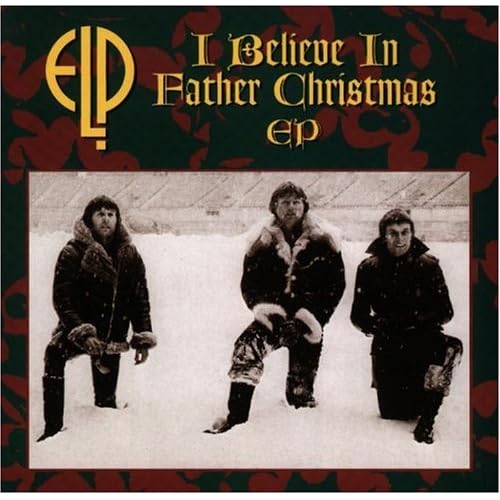
1. I believe in Father Christmas by Greg Lake on an Emerson Lake and Palmer EP.
This Greg Lake single first came out in 1975. Each Christmas that I heard it I was drawn to it. Then one Christmas I saw the 1995 EP with this and other tracks in a big record store. I didn't buy it at the time (I show restraint sometimes) but sent for it from Amazon another Christmas. It has 5 tracks - 2 versions of IBIFC, a version of Prokofiev's Troika (by Keith Emerson and the tune that provides the musical theme for IBIFC), Humbug (B-side of IBIFC single - delightful, jazzy, near-instrumental) and Nutrocker - encore from the ELP album of Mussorgsky's Pictures at an Exhibition (based on Tchaikovsky's Nutcracker so a Christmas number too).
The second version of IBIFC is a stripped down ELP version of the masterful Greg Lake single. This latter track has everything going for it as a Christmas single. First you get a beautiful 12-string guitar, a pleasant voice singing a pleasant tune. Then there's a distant choir, sleigh bells, some sort of bell/horn synthesiser to give atmosphere. Next, as we approach the final minute, timpani start, a large choir, an orchestra, military drums - all moving to a dramatic and powerful close. These are what hit you at first. Then you realise that the words (by one Pete Sinfield) are totally cynical. Poor old Pete has seen through the whole sham. No snow - only rain; no Father Christmas and (for him) no Jesus either. He tries to rescue it by wishing everyone a hopeful Christmas and a brave new year. This is highly post-modern - a song that makes you feel all "Christmassy" but that points out that the whole thing is a sham. I do believe in "the Israelite" but moaning about Christmas and enjoying it at the same time is great fun.

Holiday Gem 04

4. In the bleak midwinter by Bert Jansch.
This 1974 single is a very pleasant rendition of Christina Rosetti's hymn by the well respected Scots folk guitarist who first came to prominence in the sixties with the group Pentangle (Light flight, etc). I discussed the hymn last Christmas
here
I discovered this version of the hymn on tape 2 of the cassette version of The Best Christmas Album in the World ... Ever!


Holiday Gem 03

3. Joy to the world by Peter Green and The Men in Blue on the 1997 album I Got the Blues for Christmas.
A Peter Green played guitar in Fleetwood Mac Mark 1 (Albatross, Man of the world, etc). I found this on i-tunes and assumed it was him but apparrently no.
It is a very nice bluesy instrumental nevertheless. I downloaded 5 of the 12 tracks. These are the instrumental ones I think. I'm not so convinced about the vocal offerings. The tune Antioch is a Lowell Mason arranged thing that is just brilliant anyway. Watts's words are not really on the incarnation but it seems to be very much associated with this time of year.
Personnel: Peter Green (vocals, acoustic & electric guitars, acoustic & electric slide guitars, organ, synthesizer, bass); Brian "Bugs" Moran (vocals, keyboards, organ); Neil Burgett (vocals, synthesizer, drums); John Leddermann, Joe DeMaio (guitar); Bruce Kapler (saxophone); Frank Latorre (harmonica); Leighton Delgado (bass); Bill Fernande (drums); Tyronne Wisdom (background vocals).

Bloggy Special 19


Holiday Gem 02

2. Er Is Een Kindeke Geboren op Aarde by Thijs Van Leer and others on the 1976 album Music per la Notte di Natale.
This beautiful track features Louis Van Dijk on piano, Thijs Van Leer on flute and an orchestra conducted by the late Rogier Van Otterloo. I came across the old vinyl version in a record shop in Cwmbran when I was back home there some time after 1976. It got rather scratched at some stage but I replaced it with a CD bought at a Focus concert here in London. The track on i-tunes I seem to have from an album called Wereldsterren wensen u een Vrolijk Kerstfeest (famous stars wish you a happy Christmas time, I guess) which includes tracks from Andy Williams, Doris Day, Ray Conniff, etc! I suppose the title means There is a child born on the earth.

Holiday Gem 01

One of the joys of Christmas for me is listening to music I don't hear for the rest of the year. Some of it is on CDs that are locked away for 11 months before being brought out with the tree, etc. Others are on my i-tunes but remain unticked for most of the year. Let me tell you some things that are there.

1. Good King Wenceslas by The Roches from the 1994 album We Three Kings
Thanks to Terry Wogan this LP is no longer a secret nor are the unique Roche sisters, who I assumed were Irish at first but are in fact New Yorkers (Maggie, Suzzy and Terre).
The hymn is a Christmas favourite (outside church). J M Neale thought it up in 
the Victorian period basing it on the legend but making a good application at the end. (I quote it in my commentary on Proverbs).
This pleasant version is enhanced by the bright strings and the pleasant harmonies.
"THE ROCHES came into being one Christmas season on the streets of New York City singing these very songs. And every year when the hassles and tensions of Christmas set in, we rediscover the joyful, peaceful spirit of Christmas through these carols. This record is a dream come true for us. We send it out into the world with best wishes for everyone!"

Bio 11e Daniel Wilson

India
By the time Wilson was 54 then he had lived a full and useful life as an Anglican churchman and a doughty supporter of the evangelical movement in England. On this basis alone he may have merited our attention. However, in 1832 he became the fifth Anglican Bishop of Calcutta (then a vast diocese reaching as far as Australia). There in Calcutta, with only one break to return to England, in 1845-6, when recovering from illness, he went on to serve the Lord for another 25 years. It was during this visit home that he made a severe attack on the policies of the Society for the Propagation of the Gospel in India and received an unprecedented invitation to preach a second anniversary sermon for the CMS.
Wilson had always shown an interest in missionary work and references to this can be found as far back as his conversion. In 1829 John Turner, consecrated Bishop of Calcutta in 1829, visited Islington before leaving England and there considered the needs of the diocese with Wilson. When Turner died in 1831, the third bishop to do so in five years, Wilson, while sharing the general anxiety about the succession, was not an obvious candidate. However, when several others refused the offer and Wilson, in some desperation, indicated his willingness to be considered, the influence of evangelical friends, including Lord Glenelg, secured his appointment. He therefore resigned his post at Islington, received his DD by diploma, and was consecrated at Lambeth Palace in April, 1832.
In the manner of the day his eldest son, Daniel (b 1805), who had been appointed to Worton in 1828, succeeded him at Islington, and his nephew Josiah Bateman (subsequently his son-in-law and biographer), went with him to India as his chaplain. They left Portsmouth June 19, 1832 and arrived in Calcutta on November 5.
Wilson's predecessors had made only limited headway in establishing the extent of episcopal authority, defining the nature of the ecclesiastical establishment and standardising liturgical practice. Bishop Wilson's years in India were to be devoted to these fundamental tasks. He re-established the physical and social presence of the bishop in Calcutta, brought order to episcopal administration and revived or set in motion many of the activities familiar to him from his London parishes - clerical meetings, lecture series, infant schools, writing for the Christian Intelligencer and church building. Between 1839 and 1847 he masterminded construction of Calcutta's cathedral.
To make his leadership felt outside Calcutta he exploited the practice of episcopal visitation to the full. In five major journeys between 1834 and 1857, each lasting between two and three years, his episcopal cavalcade, often with more than 250 soldiers, elephant attendants, bearers and camp-followers, traversed the huge diocese from Simla to Colombo and from Delhi and Bombay to Singapore.
His task was slightly eased by the erection of new dioceses for Madras (1835), Bombay (1837), New South Wales (1836) and Colombo (1845) and his own appointment as metropolitan.
With his forceful personality and struggling, in his own words, to maintain ‘firm churchmanship … in the face of high-church principles and no-church principles’, Wilson often appeared to others as the embodiment of episcopal pretension. His contempt for Tractarianism, ‘this egregious drivelling fatuity’ and his sustained attacks on it, notably in his second charge in 1838 and subsequent sermons, did not save him from perhaps the greatest irony of his career - serious conflict with the CMS and its lay supporters in India over the licensing and superintendence of missionaries. To one who had done so much for the cause of missions at home, the suspicion with which missionaries on the ground viewed his plans to make Bishop's College the great training centre for ministers in India, their frequent neglect of ecclesiastical order partly under the influence of the society's Lutheran employees and, above all in southern India, compromises with caste, came as a great disappointment.
Wilson tackled these issues with characteristic vigour and displayed sufficient flexibility to reach generally acceptable agreements with both the CMS and the civil authorities on many church–state questions. He called the Indian caste system a 'cancer' and in his famous essay, On the Distinction of Castes in India (1834), he abandoned Reginald Heber's temporising for the demand that in the church it ‘must be abandoned, decidedly, immediately, finally’. Reinforcing the requirement with personal visitations, Wilson carried the missionaries with him but lost the allegiance of many local church members.
Loane sums up this final period as proving him to be a great man and a first-class bishop, a time when he did a noble work for India.

Paradise Found

Regular visitors to this blog may have noticed a predeliction for the hymns of Charles Wesley. This year is the 300th anniversary of his birth and to mark that date one of the things that has been done this year is the release of a CD, which I have just purchased. It is by Maddy Prior and the Carnival Band. Maddy Prior came to prominence in the seventies with the folk rock band Steeleye Span (All around my hat, etc). The Carnival Band specialise in old instruments. I believe they came together to play some Christmas carols at first (they have three or four good Christmas CDs by now) and then later did a collection of 18th Century hymns ('Sing lustily and with good courage'). I remember being in the car with my friend Alan Davey one day and he played this latter album on CD. I was immediately struck and had to get it which I did. More recently I managed to track down a CD version which I've continued to enjoy.
I'd not noticed Paradise Found, which came out back in May, but there was a reference to it in The Times the other week and when I looked there it was on i-tunes and Amazon. I wouldn't want a praise band in church but this is very pleasant (a remarkably old fashioned idea by the way). Everything is done in the folk (rather than operatic) idiom which I think is a better way to sing hymns. There's plenty of well known stuff on this CD (Love Divine All Loves Excelling, Ye Servants Of God, Soldiers Of Christ Arise, Jesu Lover Of My Soul, etc) but often to an unfamiliar tune. There are also new ones to me like Dead Dead The Child I Loved So Well and Come On My Partners In Distress (not all the verses below but some of them). There's a very bouncy 'Come away to the skies' that grabs my fancy most on first listening.
Come on, my partners in distress,
My comrades through the wilderness,
Who still your bodies feel;
Awhile forget your griefs and fears,
And look beyond the vale of tears,
To that celestial hill.

Beyond the bounds of time and space,
Look forward to that happy place,
The saints’ secure abode;
On faith’s strong eagle pinions rise,
And force your passage to the skies,
And scale the mount of God.

See where the Lamb in glory stands,
Encircled with His radiant bands,
And join the angelic powers.
For all that height of glorious bliss,
Our everlasting portion is,
And all that Heaven is ours.

Who suffer with our Master here,
We shall before His face appear
And by His side sit down;
To patient faith the prize is sure,
And all that to the end endure
The cross, shall wear the crown.

Thrice blessèd, bliss-inspiring hope!
It lifts the fainting spirits up,
It brings to life the dead;
Our conflicts here shall soon be past,
And you and I ascend at last,
Triumphant with our Head.

That great mysterious Deity
We soon with open face shall see;
The beatific sight
Shall fill the heavenly courts with praise,
And wide diffuse the golden blaze
Of everlasting light.

The Father shining on His throne,
The glorious co-eternal Son,
The Spirit one and seven,
Conspire our rapture to complete;
And lo! we fall before His feet,
And silence heightens Heaven.

In hope of that ecstatic pause,
Jesus, we now sustain Thy cross,
And at Thy footstool fall,
’Till Thou our hidden life reveal,
’Till Thou our ravished spirits fill,
And God is all in all.

Busy weekend

It's been a busy weekend. Eleri went away (a very rare thing) with friends Friday and Saturday on the Eurostar to Cologne and so I was left in charge. First duty was lunch boxes and taking the two youngest to school. In the afternoon I was in Covent Garden for a Grace Publications Committee. Someone else kindly picked them up. I took a few minutes to look round a second hand bookshop in Charing Cross Road. Anne Fadiman had me thinking about them with one of her essays. Back home I prepared an haute cuisine tea - pizza! - before heading off to our children's meetings.

Saturday the two youngest were at a party in Gulliver's Kingdom, Milton Keynes, all day, so duties were minimal. They were home in time for Robin Hood after a really good day. In the evening Rhodri had organised a quiz night for 15 and overs. That was a fun time. I spoke on the ultimate questions, using John Blanchard's book as a basis. Eleri was back pretty late and had really enjoyed the time. On Sunday I preached from Mark 10:13 and 14 (am) and Matthew 4:10 (pm). It was the Korean pastor's last Sunday so we marked that briefly. He's off to Pusan. We're always saying goodbye here.

Monday I thought I was dying from a cold but I wasn't. We had a committee meeting for the London Inreach Project down at the London City Mission HQ in Tower Bridge Road. I got there early and had a wander and a cafe at a very nice Caffe Nero they have there. I'm rarely in that part of town.

Bio 11d Daniel Wilson

Also in 1821 opportunity was taken to enlarge the building at Bedford Row. Uncompromising in his readiness to fight the good fight for evangelical principles and practice, Wilson inevitably emerged as a forceful public figure and Loane observes how he soon became 'the most prominent Evangelical in the whole of London'.
Wilson also embraced a wide range of evangelical causes, including foreign missions, anti-slavery, church building and education. On alternate Mondays his vestry was home to the well known Eclectic Society for ministers (founded 1783). In 1816 he founded the London Clerical Education Society for helping young men prepare for the ministry. He was a member of the Church Missionary Society (CMS) committee from 1810 and in 1817 he preached their annual sermon (he was later uniquely invited to preach a second annual sermon). A frequent contributor to the Christian Observer, he also published various sermons and pamphlets. He also toured the country most summers for the CMS or for the British and Foreign Bible Society. Not one year passed from 1813-1822 in which he did not take undertake extensive tours speaking on behalf of these societies in various places. He was often accompanied by William Marsh who remarked on how the last thing at night and the first thing in the morning he would see would be Wilson on his knees in prayer.
While researching this subject I found myself on the pleasant Channel Island of Guernsey. I was very interested to read a brief account, therefore, of Wilson's one and only visit there – on behalf of the CMS. It sounds typical of the man in many ways.
I left London on Monday, August 5th, and reached Exeter on the Friday, where our friends the Cornishes received us most hospitably. I preached there twice on the Sunday, and was present at the missionary meeting.
On Friday, August 14th, I embarked at Weymouth for the Channel Islands. Twenty-four hours of calm, and then of contrary winds and tempest (throughout which I felt as if I should die from sea-sickness) brought me to Guernsey. It is a delightful island – 30,000 souls, Normandy customs, beautiful scenery, soft, mild climate, delicious fruits; - the novelty of everything charmed and fascinated me. I was never more struck. In addition to all this, I was greatly touched by the kindness and friendship of Mr Brock. I preached in French, for the first time in my life. Imagine my embarrassment on mounting the pulpit, and seeing before me a vast array of a thousand listeners, understanding nothing but French. I managed to be understood. I believe the warmth of my heart opened my way, for it seemed to me that the more interested they were in the subject, the more they listened. There is one universal language which religion purifies and strengthens - the love of Christ, contrition of heart, faith in the redemption of the Cross - this attracts the soul of man, and is conveyed better by feeling than by words.
During much of 1822–4 he suffered a breakdown, probably due to overwork. He travelled with his family to the continent to recuperate but it did not solve the problem. Loane comments too that he 'found that in London no less than at Oxford, the iron would eat into his soul'. A later journal entry says
My course in London was strangely intermingled with great mercies from God, and great miseries from my own evil heart. My Saviour knows all. I can neither record nor realize all the temptations, the backslidings, the corruptions of heart, which have defiled me. It is terrible to think of.


Islington
Having inherited the rights to St Mary's, Islington, London, from his uncle, in 1821, he decided on the death of the incumbent in May 1824 to take up the parish, to the initial dismay of a congregation not known for its evangelicalism. He was instituted as vicar on 4 June and by the end of that year had recovered his former energy. He returned to the tasks of church extension and school building, established the Islington Clerical Conference, formed the Islington Association for the CMS (which rapidly became one of the society's most substantial sources of funds), and continued to write. Once gain he was successful in reaching out in an area of great need.
In 1827 he built a new and imposing library that contained some 10,000 volumes and was a great delight to him. Bateman says
His love for books was well known, and he seldom returned home from his morning drive without finding a little bazaar established at his gates. Thither the various books purchased at book-sales, so frequent in Calcutta, were brought and spread before him. He could not pass without examining the contents of the stalls; and if an old copy of "Scott" appeared, it was at once bought and given away. ...
Whilst he had any work in preparation for the press, everything having any bearing on the subject was purchased without stint, and then retained. He was careful of his books; said that he looked upon them as his children, and could not bear to see them ill-used. No turning down of the leaves was tolerated, and even a "mark" was deemed unmanly. "If you cannot tell where you leave off, you arc not worthy to read a book," he would say. He needed quiet for study, but not solitude. "Go or stay, as you please; but if you stay, be quiet;" and then he would turn, and in a moment enter the world of books. He kept no late hours; his last reading (as his first) was always devotional and scriptural; and he generally retired about eleven o'clock. In working hours, all his reading had reference to the sermon, or the controversy, or the publication which might be in hand. But in the hour of repose, after dinner, or in the country, the current literature of the day had its turn, and one member of the family generally read aloud to all the rest.
Perhaps this would be a good point at which to mention his literary output. Apart from various sermons and pamphlets, works for children and young people and his descriptions of his travels on the continent, we can mention among his more important works his substantial Foreword to a new edition of Wilberforce's A Practical View (1826). He praises Wilberforce who was still living. It is said that the latter protested that 'such things ought never to be published till a man is dead'. He also wrote prefaces in the same series for Thomas Adams' Private Thoughts, Butler's Analogy and Baxter's Reformed Pastor. Other works include Thoughts on British colonial slavery (1827) The Divine Authority and Perpetual Obligation of the Lord's Day (1831) The Evidences of Christianity (2 vols, 1828, 1830), 'a work as traditional as it was lengthy'. He later wrote On the distinction of castes in India (1834) and Expository lectures on St Paul's Epistle to the Colossians (1853).