The similar phrase 'Worldly Christianity' is one used by Bonhoeffer. It's J Gresham Machen that I want to line up most closely with. See his Christianity and culture here. Having done commentaries on Proverbs (Heavenly Wisdom) and Song of Songs (Heavenly Love), a matching title for Ecclesiastes would be Heavenly Worldliness. For my stance on worldliness, see 3 posts here.

George Whitefield


This painting of Whitefield hangs in the vestibule of the American church. Probably not contemporary it looks fairly accurate and is rarely seen.

Rhodnam


Rhodri continues to download his videos to Youtube and on his blog. I liked these two. HE still has a head (and a beard again now - mae yn blewog).

Grace publications


Grace Publications Trust have purchased an eminently portable banner recently. I took it from the meeting on Friday and used it in Pains Hill adn at the Westminster Conference. I then put it up last night in the church. If you double click you might be able to read it.

Quotation Thomas Watson

In his Art of divine contentment Thomas Watson writes
Grace is beyond gifts; thou comparest thy grace with another’s gifts, there is a vast difference; grace without gifts is infinitely better than gifts without grace. In religion, the vitals are best; gifts are a more extrinsical and common work of the Spirit, which is incident to reprobates; grace is a more distinguishing work, and is a jewel hung only upon the elect. Hast thou the seed of God, the holy anointing? Be content.
Thou sayest thou canst not discourse with that fluency as others. Experiments in religion are beyond notions and impressions beyond expressions. Judas (no doubt) could make a learned discourse on Christ, but well-fared the woman in the gospel that felt virtue coming out of him, (Lk 8:47) a sanctified heart is better than a silver tongue. There is as much difference between gifts and graces, as between a tulip painted on the wall and one growing in the garden.
Thou sayest thou canst not pray with that elegancy as others. Prayer is a matter more of the heart than the head. In prayer it is not so much fluency that prevails, as fervency, (Jas 5:16) nor is God so much taken with the elegancy of speech as the effficacy of the Spirit. Humility is better than volubility; here the mourner is the orator; sighs and groans are the best rhetoric.

Ted Hughes Parson Grimshaw

Ted Hughes (1930-98), poet laureate from 1984 until his death, was brought up in the village of Mytholmroyd, near Haworth and the effect of Grimshaw’s ministry upon the whole area had also left a strong impression on him. Faith Cook notes that writing in Remains of Elmet in 1979, Hughes could say of Grimshaw:

To judge by the shock-wave that can still be felt … he struck the whole region like a planet … To a degree, he changed the very landscape. His heavenly fire, straight out of Blake’s Prophetic Books, shattered the terrain into biblical landmarks; quarries burst open like craters, and chapels – the bedrock transfigured – materialised, standing in them.

Westminster Conference 02


The second day of conference was at least as good as if not better than the first day. Certainly the standard of discussion seemed a little better. Robert Oliver, Jeremy Walker and Robert Strivens chaired.
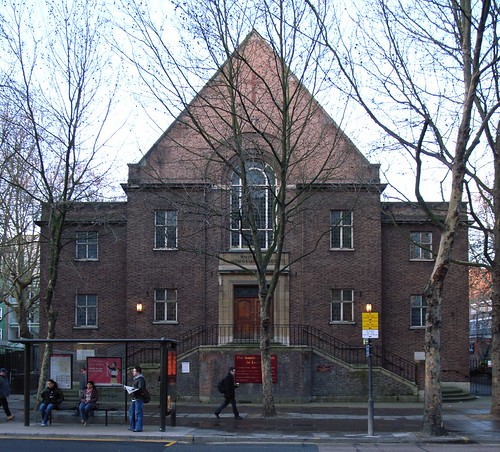
We kicked off with Westminster Seminary West President Robert Godfrey on tradition. Drawing on the work of Heiko Oberman (The Dawn of the Reformation) and one or two others he helpfully untangled the muddle of tradition using Oberman's three types and adding a fourth of his own. Oberman says
"Whereas in Tradition I truth is grasped and held through reflection on Holy Scripture and in Tradition II through reflection on Scripture and Tradition ... (in) Tradition III, truth is grasped and held by introspection and self-analysis on the part of the Church focused in the Teaching office".
So T1 is a school of interpretation such as the Reformed one; T2 involves an appeal to oral tradition as is common in Eastern Orthodoxy; T3 is tied up with J H Newman's idea of development of doctrine.
Godfrey's T4 includes ideas passed won that are a matter of prudence rather Scripture.
Having set this out at some length and illustrated it by reference to the controversy over images, Dr Godfrey went on to speak of the necessity of certain traditions and the usefulness of others. he closed by warning of the obvious dangers of traditions.
Of course, the difficulty is in disentangling what sort of traditions our traditions are.
In the second session Jonathan Watson tackled Thomas Brooks' excellent Precious remedies against Satan's devices. This sort of paper can be done badly but was done very well on this occasion. After a brief biography (there is not much to say as we have seen on this blog) we had a four point summary of how to deal with Satan's devices.
1. Know yourself
2. Know your enemy (his names, pervasiveness, hatred for us, great experience and his requiring a double leave to move - from God and then from you!)
3. Know your weapons
4. Helpful directions for Christian soldiers - there were 10 of these, to do with obeying the Word, not grieving the Spirit, seeking heavenly wisdom, resisting at the first moment, endeavouring to be Spirit filled, keeping humble, being on guard, keeping up communion with God, never relying on self and being much in prayer.
The book contains 38 devices and 189 remedies!
The final paper, given by Faith Cook, was on William Grimshaw. Much of this material was familiar to some of us but it was good to be reminded again of his example in this anniversary year.
On a personal note I have found the conference most heart warming. I especially appreciated the reminder of the Puritans commitment to godliness through disciplined highlighted in Brooks' gem of a work.

Westminster Conference 01


It was good to be one of around 200 today who gathered in the American Church in Tottenham Court Road for the first day of the annual Westminster Conference. We had three papers from three older men - Iain Murray, John J Murray and Paul Brown. Erroll Hulse, Robert Oliver and Phil Arthur chaired. J J Murray has recently produced a book on the rise of the Reformed movement and he sought to recap on some of that. Paul Brown looked helpfully at the life of the first principal of London Bible College, Ernest Kevan. Perhaps the best paper was Iain Murray's on what we can learn from the Puritans. He considered six areas -

1. The vital nature of conversion
2. The need for method and structure to live the Christian life
3. The sanctification of the Lord's Day
4. The importance of Christian unity - not developed but perhaps it will be in the printed paper
5. The danger of Roman Catholicism
6. The power of the preached Word

Sadly, discussion was as unproductive as ever. It is difficult to see how it can be improved unless we distribute papers before hand.

Kerst met Thijs & Co


One of the delights of the season is getting out my Christmas CDs especially these 4 Thijs Van Leer offerings from 1976, 1982, 1996 and 2000. Each of the albums is slightly different in its approach and they include a variety of musicians accompanying Thijs's flute. Some 54 tracks are presented altogether, mostly Christmas carols. Several tracks are repeated - Ave Maria, Away in a manger (on 3 of the 4), Gloria in excelsis Deo, Hark the herald, Joy to the world, Mary had a baby, O Jesulein Suss, Silent Night.
Also there are the Adeste Fideles, Coventry Carol, Ding Dong Merrily on High, Er is een Kindeke geboren op aard´, Es ist ein Ros´ entsprungen, For unto us a Child is born, God rest ye merry Gentlemen, Hoe leit dit Kindeke, Ich steh´ an deiner Krippen hier, In the bleak midwinter, Maria die zoude naar Bethlehem gaan, Mary's Boychild, Mary Sing Alleluia, Schlummert Ein, Süsser Trost Mein Jesus Kommt, The First Noel, The Royal Line, Tous Les Bourgeois de Chatre, Vom Himmel hoch and What child is this (Greensleeves).
There are more secular Christmas songs on the two later albums - Deck the halls, I'll be home for Christmas, When a child is born and White Christmas - and some tracks that have no obvious Christmas connection (Rondo 1, Fin de Siecle, House of the King, I have a dream, Tango, pieces by Corelli and Vinci).
Things can get a little muzacky at times but all in all these are great albums mainly highlighting the solo flute skills of a great musician.

Penblwydd hapus Rhods

Pains Hill Chapel


I set off around 9 am yesterday to travel the 33 miles through London to the little country chapel on Pains Hill near Oxted and Limpsfield in Surrey. Most of the journey is very familiar due to several recent trips to Gatwick. I've preached there more than once before anyway. The connection is an Aber University friend who is in the congregation. As it turned out he was unwell and so I didn't get to stay with the Averies but had a very nice afternoon with the Copemans who I did not know at all. Alan is heavily involved in Pilgrim Homes and it was interesting to find out more about them.
The chapel is very well looked after. The people are serious minded and appreciative of the Word too, though they all travel in to the chapel. (Someone told me that the illustrator Arthur Rackham [1867-1934] used to live next door, which I'd not realised before.) I preached on Mark 8:1-10 and Ephesians 2:1. I'd been at a GPT meeting last Friday and so I took some leaflets along and put up our new roll out display. I was encouraged when one woman said she'd gone to the Evangelical Library to try and read Luther, etc but found it hard going. They recommended to her GPT's Christian Classics (abridgements of the greats) and she found it really helpful. Being involved in both organisations I was glad to know they'd been such a help.

Christmas meal


We had a Christmas meal mainly for older folk at the chapel on Saturday. My wife and a deacon's wife ably assisted by others provided an excellent meal for a round a dozen. I spoke briefly on Bethlehem and we finished off with a quiz. It was alovely time. We tried it two years ago but weren't able to get it together last year. I'm glad we did this time round. it was really appreciated by those able to be there.

Rhodri's back (and front)


Rhodri got back from Vietnam last Wednesday. I collected him from Gatwick first thing. He was wearing this T shirt. On the front is his name (as Sibyl says it anyway). The Vietnamese just couldn't get it at all. On the back it says "You're worth a square world" (a genuine idiom he reckons). He's busy updating his blog but should be over today to celebrate his 19th birthday.

Dechrau canmol


The youngest boys were singing with their friends from the Welsh School on Welsh TV yesterday on the Welsh equivalent of Songs of praise Dechrau canu Dechrau canmol (start to sing, start to praise?) The programme was recorded last week in a Welsh Baptist chapel in central London (see here). One has mixed feelings about such things but such programmes do some good I'm sure. The producer has managed to get them sounding very good. For the next month or so the programme is available here. Huw Edwards introduces the short piece (Little drummer boy) around the 11:40 mark. Click the owl for subtitles.

Michael Praetorius


In the December Grace Magazine I notice that, among other good things, Mike Perrin has an article chiefly on the composer Michael Praetorius (1571-1621). Praetorius is well covered on the net. See here (wikipedia) and here (Cyberhymnal) and here and here, etc. I knew In dulci jubilo, of course and Ein Ros ist Entsprungen but not much more I confess. The above is just an audio track featuring two nice dances from his terpsichore.

Drive the Cold Winter Away

As a little Christmas treat I recently downloaded Horslips 1975/6 acoustic album Drive the cold winter away. It has lost some of its impact over the years (now everyone does the unplugged thing) but it is a lovely and quietly Christmassy album. It has 13 quite short tracks using mandolins, fiddles, tin whistles, banjos, harpsichords, etc. Brilliant!

1. We start with a medieval arrangement of Rug Muire Mac do Dhia (Mary Bore a Son to God) a traditional carol in Gaelic (probably Jim Lockhart's voice).
2. Next up is Sir Festus Burke a jolly Carolan tune. It's joined with the festive Planxty Tom Judge known as Carolan's Frolic.
3. The Snow that Melts the Soonest was picked up from a Newcastle street singer in 1821 and reminds us of fiddle player Charles O'Connor's North Eastern roots. it must be him singing.
4. The Piper in the Meadow Straying is a hornpipe suggested by guitarist Johnny Fean. It has a "Deck the Halls" feel.
5. Playford's "Dancing Master" 1651 is the official source for Drive the Cold Winter Away and was contributed by keyboard player and flautist Jim Lockhart. Some nice banjo work here. It was this tune's use in the recent BBC Tess that reminded me of the album. They resist singing until the very last line.
6. Thompson's and Cottage in the Grove are a pair of reels featuring O'Connor's concertina
7. Ny Kirree fa Naghtey (Lockhart sining again) is a Manx carol. The title translates as The Sheep 'neath the Snow. Manx is quite like Donegal Irish and Scots Gaelic (in Irish the title is Na Caoirigh faoi Shneachta)
8/9. Crabs in the Skillet is a jig played with Denis O'Connor, another Carolan tune first played on Christmas day 1723.
10. Lockhart again sings on the Gaelic carol Do'n oiche ud i mbeithil (that night in Bethlehem)
11. The Lullaby is done as an instrumental but can be sung with various words
12. The Snow And The Frost Are All Over/Paddy Fahey's instrumentals
13. When a Man's in Love is another O'Connor suggestion. Presumably he sings.