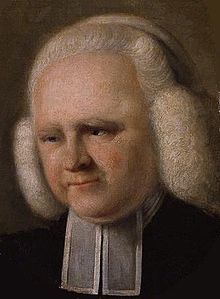
The similar phrase 'Worldly Christianity' is one used by Bonhoeffer. It's J Gresham Machen that I want to line up most closely with. See his Christianity and culture here. Having done commentaries on Proverbs (Heavenly Wisdom) and Song of Songs (Heavenly Love), a matching title for Ecclesiastes would be Heavenly Worldliness. For my stance on worldliness, see 3 posts here.
Showing posts with label George Whitefield. Show all posts

Pre-conference days in Aber


We are here in Aberystwyth for the EMW conference. We came up from Cardiff on Friday in order to be at the funeral of Arthur Murray, a godly man who lived most of his life in Aber and was for many years a member in Alfred Place, where the funeral was. My son Rhodri led the meeting and there were tributes from one of Arthur Murray's daughters and Stuart Bell.
On the Lord's Day Rhodri preached twice - from Matthew 5 and Romans 8. A great blessing to be there.
On Monday the church had organised an excellent lecture by Heather Nicholas on Whitefield and his books. (Heather is studying Whitefield at PhD level). This was marking the fiftieth anniversary of the church's bookshop, which began near the station and has been next to the church since 1994. Good sales followed I think. (I bought some volumes myself, including one on Whitefield by James Schwenk, which I'd not seen).

10 Popular Preachers listed by John Bacon in 1799


When the Eclectic Society met in January 1799 they discussed what made preachers popular or unpopular. At the beginning John Bacon listed a number of preachers of the day and what made them popular. Here are ten

1. [George] Whitfield was remarkable for feeling, susceptibility, force
2. [William] Romaine for realizing faith; he had one subject indeed but this was the panacea; there was some variety.
3. [John] Berridge gained in some degree from the place in which he preached; he was always in populous places; simplicity was his one object
4. Rowland Hill is irregular extravagant bawling &c yet something extraordinary; upright, devoted, comes out; fire, brilliance, genius; talks rather than preaches; strong comparisons but they interest; stories.
5. [William] Jay has great natural powers, memory
6. [Samuel] Medley had some party in his spirit; glib, jocular.
7. [William] Huntington had promptitude, was easy, pleasant, fanciful like a harlequin
8. [Henry] Venn of Huddersfield some tone but remarkably fiery; current; realizing; heavenly; rapturous, holy, quickening.
9. [John] Wesley good sense, promptitude, clear, treats all circumstances as belonging to a system not that in his ministry which would independently have been popular.
10. [Robert] Robinson of Cambridge had ease comprehension, no turns or twists but new views of things &c
(He also mentions forgotten preachers [Jehoiada] Brewer - possessed moderate talents but pathos was fervent affectionate savoury no peculiar tone to obstruct and rather aided his manner encouragement to diligence was one of his frequent topics perhaps compared with the drawling manner of some other dissenters he may be classed as above the average; [William Bromley] Cadogan - had no variety tone or dash but perception of subject determination sawing through energy reality he took by force the one object he kept in view; [William Alphonsus] Gunn - without extraordinary talents but gives direction and application to the truth no tone or twang addresses this and the other evidently a good man his preaching is not treating the subject so much as dealing in address deals in general truths; [James] Fordyce - an orator but it looked not like the real thing; gilded but it wore off. He also gives the names - [William] Dodd, Harrison and Hodgson)

Some interesting anniversaries coming up in 2020


1520 Birth of Sir Walter Mildmay

1570 Thomas Cartwright's lectures on the Acts of the Apostles

1620 The Mayflower sails for New England

1670 Death of Puritan Vavasor Powell and Educationist Jan Comenius

1770 Death of Whitefield and Welsh Methodist Howell Davies

1820 Birth of Florence Nightingale, Anna Sewell, Anne Bronte and Fanny Crosby (and Richard Redhead)

1970 Publication The Late Great Planet Earth by Hal Lindsey

I'm sure there are others. Do let me know. I did have Constantine in this list for some reason but have removed him.

Lunch Time Lecture at the Evangelical Library


It was most gratifying to see such a good turn out at the Evangelical Library recently for the first of this Autumn's lunch time lectures. A special thanks to Stan Evers who gave an excellent overview if the life of the 18th century preacher George Whitefield with a helpful PowerPoint presentation adding to the pleasure. Whitefield's life is one that ought to be kept in the public eye as it is easy to forget how powerfully God used him in time of revival. The talk was videoed as well as being recorded in audio and will soon be available. Do join us next time on October 14 at 1 pm when Rob Childs from Manchester will speak about John Wycliffe.

Whitefield's Tomb

I read here that

John Greenwood after Nathaniel Hone, CC0, via Wikimedia Commons


The family of an influential 18th century preacher, who was buried in an American church that he founded, are fighting to have his remains returned to England.
George Whitefield, one of the founders of Methodism and the evangelical movement, was laid to rest beneath the pulpit of The Old South Presbyterian Church, Massachusetts after he passed away in the parsonage - the church house provided for clergy members - in 1770.
The Gloucestershire born preacher started the Newburyport church in 1746 during the Great Awakening - a Christian revival that impacted British colonies in the 1730s and 40s.
His funeral was held in London, where another founder of the Methodist Church, John Wesley, delivered the sermon at Whitefield's personal request.
According to the Times, Whitefield's great-great-niece, Vicki Kenderdine, has accused the Old South Presbyterian Church of "claiming his body as their own property" and ignoring her grandfather's wishes to be buried alongside his wife in Britain.
She is hoping to raise £41,000 to fly his body back to Gloucester.
Rev Sara Singleton of the Old South Presbyterian Church said that funeral directors had attempted to exhume the remains last year, but the church refused to give them authorisation.
There have been a number of campaigns to send Whitefield's body back to his home country but the church has maintained that it was Whitefield's desire to be buried there in 1770.

A great blessing to me

This book by Canadian Grant Gordon explores the relationship between John Newton (1725-1807) and George Whitefield (1714-1770). I can't remember reading a book exactly like this but it certainly works well in that it sheds light both on Newton and Whitefield and is very stimulating to thought. I suppose when you read a single biography you identify or fail to identify and there can be no easy way to apply the lessons learned. This format means that you are forced to stand back and consider two pretty different men - not even exact contemporaries (they only knew each other the last 15 years of Whitefield's life) - and so the danger of over identifying is not really there in the same way,
The approach is to briefly give the two men's lives up to 1754 then in five chapters look t the life of Newton and his interactions with Whitefield. Closing chapters consider Whitefield's impact on the younger man and how they compare and contrast with a final page or two on Newton's final tribute to Whitefield. If you know the story of Newton and Whitefield you will enjoy the way they are delineated that much more sharply by this book.
Dr Grant intimated that he intends a similar book on Newton and Wesley which would be very welcome. This present volume is enhanced by several visual items, an index, etc. It is a pity it is not in hardback.

10 men who preached sermons marking Whitefield's death


This is a selection of the many preached when George Whitefield died on September 30, 1770. Luke Tyerman says there were 17 such sermons, seven of them being published.
1. Jonathan Parsons, Newbury Port, Phil 1:21, Sep 30
2. Ebenezer Pemberton, Boston, Heaven the residence of saints, Oct 11
3. James Sprout, Philadelphia, Oct 14
4. Edward Ellington, Savannah, Reproach of Christ the Christian's treasure
(and John Joachim Zubly, The wise shining as the brightness of the firmament, Nov 11)
5. David Edwards, London, Hebrews 11:4 (two sermons), Nov 11
6. John Wesley, London, No 23:10, Nov 11 and 23
7. John Newton, Olney, John 5:3, Nov 11
8. Henry Venn, Bath, Isa 8:18, Nov 18
9. William Romaine, London
10. John Berridge, Everton in Bedfordshire,

In Writing 124 Latest Edition

The latest issue of the Evangelical Library magazine In Writing is out. The main item in it is Andrew Atherstone's piece on George Whitefield and the elegies that followed his death in 1770. The substance of it was given as the Library's annual lecture in 2014. This year Digby James will address us on Richard Baxter (June 1). Next Monday (May 18 at 1 pm) Ian Densham will speak on “The Infinity and Eternity of God”. Do join us if you can.

Westminster Conference 2014 Day 1

It was a good day today in Oxford Street at the Westminster Conference. Today had a very Welsh flavour with three Welsh speakers (Stephen Clark, Adrian Brake and Andrew Davies) and three Welshish subjects. Welshmen seemed thicker on the ground than usual too.
The first paper was called holy worldliness (almost the same name as this blog). After a laudatory introduction concerning Whitefield we moved to the way he and Harris were less than perfect in their approach to marriage. Certainly the Harris, Whitefield, Elizabeth James affair is bizarre and Harris's obsession with Mrs Griffith wrong but I felt it was harsh to criticise Whitefield's unsuccessful letter of proposal to Elizabeth Delamotte. Failures by two men in one area does not justify the accusation of dualism. Anyway we had a half decent discussion following the paper.
We then had an excellent introduction to Thomas Charles who died in 1814. His Bible Dictionary had an incredible impact. It makes you wish you spoke Welsh. It begins
"The Holy Scriptures are a treasure house of all profitable and essential knowledge ….. Since they have all been given by the inspiration of God, they must partake of his perfection, and befit it. Because of the perfection of his knowledge, he cannot err; and because of the integrity of his nature, he will not deceive us in any matter; therefore, the knowledge given to us in the Scriptures is lofty, certain and complete. There is nothing which pertains to our condition and our blessedness in another world; nor anything which pertains to our circumstances and our duties in this world, that God, in his holy word, has not given us full instruction, how to behave in all things, in all situations, and towards everyone. The great plan of salvation, through a Mediator, shines clearly and fully in it, before a world of sinners."
You can get one in leather on ebay for around £60-70. There appear to some volumes available online.
The final paper was on Calvinistic Methodism and so the focus was on Wales again but it went well beyond that. The discussion after limped along a little.

Whitefield Elegies Footnotes 1 and 2

George Whitefield's grave in the crypt of Old South Presbyterian Church, Newburyport, Massachusetts between Jonathan Parsons and Joseph Prince
1. One of the things that came up the other night was the fact that Whitefield died at the age of 55 (which I had forgotten). I turned 55 the other week. There was a time when it was thought his problem was asthma but it is now agreed that it was probably angina pectoris, ie heart problems. I can confirm that such heart problems do present with breathlessness, which could be misconstrued to be asthma.
2. The other things follows Dr Atherstone saying that he had difficulty finding Baptists who had preached or written elegies in memory of Whitefield. At the back of my mind I recalled that Benjamin Francis of Shortwood, Horsley had written something and when I checked I found that to be the case, though I can't see anything online. John Fellows was quoted briefly and though some doubt it he was a Baptist. So no problem there then.
 

Elegies for Whitefield

We had a very good meeting at the Evangelical Library last night. Dr Andrew Atherstone took us through some of the many elegies composed and sermons preached at the time of George Whitefield's death in New England in 1770. These appeared first in New England and then in England when the news reached there. Sermons came first then poems, not all of the best quality.
This material has been rather neglected but is worth examining it was argued. Dr Atherstone highlighted the way they focus on five main things. They all lament the loss of such a great man. They note his powerful preaching and his ecumenical spirit. They also often give an evangelistic call and often contemplate life without Whitefield.
Dr Atherstone gave copious examples without being at all tedious and the printed paper will be worth seeing.
Here by way of example
1. Lament
"He died like a hero on the field of battle. Thousands in England, Scotland, and America have great reason to bless God for his ministrations." (Edward Ellington)
"Shall I a momentary loss deplore. Lamenting after him that weeps no more? What though, forbid by the Atlantic wave, 1 cannot share my old companion's grave, Yet, at the trumpet's call, my dust shall rise. With his fly up to Jesus in the skies. And live with him the life that never dies." (Charles Wesley)
2. Preaching
"What an honour it pleased God to put upon his faithful servant, by allowing him to declare his everlasting gospel in so many various countries, to such numbers of people, and with so great an effect on so many of their precious souls! Have we read or heard of any person since the apostles, who testified the gospel of the grace of God through so widely wended a space, through so large a part of the habitable world? Have we read or heard of any person, who called so many thousands, so many myriads of sinners to repentance!" (John Wesley)
"fired with a flaming zeal for his Lord and Master; filled with bowels of tender compassion to immortal souls; and favoured with more than Ciceronian eloquence - he soon became the wonder of
the world as a preacher." (James Sproat)
3. Ecumenism
Preachers of many different denominations praised him and many picked up on this.
"Though long by following multitudes admired
No party for himself he e'er desir'd.
His one desire to make the Saviour known,
To magnify the name of Christ alone" (Charles Wesley) 
This emphasis meant that Calvinism was downplayed. The one exception here was a sermon by Richard Elliott.
4. Evangelistic call
...
5. A future without Whitefield
"O had he dropped his mantle in his flight!
O might his spirit on all the Prophets light!" (Charles Wesley)


Annual Lecture Evangelical Library 2014

Do note that the Annual Lecture of The Evangelical Library for 2014 will be held at 6:30 pm at the Library when Andrew Atherstone (Wycliffe Hall, Oxford) will lecture on “George Whitefield: Eulogies and Elegies in England and New England” All are very welcome.

10 interesting facts about Charles Hodge

I have tried reading biographies of Charles Hodge the Princeton professor of systematics before but not finished. The bitesize one by S Donald Fortson III is a great overview.
 
1. His grandfather and great aunt would have heard and appreciated Whitefield
2. Benjamin Franklin was his wife's great grandfather
3. George Muller taught him German
4. He heard Charles Simeon preach in Cambridge
5. He heard Schleiermacher (who he disagreed with but thought was a Christian) preach
6. He became a lifelong friend off Tholuck in Germany
7. On his return from Europe he developed a leg problem that left him lame. When he could walk again he had to use a cane.
8. His study door was always open to his children (and grandchildren)
9. His sons A A Hodge and C W Hodge also taught at Princeton
10. His first book was on Romans and came out in 1835 (the same year as Albert Barnes' work)

10 Actors turned preachers

There is a reference in the Spurgeon biography to James Sheridan Knowles, an actor turned preacher. I also read of Thomas Barnardo's conversion recently where there was an actor turned evangelist involved at one point (John Hambleton I think). Here are ten names I have found who more or less meet the description. Perhaps the list can be improved.
1. Stephen Gosson English satirist and Anglican clergyman 1554-1624
2. George Whitefield Methodist Evangelist and amateur actor in his youth 1714-1770
3. James Sheridan Knowles Irish Dramatist, actor and latterly Baptist preacher 1784-1862
4. John Hambleton Evangelist and one time actor 1820-1889
5. Spencer Houghton Cone American Baptist Chaplain and some time actor 1785-1855
6. Charles B Parsons American Methodist preacher and former actor 1805-1871
7. Gu Ren'en or Ku Jen-en Flamboyant Chinese evangelist and one time movie actor 20th century
8. Peter Trumper former equity card holder and friend of Anthony Hopkins who became a Presbyterian minister in Wales lived 1934-2015. See here.
9. R Gary Heikkila Former Hollywood actor and ordained minister now retired 193*-*. See here.
10. Kirk Cameron American actor and street preacher 1970-. See here.

The well-known preacher Alistair Begg appeared in the 2004 film Bobby Jones: stroke of genius

Down with the kids

George Whitefield records a PS in one of his letters the persecution he received when he first preached in the fields:
I cannot help adding that several little boys and girls, who were fond of sitting around me on the pulpit while I preached and handed me people’s notes though they were ofte pelted with eggs and dirt, thrown at me – never once gave way; but on the contrary, every time I was struck, turned up their little weeping eyes, and seemed to wish they could receive the blows for me. God make them, in their growing years, great and living martyrs for him who, out of the mouths of babes and sucklings, perfects praise.

Whitefield on Justification


In his sermon What think ye of Christ? George Whitefield helpfully says


Every man that is saved is justified three ways: First, Meritoriously, by the death of Jesus Christ: "It is the blood of Jesus Christ alone that cleanses us from all siu." Secondly, Instrumentally, by faith: faith is the means or instrument whereby the merits of Jesus Christ are applied to the sinner's heart: "Ye are all the children of God by faith in Christ Jesus." Thirdly, We are justified Declaratively, namely, by good works: good works declare and prove to the world, that our faith is a true saving faith. "Was not Abraham justified by works?" And again, "Shew me thy faith by thy works."

Sarah on George

This letter was written by Sarah Edwards, wife Jonathan Edwards, to her brother, James Pierpoint of New Haven about the visit of the evangelist, George Whitefield, who came to Northampton in October, 1740.

October 24, 1740

Dear Brother James,

I want to prepare you for a visit from the Rev. Mr. Whitefield, the famous preacher of England. He has been sojourning with us, and after visiting a few of the neighbouring towns, is going to New Haven, and from thence to New York.

He is truly a remarkable man, and during his visit, has, I think, verified all we have heard of him. He makes less of the doctrines than our American preachers generally do and aims more at affecting the heart. He is a born orator. You have already heard of his deep-toned yet clear and melodious voice. O it is perfect music to listen to that alone!

And he speaks so easily, without any apparent effort. You remember that David Hume thought it was worth going twenty miles to hear him speak; and Garrick said, 'He could move men to tears or make them tremble by his simple intonations in pronouncing the word Mesopotamia.' Well, this last was a mere speech of the play actor; but it is truly wonderful to see what a spell this preacher often casts over an audience by proclaiming the simplest truths of the Bible. I have seen upwards of a thousand people hang on his words with breathless silence, broken only by an occasional half-suppressed sob.

He impresses the ignorant, and not less, the educated and refined. It is reported that while the miners of England listened to him, the tears made white furrows down their smutty cheeks. So here, our mechanics shut up their shops, and the day-labourers throw down their tools, to go and hear him preach, and few return unaffected. A prejudiced person, I know, might say that this is all theatrical artifice and display; but not so will anyone think who has seen and known him.

He is a very devout and godly man, and his only aim seems to be to reach and influence men the best way. He speaks from a heart aglow with love, and pours out a torrent of eloquence which is almost irresistible. Many, very many persons in Northampton date the beginning of new thoughts, new desires, new purposes, and a new life, from the day on which they heard him preach of Christ and this salvation. I wish him success in his apostolic career; and when he reaches New Haven, you will, I know, show him warm hospitality.

Yours in faithful affection,
Sarah

Whitefield in Hampstead


I was looking at a map on* Hampstead Heath the other day and noticed Preachers hill marked on it. Apparently a grove stood near Hampstead with a large green and an old village tree. In 1739 (Thursday May 17) George Whitfield preached there. Hence Preacher's Hill. Preachers Hill is situated off East Heath Road, opposite the top of Pryors Field.
 'Preached, after several invitations thither, at Hampstead Heath, about five miles from London. The audience was of the politer sort, and I preached very near the horse course, which gave me occasion to speak home to the souls concerning our spiritual race. Most were attentive, but some mocked. Thus the Word of God is either a savour of life unto life, or of death unto death. God's Spirit bloweth when, and where it listeth.'
His visit is said to have led to the founding of a Congregationalist church.
* sic

Wesley Film


"Whitefiled and Wesley in Bristol"
If I have this right the John Welsey film mentioned in my 1974 diary was produced by the Radio and Film Commission of the Methodist Church in cooperation with J Arthur Rank in 1954. It was re-released in 2004 and is available on DVD still. ImDB says
"When young John Wesley is saved from the flames burning his family's home, he believes God has chosen him for a higher mission. He grows up to become a minister in the Church of England but disapproves of concern within the church over the social position of the clergy. He concerns himself more with the common people and with individual religious experiences. He tries to accomplish his purposes by remaining within the church but the methodical way in which he and his followers go about their duties soon sets them apart as a special group jeeringly called Methodists."