1. Revolution Beatles (also Revolution 1 and 9)
2. Revolution Bob Marley
3. Revolution Nina Simone
4. Revolution, Revolutions Jean Michel Jarre
5. Talkin' 'bout a Revolution Tracy Chapman
6. Children of the Revolution T Rex
7. Revolutionary Etude Chopin
8. The Rebel Jesus Jackson Browne
9. Changes David Bowie
10. Change Tracy Chapman

A blog featuring whatever I fancy, often on the Christian faith but not exclusively


September Revolution


It was a busy weekend. I was speaking to the children and then the young people on Friday night on Lot and his bad choice. A bit low on numbers with the younger ones but a decent number of older ones. We played the yes, no game and just a minute after. Good fun.
On Saturday morning we gave out tracts in Golders Green. Little response there but naive to meet Elias, an Angolan pastor based at a Pentecostal church in Hammersmith.
In the evening we had a 15+ meeting for the older ones at our house. About 12 came. I chose September Revolution as the theme. I found some revolution music and did a revolution quiz. Why September Revolution? September obviously because it's still September. As for revolution -
The word is from Latin and means to turn around. A revolution can refer to the act of revolving, rotating, turning round on an axis or a centre as with a wheel or top or earth on its axis. When a car engine turns over that is called a revolution, a rev for short. When I was a boy vinyl records were more popular than today. The big ones (LPs) were 33 1/3 rpm and the small ones (singles) 45 rpm. Rpm = “revolutions per minute”. Today's CDs have a variable rpm (200-500 rpm).
We're much more familiar with the word in reference to a fundamental change in power or organisational structures that takes place in a relatively short period of time. Revolutions of various sorts have occurred throughout human history. Scholars debate what is and isn't a revolution but among the most famous are the various French, American and Russian (leading to communism). Less obvious - Glorious Revolution, 1688 when one king (James II) was deposed and a new king and queen brought in from overseas (William and Mary of Orange). The word is also used for social or intellectual movements such as the Copernican, agricultural, industrial or scientific revolutions.
One dictionary defines it “a drastic and far-reaching change in ways of thinking and behaving” and as you may have guessed that is the meaning that I focused on. I myself knew “a drastic and far-reaching change” in my ways of thinking and behaving when I was about 12. I was born again. It was like a revolution. Everything turned round. I experienced what the Bible talks about when it talks about being born again, when it says If anyone is in Christ he is a new creation. The old has gone the new has come. (2 Cor 5:17).
In other words, if you turn from your sin and put your trust in Christ then you'll be made into a new person. Everything will change. Not that you'll become a different person in the sense of your personality changing but all the old ways will go and in will come all sorts of new ways. There will be a revolution of enormous proportions. I'm sure it is more noticeable if like me you don't come from a Christian home. I was brought up to believe in God and believe the Bible was his Word but my parents didn't know God and didn't know much about what was in the Bible. When the revolution came to me then it was quite obvious there had been a big change. If you grow up in a Christian home the change may be less obvious to outsiders. Nevertheless becoming a Christian is a big change – as big a change as any earthly revolution. For me
1. It was like a Copernican Revolution. The Copernican Revolution is the term used to describe the change that took place when Nicholas Copernicus discovered that it is not that the sun goes round the earth but that the earth and the other planets go round the sun. I had thought that everything revolved around me but I discovered that in fact it all centres on God. Have you had a Copernican Revolution? Is God now at the centre of your life?
2. It was a little like the American Revolution and other revolutions of that sort it was all about who was going to rule over my life. There was a time when that old tyrant was ruling but he was overthrown by that powerful revolutionary Jesus Christ. He now rules in my life.
3. It was also cultural revolution, a big change like the agricultural or industrial revolutions. All sorts of changes have come from that one great change in my life.
4. Finally, it was like the Peaceful Revolution of 1989 in Germany or the Glorious Revolution of 1688 here, sometimes called the bloodless revolution. I say that because there was no actual blood shed in my conversion although just as there was some fighting and some bloodshed in the Glorious Revolution and the overthrow of communism came at a price too so in fact blood was shed in order for me to become a Christian too - the blood of Jesus Christ on the cross. If he'd not died in my place then I could never have found forgiveness and I could never have been born again.
So I am saying that a radical revolution has come in my life. There has been a very great change. Now you may say that is very nice for you but what has it got to do with me? It is not just me who has known this revolution but countless thousands of others around the world have had their lives turned around too. They too have been converted. They have been born again. They have come to trust in Christ and so they are a new creation. The old has gone the new has come.
In Bob Marley's song Revolution he starts by singing the slightly different word Revelation. He says “Revelation reveals the truth – revelation” before saying “It takes a revolution to make a solution”. I'm not sure why he does that but God's Revelation, the Bible, makes clear that this revolution that I'm talking about is something that needs to happen to us all. Without this you can't hope to go to heaven. Jesus himself says (Matthew 18:3) I tell you the truth, unless you change and become like little children, you will never enter the kingdom of heaven. To be a Christian you need to change. There needs to be a revolution, a turn around. There are many calls to repent – to change your mind, to undergo a revolution in your head. So Peter says in Acts 3:19 Repent, then, and turn to God, so that your sins may be wiped out, that times of refreshing may come from the Lord.
So when I speak about a September Revolution I'm saying to you "Now is the time for change. Now is the time for revolution. Now is the time for repenting."
1. Stop thinking everything revolves around you and start seeing that God needs to be at the centre of what you do.
2. You've spent enough time following the ways of this world and of the ruler of the kingdom of the air, the spirit who is now at work in you, Satan. Don't you see that tyrant is doomed. The ruler of this world has been thrown down by Christ and he has as much of a future as poor old Louis XVI who they sent to the guillotine in the French Revolution or poor old Tsar Nicholas II whose body they soaked in acid and burned in the Russian Revolution.
3. Big changes are needed in your life – in the way you think, the way you speak, the way you live. The Bible says that by nature you have a heart of stone. You need to have that stony heart torn out and a new fleshy heart put in its place. You need a new heart and a new spirit. The axe needs to be put to the root of the old true and a new tree put in its place.
4. It's not a matter of starting some sort of war or shedding your blood. All the fighting and bloodshed needed has already been done by Christ on the cross. On the cross he fought against sin, death and Satan and was victorious. He paid the price – his own life blood – to set people like us free. All you have to do is look to him and you'll be free. All your sins will be taken away and you'll have the power to begin again, to turn round and start all over again. You will be a new creation in Christ.
Very practically, how does the revolution begin? Recognise how very sinful you are, how you've broken God's law. Confess your sins to him, ask for forgiveness in Christ. Trust only in him. Do this and you'll be saved. But be warned, it will change everything. It's like a revolution – a September Revolution!
Shakespearean Pub Landlord
Happened to see this Friday. Al Murray is a genius and streets ahead of BBC's alternative Jonathan Ross (although neither programme can be recommended because of the content). To see the genius with this clip you really have to wait until 2:11 where out of nowhere Murray launches into the seven ages of man speech from Shakespeare's As You Like It. It's another example of the low and high brow that I find so amusing.
Down Town
I wanted to put this clip up as soon as I saw it on TV but it wasn't on youtube at first. Good fun if, like me, you find the mixture of high brow and low brow irresistibly amusing (BTW it's the key to Monty Python).
This day in history too
On September 25, 1929, Westminster Theological Seminary opened in the Witherspoon building in Philadelphia, with an enrollment of fifty students.
In his opening address, "Westminster Theological Seminary: Its Purpose and Plan," J. Gresham Machen set forth the school as the successor to Princeton Seminary, which had been recently reorganized to include modernists on its Board:
[T]hough Princeton is dead, the noble tradition of Princeton is alive. Westminster Seminary will endeavor by God's grace to continue that tradition unimpaired; it will endeavor, not on a foundation of equivocation and compromise, but on an honest foundation of devotion to God's Word, to maintain the same principles that the old Princeton maintained. We believe, first, that the Christian religion, as set forth in the Confession of Faith of the Presbyterian Church, is true; we believe, second, that the Christian religion welcomes and is capable of scholarly defense; and we believe, third, that the Christian religion should be proclaimed without fear or favor, and in clear opposition to whatever opposes it, whether from within or without the church, as the only way of salvation for lost mankind. On that platform, brethren, we stand. Pray that we may be enabled by God's grace to stand firm. Pray that the students who go forth from Westminster Seminary may know Christ as their own Savior and may proclaim to others the gospel of his love.
Though an independent school, Westminster Seminary proved crucial to the founding and development of the Orthodox Presbyterian Church. Most of the church's ministers have graduated from Westminster, and its founding faculty, all of whom were ministerial members in the OPC, were active and prominent churchmen. In the words of Charles Dennison, the two institutions developed "one of the most amazing relationships in Presbyterian history.”
In his opening address, "Westminster Theological Seminary: Its Purpose and Plan," J. Gresham Machen set forth the school as the successor to Princeton Seminary, which had been recently reorganized to include modernists on its Board:
[T]hough Princeton is dead, the noble tradition of Princeton is alive. Westminster Seminary will endeavor by God's grace to continue that tradition unimpaired; it will endeavor, not on a foundation of equivocation and compromise, but on an honest foundation of devotion to God's Word, to maintain the same principles that the old Princeton maintained. We believe, first, that the Christian religion, as set forth in the Confession of Faith of the Presbyterian Church, is true; we believe, second, that the Christian religion welcomes and is capable of scholarly defense; and we believe, third, that the Christian religion should be proclaimed without fear or favor, and in clear opposition to whatever opposes it, whether from within or without the church, as the only way of salvation for lost mankind. On that platform, brethren, we stand. Pray that we may be enabled by God's grace to stand firm. Pray that the students who go forth from Westminster Seminary may know Christ as their own Savior and may proclaim to others the gospel of his love.
Though an independent school, Westminster Seminary proved crucial to the founding and development of the Orthodox Presbyterian Church. Most of the church's ministers have graduated from Westminster, and its founding faculty, all of whom were ministerial members in the OPC, were active and prominent churchmen. In the words of Charles Dennison, the two institutions developed "one of the most amazing relationships in Presbyterian history.”
10 Hair References in Pop Songs
1. T Rex Telegram Sam
"Me I funk but I don't care/I ain't no square with my corkscrew hair"
2. Larry Norman Why should the Devil have all the good music
"They Say to Cut my Hair / They're Driving Me Insane / I Grew it out Long to make Room for my Brain"
3. Sonny and Cher I got you babe
"So let them say your hair's too long /'Cause I don't care, with you I can't go wrong"
4. Musical Hair Frank Mills
"But he wears his hair/ Tied in a small bow at the back"
5. Beach Boys Surfin' USA
"Huarachi sandals too/A bushy bushy blonde hairdo/Surfin' U.S.A."
6. Scott McKenzie If you're going to San Francisco
"If you're going to San Francisco
Be sure to wear some flowers in your hair"
7. The Who Cut my hair
"Why should I care
If I have to cut my hair?
I've got to move with the fashion
Or be outcast"
8. Led Zeppelin The Girl I Love She Got Long Black Wavy Hair
9. Aretha Franklin I say a little prayer
"While combing my hair now
And wondering what dress to wear now
I say a little prayer for you"
10.
Almost cut my hair CSNY
"Almost cut my hair Happened just the other day
It's gettin' kind of long
I could've said it was in my way"
Unfair slur 02
In the opening sentences of his essay on Machen in the new Themelios Carl Trueman writes
"In the lounge next to my office hang the portraits of a number of the founding faculty of my institution, Westminster Theological Seminary in Pennsylvania. There is one of John Murray, the dour-looking Scotsman with the glass eye. Legend has it that you could tell which eye was the real one because that was the one which did not smile."
I know he is writing for students but it is a shame that he is perpetrating a myth. My father-in-law, Geoff Thomas, knew Murray personally and gives quite a different impression (the man I have described as more full of God than anyone else I have known). The impression I am left with is of an Aslan type figure and if you know anything abut Aslan he was no cold fish.
In 1966, The 33rd OPC General Assembly recognized Murray's labors with a testimonial scroll which read (with my italics):
"You have been a warm friend and counselor to us, one and all, giving individual counsel whenever we sought always out of a rich wealth of knowledge and inspiring reverence for the written Word.
You have been a faithful presbyter, spending untold days in the service of our beloved church, both in its assembly services and as a member of many of its committees.
You have been a gracious reprover, a hearty encourager, and an un-bitter dissenter in our deliberations.
To many of us you have been a patient teacher and more, for you have taught us exactness in the study of Holy Scripture, and a deep reverence for its high doctrine.
We honor you in our hearts. We respect you for your scholarship and wisdom. We are grateful to our God for you, Professor Murray. But we are compelled to say more: we love you dearly, and it is with deep sorrow that it appears that we may not see your face or hear your voice in future assemblies. We pray God that He may lay His hand on you for a most useful and happy ministry during your retirement years in your native land. We "thank God on every remembrance of you.""
Unfair slur 01
I am currently reading a book by Tim Keller. In a remark that has nothing to do with his main thesis Keller says he has often preached on Joseph. He calls him "an arrogant young man who was hated by his brothers". I know this is a common view (the majority view?) but I have also preached on Joseph and I beg to differ. Naive, yes; arrogant, no. Certainly Moses never says that Joseph was arrogant and we should be slow to assume he was.
A quick look reveals that certainly R T Kendall and Achille Blaize don't take this view. Blaize says "We have no evidence to show that Joseph was either cocky, proud or too sure of himself". Kendall: "It was not that he was arrogant or cocky; it was simply that he knew something of the ways of God and had no fear whatsoever of being contradicted". Also see on my side J G Vos, the NET Bible (in a footnote on page 86) and A W Pink.
Paned Power etc
 "With a cup of tea in your hand, anything is possible". Leading the sheltered life I do I'd never seen a Welsh joke card before. Someone sent this card to Eleri the other week. (September is full of birthdays in our family - Dewi, Eleri, gwion, my sister, etc). They have them here.
There was bound to be a problem somewhere. I notice that one (Pillars of the community and Archers fans) had to say "and never miss Cefn Gwlad" (a Welsh programme for farmers I think). See here.
London Inreach


It was good to be at the London Inreach Project meetings last Saturday. The initial meeting was held at the LCM's Cafe Eterno where the church regularly meets. I was not able to be at that as I was obliged to attend the meeting of the trustees of the Project who gather annually. I am not a trustee but attend with our treasurer Peter Jermyn as chairman of the management committee. I managed to get a cuppa at Cafe Eterno before heading then for the Chinese Church in Shaftesbury Avenue where I chaired our preaching meeting.
It was good to see about fifty or so present. Derek Sewell gave a balanced report on the work, which is still hard going but not without its challenges and encouragements. Andrew Murray then spoke for a while and introduced our new worker Roger Carter to us, the successor to Ben Thomas. Peter Jermyn had a word finally and then our preacher, Ray Evans of Bedford (fresh from a paintball fight that morning - don't ask) turned our attention very helpfully to Dr Luke's case notes on Simon the Pharisee and the woman who kissed Jesus's feet.
Most people then drifted off but some took opportunity to head across Shaftesbury Avenue once again to the Fair Trade shop that the church continue to run (at the local council's behest) in Berwick Street, Soho. (This is where I had started my afternoon with the committee in the basement).
This is wonderful work. Not easy at all but vital. Do find out more. Start here.
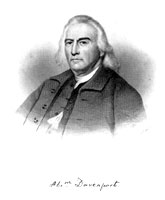
Davenport's Dark Day
.jpeg) |
| Ralph Earle Public Domain via Wikipedia Commons |
I was trying to recall an anecdote the other day and spoke to others about it. One of them, my good friend Luke Jenner, said he had just read it in (of all places) Christopher Hitchens' God is not great and very kindly sent me a photocopy of the relevant page (page 61). Hitchens likes Davenport's attitude. You can check it out here. I also found this fuller version with another story about Abraham Davenport the man in question here. The incident was popularised in an 1868 poem by John Greenleaf Whittier. See here.
ABRAHAM DAVENPORT, A long-time Councillor of the colony and later of the State of Connecticut, was a man distinguished by his vigorous understanding, uncommon firmness of mind and Christian integrity of character. A resident of Stamford, he was the grandson of the Rev. John Davenport, one of the founding fathers of the New Haven colony and a man who had played an important role in the "Great Shippe" disaster. Abraham Davenport was the central figure in two stories celebrated in literature and legend and traditionally cited to illustrate the constancy of Connecticut character.
As a matter of fact, one of the Davenport tales, the story of Connecticut's "Dark Day," has become so much a part of the state's lore that the event's bicentennial was remembered by special ceremonies in the House of Representatives of the Connecticut General Assembly on February 27, 1980. Although the memorial occurred somewhat prematurely because the legislature would not have been in session on the actual anniversary date, legislators were reported to have listened in hushed fascination as House Speaker Ernest Abate of Stamford recounted the legend of his illustrious fellow-townsman from an earlier time.
They say that during the first two weeks of May in 1780 the skies over much of New England had been so dark that people had difficulty conducting their daily affairs because of reduced visibility, even during the sunniest days. Many of the good Puritan folk saw in the lowering heavens a sign of God's displeasure. While the actual cause of the unnatural lack of light has been lost to history, both widespread and unchecked forest fires spreading their leaden smoke over the land and a complete eclipse of the sun, especially on the ultimate "Dark Day," have been cited by chroniclers as possible sources of the phenomenon.
Be that as it may, as the Connecticut General Assembly began their deliberations on May 19, 1780, the chambers of the State House in Hartford grew so dark that it seemed as if the sun had been turned off. Reports came from those who had been outside that the streets of Hartford, too, had been reduced to inky blackness. In many homes candles flickered in windows, birds were silent and disappeared, and fowl retired to their roosts. To many members of the legislature, devout Puritans as they were, it appeared that the promised Day of Judgment was at hand.
Probably as much out of general consternation as out of inability to conduct business in the dark, the House of Representatives adjourned. In the Council, however, it was a different story. There, advice on how to proceed under such trying circumstances was sought by the members from their most respected colleague, Abraham Davenport. With scarcely any hesitation, the worthy Stamford lawmaker answered: "I am against adjournment. The day of judgment is either approaching, or it is not. If it is not, there is no cause for an adjournment; if it is, I choose to be found doing my duty. I wish therefore that candles may be brought." That settled it. The candles soon dispelled the dismal gloom, deliberations continued, and a bill amending an act regulating the shad and alewife fisheries passed the Council that very day.
Needless to say, news of Colonel Davenport's decisive words received wide circulation. Not only did their repetition become a source of pride for his fellow citizens in Connecticut, but they also inspired John Greenleaf Whittier, one of New England's best-loved poets, to celebrate them in verse many years later, thus perpetuating the legend well beyond its time of origin. The final lines of Whittier's "Abraham Davenport" (1866) summed up the sentiment attached by the folk to Davenport's speech that black day: And there he stands in memory to this day, Erect, self-poised, a rugged face, half seen Against the background of unnatural dark, A witness to the ages as they pass, That simple duty hath no place for fear.
Revered throughout Connecticut for his courage and foresight during the famous "Dark Day" episode, Abraham Davenport spent his final years as Chief Justice of the Court of Common Pleas. In this capacity Davenport once again affirmed the value of devotion to duty, even under dire circumstances.
As the story goes, the venerable Chief Justice was "struck with death" (i.e. suffered a serious heart attack) while hearing a case in Danbury. Since the trial was only well-started at the time of his illness, the judge refused to be relieved from the bench until the case went to the jury. While in obvious and severe pain, he heard a considerable portion of the trial, gave the charge to the jury and even called the jury's attention to an article in the testimony which had escaped the notice of lawyers on both sides of the case. Once he had discharged his judicial obligations, however, Justice Davenport immediately retired to his chambers, lay down on a couch and died. The people of Connecticut would not soon forget the example of Abraham Davenport.
Heavenly Worldliness
Found this great Machen quote here
In reading through J. Gresham Machen’s Notes on Galatians (p 33), I found this interesting quote. It first appeared in Christianity Today in January 1931. Machen died in 1937. I assume this comment is a product of Machen’s more mature thought:
“In the second place, Christians should by no means adopt a negative attitude toward art, government, science, literature and other achievements of mankind, but should consecrate these things to the service of God. The separateness of the Christian man from the world is not to be manifested, as so many seem to think that it should be manifested, by the presentation to God of only an impoverished man; but it is to be manifested by the presentation to God of all man’s God-given powers developed to the full. That is the higher Christian humanism, a humanism based not upon human pride but upon the solid foundation of the grace of God.”

Best ofs 06
 Next up is an album of 25 hits by the US answer to the Beatles - The Byrds. The key to the Byrds sound, I guess, is the Rickenbacker or what I call the jangly guitar. A large part of the genius is taking Bob Dylan and making him palatable to non-purists like me. This Definitive Collection probably has too many tracks on it and would have been improved by being pruned. Less is more. But then we may have missed the two Arthur Reid Reynolds tracks (Jesus is just alright and Glory, glory). Who was that guy? Also glad to see Turn Turn Turn (from Ecclesiastes) here Bells of Rhymney - words by Monmouthshire born Idris Davies. My favourite seven:
1. Chestnut Mare
2. Turn Turn Turn
3. My back pages
4. The bells of Rhymney
5. Mr Tambourine Man
6. I'll feel a whole lot better
7. All I really want to do
Subscribe to:
Posts (Atom)