The similar phrase 'Worldly Christianity' is one used by Bonhoeffer. It's J Gresham Machen that I want to line up most closely with. See his Christianity and culture here. Having done commentaries on Proverbs (Heavenly Wisdom) and Song of Songs (Heavenly Love), a matching title for Ecclesiastes would be Heavenly Worldliness. For my stance on worldliness, see 3 posts here.
Showing posts with label Marx Brothers. Show all posts

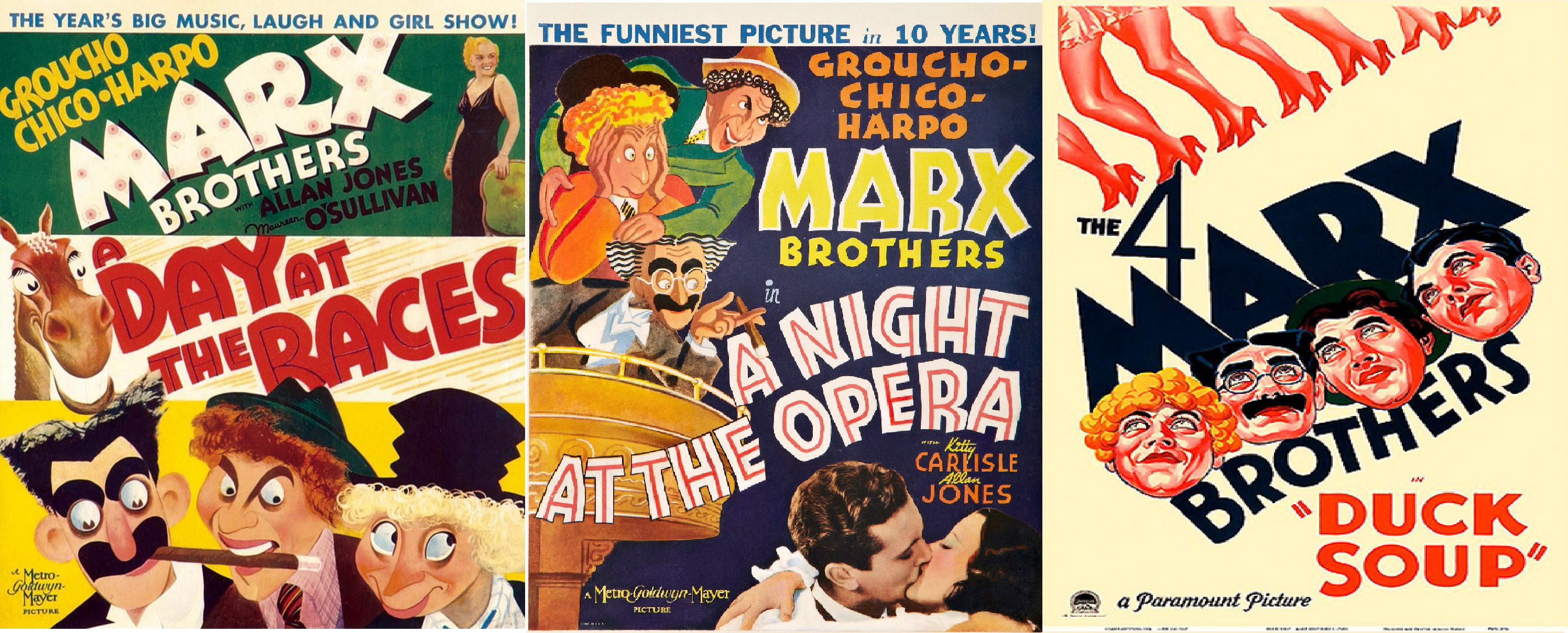
10 Marx Brothers Films


  1. The Cocoanuts (1929)
  2. Animal Crackers (1930)
  3. The House That Shadows Built (1931)
  4. Monkey Business (1931)
  5. Horse Feathers (1932)
  6. Duck Soup (1933)
  7. A Night at the Opera (1935)
  8. A Day at the Races (1937)
  9. Room Service (1938)
  10. At the Circus (1939)
(The others are Humor Risk (1921) Go West (1940) The Big Store (1941) A Night in Casablanca (1946)
Love Happy (1949) The Story of Mankind (1957))
This arises out of a love of lists rather than any particular affection for Marx Brothers movies.

10 lots of siblings in history


1. Henry and William James
2. Charlotte, Emily and Anne Brontë
3. Orville and Wilbur Wright
4. Wilhelm and Jacob Grimm
5. George and Ira Gershwin
6. Groucho, Chico, Zeppo and Gummo Marx
7. John, Robert and Edward Kennedy
8. Frank and Jessie James
9. Fernand, Louis and Marcel Renault
10. Wilhelm Friedemann, Carl Philipp Emanuel, Johann Christoph Friedrich and Johann Christian Bach

Was Marconi mad?

Published on LIFE, Public domain, via Wikimedia Commons
I was quoting my late mother just now, as I do from time to time. She used sometimes to say
"They said Marconi was mad".
Guglielmo Marconi is often thought of as the inventor of radio and shared the 1903 Nobel prize for physics due to his work in this area. The point of the saying is that general opinion is not always right.
I'm not sure how common a saying it was or is but the phrase did feature in a Marx brothers skit.
 
Groucho: "They said Edison was mad! They said Einstein was mad! They said Marconi was mad! They said my uncle Herbert was mad!-"
Chico: "Your uncle Herbert? Nobody ever hoid of your Uncle Herbert!"
Groucho: "That's because he was mad!"

The term applies especially to Marconi as after inventing his wireless telegraph he wrote to the ministry of Post and Telegraphs, which at the time was under the direction of the honorable Pietro Lacava, explaining how the machine worked and asking for funding. He never received a response to his letter which was eventually dismissed by the minister who wrote "to the Longara" on the document, referring to the insane asylum on via della Lungara in Rome.