The similar phrase 'Worldly Christianity' is one used by Bonhoeffer. It's J Gresham Machen that I want to line up most closely with. See his Christianity and culture here. Having done commentaries on Proverbs (Heavenly Wisdom) and Song of Songs (Heavenly Love), a matching title for Ecclesiastes would be Heavenly Worldliness. For my stance on worldliness, see 3 posts here.
Showing posts with label Tchaikovsky. Show all posts

10 Insults aimed at other composers by Tchaikovsky

Public Domain, via Wikimedia commons

Tchaikovsky could apparently be quite acerbic aboout other composers. Here are a set of 10 from him.

  1. “I like playing Bach because it is entertaining to play a good fugue, but I do not acknowledge in him (as others do) a great genius.”  – Tchaikovsky about Bach
  2. “Handel is only fourth rate. He is not even interesting.” – Tchaikovsky about Handel
  3. “And so what is Beethoven to me? I bow before the greatness of some of his works - but I do not love Beethoven.”  – Tchaikovsky about Beethoven.
  4. “He can’t compose a single note without someone’s help.” – Tchaikovsky about Borodin
  5. “Mussorgsky’s idiom is narrow, his artistic instinct is entirely absent ... He likes what is coarse, unpolished, and ugly.” – Tchaikovsky about Mussorgsky
  6. “Rimsky-Korsakov is a very great talent ... [But] he was a member of that circle which believed itself to be destined to create a new Russian music ... They all fell into despair and took up a different path. Rimsky-Korsakov is the only one among them who realised that their path was a dead end ... He suddenly threw himself into the study of classical counterpoint and strict fugue. ... He has written dozens of fugues and counterpoints, and now his music is completely weighed down by this academic baggage. ....”
  7. “I have played over the music of that scoundrel Brahms. What a giftless bastard! ... What would I say to [Brahms]? … I would have to tell him this: ‘Herr Brahms! I consider you to be a very untalented person, full of pretensions but utterly devoid of creative inspiration. I rate you very poorly and indeed I simply look down upon you.’” – Tchaikovsky about Brahms
  8. “The Fourth Symphony is the last of the series, and at the same time the least in value. It has not that overwhelming power, that searching pathos, which strikes us in the first two symphonies. The sum-total of its beauties cannot unfortunately redeem that great fault which prevails in all works of Schumann, considered especially as a symphonic writer. This fault would be called by painters a lack of colour; it is a pallor, a dryness — I may almost say harshness — of orchestration. Without entering into technical details, I may explain to my readers that the art of instrumentation (i.e. the distribution of a work among the various instruments) consists in understanding how to employ alternately the individual groups of instruments; how to blend them appropriately; how to economise strong effects, and also in the intelligent use of colouring - that is to say, the application of timbre to musical ideas. This knowledge Schumann has not acquired. His orchestra works continuously; all the instruments take part in the exposition and development of his ideas. They are not used in detachments; there is no contrast between them (and contrasting effects are inexhaustible in orchestration); most of the time they mingle in a continuous roar, often spoiling the best parts of the work. As regards instrumentation, Schumann not only stands on a lower level than such masters as Berlioz, Mendelssohn, Meyerbeer, and Wagner, but he cannot even be compared with many second-rate composers who have borrowed his best inspirations.” – Tchaikovsky about Schumann
  9. “Such an astounding lack of talent has never before been united to such pretentiousness.” – Tchaikovsky about Richard Strauss
  10. “I’ve been to the theatre a few times and heard Wagner’s Walküre, from which I carried away memories of two or three glorious minutes and a whole ocean of boredom and utter emptiness. ... After the last notes of Götterdämmerung, I felt as though I had been let out of prison.” – Tchaikovsky about Wagner
(Also "As for Liszt, he is an old hypocrite who lavishes the most exaggerated praises on any piece of music submitted to his august judgment. He is naturally kind. He is one of the rare famous artists who has never been envious or tempted to hinder [others]...")

10 Romantic Composers

1. BRAHMS, Johannes 1833 - 1897 German composer and pianist considered a leading composer in the romantic period.
2. WAGNER, Richard 1813 – 1883) German composer, theatre director, polemicist and conductor. primarily known for his operas.
3. TCHAIKOVSKY, Pyotr Ilyich 1840 – 1893 Russian composer of the late-Romantic period, some of whose works are among the most popular music in the classical repertoire.
4. PAGANINI, Niccolo 1782 – 1840 Italian violinist, violist, guitarist and composer. The most celebrated violin virtuoso of his time, he left his mark as one of the pillars of modern violin technique.
5. LISZT Franz 1811 – 1886 Prolific Hungarian composer, virtuoso pianist, conductor, music teacher, arranger, organist, philanthropist, author, nationalist and Franciscan tertiary.
6. CHOPIN, Frederic 1810 – 1849 Polish composer and virtuoso pianist who wrote primarily for the solo piano. Gained and maintained renown worldwide as a leading musician of his era. His "poetic genius was based on a professional technique that was without equal in his generation."
7. MUSSORGSKY, Modest Petrovich 1839 – 1881 Russian composer, one of the group known as "The Five". An innovator of Russian music, he strove to achieve a uniquely Russian musical identity, often in deliberate defiance of the established conventions of Western music.
8. MENDELSSOHN, Felix 1809 – 1847 Short lived German composer, pianist, organist and conductor formerly known as Jakob Ludwig Felix Mendelssohn Bartholdy.
9. BERLIOZ, Hector 1803 – 1869 French Romantic composer, best known for his compositions Symphonie fantastique and Grande messe des morts (Requiem). He made significant contributions to the modern orchestra with his Treatise on Instrumentation.
10. DVORAK, Antonin 1841 – 1904 Czech composer. After Smetana, he was the second Czech composer to achieve worldwide recognition. Following Smetana's nationalist example, he frequently employed aspects, specifically rhythms, of the folk music of Moravia and his native Bohemia.

10 People who died at age 53

I discovered this (to me) interesting info here
19,366 days old - Jerry Garcia
19,378 days old - Maurice Gibb
19,459 days old - Babe Ruth
19,497 days old - Spike Jones
19,511 days old - Jack Wild
19,541 days old - Peter Tchaikovsky
19,592 days old - Jim Henson
19,644 days old - John Denver
19,647 days old - Maria Callas
19,675 days old - René Descartes

TTRMOMG 08 Swan Lake

I've never seen the ballet Swan Lake performed but I remember three pictures my Nana Brady had similar to the one above. Like the snow globes with London scenes they fascinated me as a kid. 

CM 09 Tchaikovsky


Once you're talking Russian composers you come to Tchaikovsky and any number of his pieces have wormed their way into our thinking, especially from the ballets. This is from the Nutcracker as Disneyfied way back in 1940 for Fantasia.

RnR03 Nutrocker

I suppose messing around with the classics is just what people do. This version of Tchaikovsky's ballet piece The nutcracker appeared in 1962 and was performed by Kim Fawley and other session musicians. It is one of several attempts at this sort of thing, of which this is the best. The track gained a new lease of life in the seventies when Emerson, Lake and Palmer (whose whole career was based on this sort of thing) so appropriately used it as an encore to their famous live rendition of Mussorgsky's Pictures at an Exhibition.

Nutcracker excerpt


This was filmed on December 3 and is similar to what we saw (except for the intro, of course)

Nutcracker Ballet

Did something new again last night. A few weeks ago I was in town and I saw a poster advertising the Nutcracker Ballet. I thought to myself 'that would be a good thing to take Eleri to' (like me she'd never been to a proper ballet though she loves dancing). Anyway I got on line and booked to see last night's perfomance of the Nutcracker by the English National Ballet. (I think I actually saw a poster for the Royal Ballet's production another of at least three that are on in London this Christmas). Anyway Eleri loved it and so did I. Knowing most of the music helps and I found it much easier to enjoy than the musical Guys and Dolls (last thing like this I took Eleri to). With ballet you are not looking for character or plot I suppose. Good old Tchaikovsky, eh? Of course, I am unable to judge the production itself but it looked pretty good to me. Lovely sets, a few nice jokes, good pace, very colourful, well danced.
More on this production here. More on the Nutcracker here (more than you could ever want to know!)

Holiday Gem 05


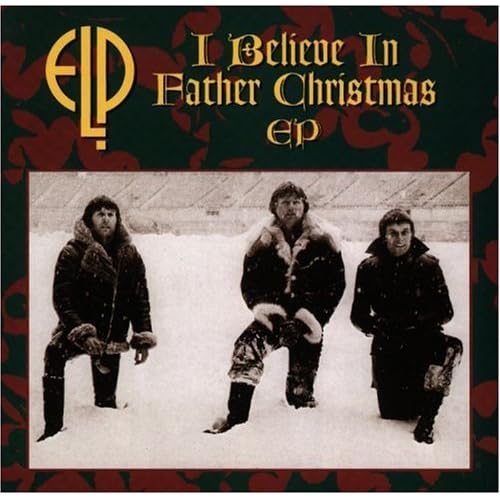
1. I believe in Father Christmas by Greg Lake on an Emerson Lake and Palmer EP.
This Greg Lake single first came out in 1975. Each Christmas that I heard it I was drawn to it. Then one Christmas I saw the 1995 EP with this and other tracks in a big record store. I didn't buy it at the time (I show restraint sometimes) but sent for it from Amazon another Christmas. It has 5 tracks - 2 versions of IBIFC, a version of Prokofiev's Troika (by Keith Emerson and the tune that provides the musical theme for IBIFC), Humbug (B-side of IBIFC single - delightful, jazzy, near-instrumental) and Nutrocker - encore from the ELP album of Mussorgsky's Pictures at an Exhibition (based on Tchaikovsky's Nutcracker so a Christmas number too).
The second version of IBIFC is a stripped down ELP version of the masterful Greg Lake single. This latter track has everything going for it as a Christmas single. First you get a beautiful 12-string guitar, a pleasant voice singing a pleasant tune. Then there's a distant choir, sleigh bells, some sort of bell/horn synthesiser to give atmosphere. Next, as we approach the final minute, timpani start, a large choir, an orchestra, military drums - all moving to a dramatic and powerful close. These are what hit you at first. Then you realise that the words (by one Pete Sinfield) are totally cynical. Poor old Pete has seen through the whole sham. No snow - only rain; no Father Christmas and (for him) no Jesus either. He tries to rescue it by wishing everyone a hopeful Christmas and a brave new year. This is highly post-modern - a song that makes you feel all "Christmassy" but that points out that the whole thing is a sham. I do believe in "the Israelite" but moaning about Christmas and enjoying it at the same time is great fun.