The similar phrase 'Worldly Christianity' is one used by Bonhoeffer. It's J Gresham Machen that I want to line up most closely with. See his Christianity and culture here. Having done commentaries on Proverbs (Heavenly Wisdom) and Song of Songs (Heavenly Love), a matching title for Ecclesiastes would be Heavenly Worldliness. For my stance on worldliness, see 3 posts here.
Showing posts with label Bunhill Fields. Show all posts

Day Off Week 27 2021


The main thing today was a trip into town with my fourth son Gwïon and his girlfriend. They are staying here this week. We went down to Bunhill Fields to see the graves of Bunyan, Blake, Defoe, Owen, Goodwin, etc, etc. We also saw Wesley's grave across the road; the house was closed. After that we headed for the flagship Shoreditch branch of the Origin coffee shop, where I did the crossword and Gwïon and Marni played chess. Very nice coffee. En route I spotted Esme Young from Sewing Bee and told her how much my wife enjoyed the show. Back here it was football in the evening, of course. I also found time to read a chunk of Gerald Bray's new The History of the Christianity in Britain and Ireland. I also found time to watch some TV. Oh yes and the latest Private Eye on the right day. Pretty good day all told.

Bunhill Fields Again

I did not think we would be returning to this subject so soon but if you have been watching the series of J K Rowling detective stories you may have noticed that Bunhill Fields features (slightly egregiously) in the second episode of silkworm, as illustrated. The snag here is that no new graves have been made in this London graveyard for well over a hundred years. (In this episode you also see shelves of books in someone's home and people have spotted a fat Harry Potter book there). I've enjoyed the episodes so far.

Thankful Owen 1620-1681

I recently posted the following on my 1662 blog. It is from Alfred W Light's book on Bunhill Fields.


(Same Tomb as Goodwin.)
Translation of Latin Inscription.
Thankful Owen, STB. Here mingles his sacred dust with that of Goodwin; to whom in life he was most dear. He scarce survived an hour the finishing of a Preface which he had been writing to that great work of Goodwin's on the Epistle to the Ephesians, the publication of which had fallen to his care. Dying with the same calmness with which he had lived, without a groan, save of the heart to Christ, on the 1st April, 1681, in the 63rd year of his age.
Thankful Owen was born, according to one account, at Taplow in Buckinghamshire, but another authority states that he was born in London. While quite a youth he had a remarkable preservation from drowning, for as he was swimming near Oxford he sank twice under the water. He received his education chiefly at Exeter College, Oxford, where his tutor was a Puritan. He became a man of much learning, and was greatly admired for the easy fluency of his language and compositions, and for the quite exceptional purity of his Latin style. He joined the Independent Church, afterwards becoming one of their preachers, and he was also chosen Proctor of the University in 1650, whilst in the same year he became President of St. John's College.
At the Restoration he was ejected by the Commissioners and, like Goodwin, removed to London. Here he lived very quietly, preaching as often as he could and steadfastly maintaining his nonconformity. On the death of Goodwin he was chosen to succeed him, but was only pastor for a fortnight, as he died quite suddenly at his house in Hatton Garden. His last labour was, as stated in the Inscription, to write a Preface for Goodwin's work on the Ephesians, and he had almost finished a work of his own, entitled "Imago Imagins" which was designed to show that Rome Papal was simply an imitation of Rome Pagan. Dr. John Owen said of Thankful Owen that he had not left his fellow behind him for learning, religion, and good humour.

Bunhill Fields Virtual Tour

Reciprocal Church History Tour


Public Domain John Wesley: he visits his mother's grave in Bunhill Fields, London. Aquatint by G. Hunt after W. Lee. Wellcome Collection.


Last week, as Mike Iliff was in London, I reciprocated his tour of Llangeitho with one of Bunhill Fields and the Wesley Museum (hence the recent list here). Besides the godly men Bunhill Fields is the final resing place also of the writer Daniel Defoe (who did come to faith later in life, I believe. Robinson Crusoe is worth reading for the evangelical content alone) and poet and painter William Blake (a Swedenborgian by persuasion). For more on the dead of Bunhill Fields, see Alfred W Light's tome, accessible here. Across the road from Bunhill Fields is the Wesley Chapel and the house in which he latterly lived. It was good to see that again. There is a little museum in the basement of the chapel. Wesley is buried behind the chapel. Both places are free to enter, the nearest tubes being Moorgate and Old Street. More here and here.
(In the picture above someone has imagined John Wesley visiting his mother's grave in Bunhill Fields).

10 godly men buried in Bunhill Fields

Mike Quinn / Bunhill Fields

1. John Bunyan (1628–1688), author of The Pilgrim's Progress
2. Thomas Doolittle (?1632–1707), nonconformist minister, tutor and author
3. Andrew Gifford (1700–1784), Baptist minister and numismatist
4. John Gill (1697–1771), Baptist pastor, biblical scholar, and Calvinist theologian, author of the Exposition of the Bible and the Body of Divinity
5. Thomas Goodwin (1600–1680), Puritan theologian and preacher
6. William Kiffin (1616–1701), Baptist minister and wool-merchant
7. Hanserd Knollys (1599–1691), Particular Baptist minister
8. John Owen (1616–1683), Puritan divine, theologian, academic administrator and statesman
9. John Rippon (1750–1836), Baptist clergyman, composer of many well known hymns
10. Isaac Watts(1674–1748), hymn writer, educationalist and poet

Bunhill Fields 04 Wesley Museum


We finished off with a trip to the Wesley Museum across the street. We were very kindly given a free guided tour. It's a fascinating story. More here. The guide seemed to be mainly interested in the social history. Methodism is rather different to what it was in Wesley's day, sadly.

Bunhill Fields 03

At Bunyan's grave

Bunhill Fields 02

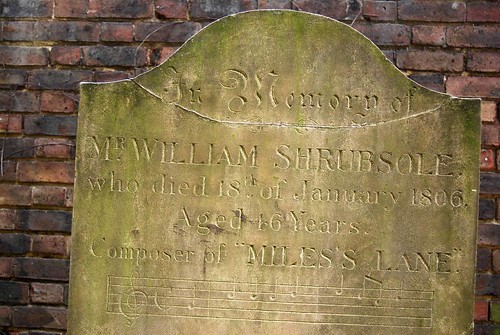
One grave I'd never noticed before in Bunhill is that of William Shrubsole (1760-1806). Not to be confused with the hymn writer fo the same name this one was a chor­ister at Can­ter­bu­ry Ca­thed­ral for se­ven years. He be­came or­ganist at Bango­r Ca­thed­ral around 1780, but his sym­pa­thies for the “dis­sent­ers” were not well re­ceived there, as ev­i­denced by these re­cords:
October 1783. Mr. Will­iam Shrub­sole, the or­gan­ist of the Church, hav­ing giv­en great of­fence to the Dean and Chap­ter, by his close con­nex­ion with one Ab­bot, late of this place, as by his fre­quent­ing con­vent­i­cles, that Mr. Dean be im­pow­ered to dis­charge the said Will­iam Shrub­sole from his place of or­gan­ist, if the said Ab­bot (who is sup­posed to have gone to re­side in Dub­lin), shall at any time here­af­ter re­turn in or­der to abide in the town of Bang­or, or the neigh­bour­hood there­of, or if the said Will­iam Shrub­sole shall be found to frequent any con­vent­i­cle or re­li­gious as­sem­bly, where any­thing is taught which is con­tra­ry to the Doc­trine or Dis­ci­pline of the Church of Eng­land.
December 1783. That Will­iam Shrub­sole be em­ployed to play on the or­gan of our Ca­thed­ral Church till Lady-day next and no long­er; that in case it should not be con­ven­ient for him to con­tin­ue in that em­ploy­ment till La­dy-day next, he shall be at lib­er­ty to leave it be­fore that time, and shall be paid the full al­low­ance to Lady-day next not­with­stand­ing. (Lightwood, pp. 167, 168)
After de­part­ing Bang­or, Shrub­sole be­came or­gan­ist at Spa­fields Cha­pel, Lon­don, in 1784, and re­mained there unt­il his death. As the gravestone notes he was the composer of Miles' Lane (which I associate with "All hail the power").

Bunhill Fields 01

Grave Joseph Hart
(Edwardx, CC BY-SA 3.0 <https://creativecommons.org/
licenses/by-sa/3.0> via Wikimedia Commons)


I made a trip to Bunhill Fields with my son and daughter in law yesterday. It was a beautiful day and we got to see and remember (or learn about) several worthies. This granite obelisk was raised in 1875. On it you may read these words

East side:

Erected by lovers of Hart's hymns, published in 1759, and still highly prized by the Church of God. The author's remains were interred on this spot, as the original stone yet remains to show.
JOSEPH HART, minister of the Gospel, died May 24th,1768, aged 56.

South side:
JOSEPH HART was by the free and sovereign Grace and Spirit of God raised from the depths of sin, and delivered from the bonds of mere profession and self-righteousness and led to rest entirely for salvation in the finished atonement and perfect obedience of Christ.

"Mercy is welcome news indeed
To those who guilty stand;
Wretches who feel what help they need
Will bless the helping hand."


North side:
"Though I am a stranger to others and a wonder to myself, yet I know Him (Christ), or rather am known of Him. Where sin abounded Grace did much more abound."

"O! bring no price!
God's grace is free
To Paul, to Magdalene and me."

"None but Jesus
Can do helpless sinners good."