The similar phrase 'Worldly Christianity' is one used by Bonhoeffer. It's J Gresham Machen that I want to line up most closely with. See his Christianity and culture here. Having done commentaries on Proverbs (Heavenly Wisdom) and Song of Songs (Heavenly Love), a matching title for Ecclesiastes would be Heavenly Worldliness. For my stance on worldliness, see 3 posts here.
Showing posts with label Evangelical Times. Show all posts

Article in the May ET


The May Evangelical Times has already arrived here. I have an article in it once again.

Article in the New ET


I've obviously been busy. There is an article of mine on 2 Chronicles 13 in the February Evangelical Times.

Article in Christmas ET

The Evangelical Times has its annual Christmas supplement out. I have an article in it called Is there room in your heart for Jesus?

Reflecting on Mirrors Article in Sep ET

Gloria Stuart posed applying makeup in Photoplay issue
(Dec. 1932) 
Public domain, via Wikimedia Commons


I was pleasantly surprised to see they have published my article "Reflecting on the mirrors of the women who served" in the September Evangelical Times. I wrote it a while back.

Review of Pastoral for Pastors in the Current ET

It was good to see the very positive review by Jeff Haskins of my latest book in this month's ET

Every pastor should get a copy of this book. You will not be disappointed. However other people such as seminary students may also benefit from it; or perhaps someone reading through Paul’s pastoral letters could get this book and read it alongside the Bible.
The book suggests following its reading plan for 30 days and then starting over again. By doing this you would read through the pastoral letters twelve times a year.
Gary Brady writes with clarity and simplicity. I particularly like the way the biblical text is explained with lists and numbering. It means that his thoughts are easy to follow, and it also allows the reader to appreciate the biblical text. The book probably falls into the category of ‘devotional commentary’ but there is much more to glean.
Brady has incorporated many years of pastoral experience into the notes. There are stories to learn from, which preachers could also use as illustrations. The application of the text is very challenging and should stir the reader to take up that challenge. Other notes help shed light on biblical terms and phrases, even those we have become accustomed to.
People might be disappointed that the Bible passage is not included in the sections, but it is woven into the commentary. But perhaps it is better that way, so that the reader has their Bible next to them when reading the book.
Jeffrey Haskins
Lancaster

Luther and the 9.5 Theses

This review for another little book recently appeared in Evangelical Times
Luther and the 9.5 Theses
by Kenneth Brownell
July 2017
Publisher: 10 Publishing
ISBN: 978-1-91127-236-6 
Pages: 104
Price: 4.99

Unless you have been hiding in a monastery, you will know that this year is the 500th anniversary of the beginning of the Reformation. A plethora of publications have appeared, drawing attention to this fact at various levels and from different points of view. This title comes from Dr Brownell, who has been pastor of East London Tabernacle for over 30 years.
This little book is one of the shorter contributions. It should not be sneered at, however, as in brief and accurate compass it not only gives you the essential story of Martin Luther and his 95 theses but places before us 10 theses for today. These follow careful reflection on the original historical debate, but also speak powerfully to today’s world.
To take one example, the third modern thesis is that ‘Unbiblical doctrines and practices in churches contradict or undermine the gospel and need to be challenged, repudiated and discarded if Reformational Christianity is to flourish’.
Brownell chases down some obvious culprits, such as liberalism, Romanism and the prosperity gospel. He also highlights two areas closer to home, namely pastoral care that is little more than pop psychology, and public worship that does not exalt the Triune God or build up God’s people before a watching world.
On page 62, the author refers to Luther as one who could write learned treatises as well as simple books. Dr Brownell is blessed with the same gift and this present volume is evidence of it. Like Luther’s own work, it is theologically informed writing that not only engages the mind but the will and the emotions also.
Like Luther’s Sermon on indulgences and grace, which was reprinted 24 times between 1518 and 1520, this book is designed for mass distribution. Let’s hope it gets it.

God's not dead 2

This new release from Pure Flix directed by Harold Cronk is a very watchable court room drama with high production values and excellent acting. With great skill a number of themes have been woven together in order to provide what is both an enjoyable movie and a thought provoking piece of Christian apologetics.
Reflecting on more than twenty cases against Christians that have gone through the American court system in recent years, it presents us with the fictional case of a state school teacher (Melissa Joan Hart) who runs into trouble when she talks about Jesus in the classroom. The court room provides the opportunity to have the apologists Lee Strobel and former homicide detective J Warner Wallace take the stand as expert witnesses. We also have brief cameos from Gary Habermas and Rice Brooks on a show with Senator Mike Huckabee.
On the matter of cameos and similar elements, older viewers will no doubt appreciate the role played by Pat Boone, now 82 years old, and may be younger viewers will appreciate the presence of rock band Newsboys who perform the song My God's not dead.
As a product of the Arminian decisionistic-tending side of evangelicalism, thoroughly committed to evidentialist apologetics, the film makes as strong a case for Christ as one can imagine.
As for it making a dent in the world it is aimed at, Rotten Tomatoes described it, not entirely unfairly, as “Every bit the proselytizing lecture promised by its title, God's Not Dead 2 preaches ham-fistedly to its paranoid conservative choir” while Bill Zwecker of the Chicago Sun-Times felt that while the underlying issues presented in the film are relevant in today's world, it lacks subtlety and “comes off as a two-hour, jazzed-up movie version of a sermon.”
As for the idea that Christians are not really under pressure in the public square, that is certainly not the case. It may be that this film will do most good in raising awareness among professing Christians of such issues.
This article or something similar is in the current edition of Evangelical Times

John Knox Documentary


KNOX Trailer from Trinity Digital Film on Vimeo.
The November issue of Evangelical Times has a review of the documentary on Knox from Trinity Digital trailed above.

Knox is a documentary produced by Murdo MacLeod, marking the five hundredth anniversary of the birth of the influential Scots Reformer, John Knox, which occurred some time around 1514.

The documentary is presented in a manner that we have grown used to. Philip Todd, the film's youthful presenter (in dark jeans, loose narrow tie, open velvet collared Chesterfield coat and leather gloves) moves from location to location (Edinburgh, Perth, St Andrews, Stirling, Berwick, Geneva, etc) telling Knox's story from his birth to his death and beyond. This is interspersed with a number of talking heads (ministers and academics such as Rev Maurice Roberts, Professor John McIntosh and Knox biographer Jane Dawson), cartoon images backed with actors reading the actual words of Knox (Stuart Falconer) and others plus a sprinkling of other appropriate images ancient and modern. Throughout, music (Charlie Wilkins) and other audio is used to enhance the presentation.

It is all done to a high standard, although Amanda Aiken's cartoons are not really up to the standard one could desire. (This is the point where the senior youth group start to snigger, if they get to see it). The documentary has, understandably, a very Scottish feel, which may limit its use in some places. Far from being a hagiography, it seeks rather to give a rounded picture.

The chief aim of the documentary appears to be to give us clear and accurate history but from time to time some of the talking heads make statements that are no doubt intended to encourage true faith in Christ and to challenge believers today. Such instruction comes over in the quotations from Knox too.

In the final section the conviction is very clearly expressed that Scotland needs a new Reformation. The final words are those of Knox himself calling on us to know God, to be faithful and to seek blessing for Scotland. It is encouraging to know that such materials are being made.

Christmas 2014 - Preaching and evangelism

I decided to preach this Christmas from Paul's epistles in the mornings and the prophets in the evenings. I began with something from Colossians 1 and then moved to the more familiar Galatians 4:4 and 2 Corinthians 8:9. Similarly, in the evenings it was Isaiah 60 and then the more obvious Malachi 4:1-3 and Micah 5:2. Midweek I looked at the second part of Matthew 1 and at the people in the Christmas story. On Christmas Day I went rather unusually but appropriately to Job 42:11.
I also got to speak at two gatherings for the elderly, giving a gospel message. We distributed a few hundred copies of the Christmas Evangelical Times. A Hungarian man did come in on Christmas Day interested to know more. I gave him an English Bible and a John Blanchard booklet. I hope we see him again soon.

Noah

(Paul Gamston or Russell Crowe?)
I was able to see the new film Noah yesterday afternoon. I have sent this review to Evangelical Times.
 
Noah 12A, a Paramount Pictures production in cinemas from April 4
 
One of my pet hates is the dinky sort of “Noah's ark” you see in toy shops and in children's books. The ark in Paramount Pictures new film Noah is nothing like that. It is a hulking great thing and when the animals come into it and it floats on the surface of the water in a worldwide flood, it is a great sight to behold. However, that is probably the best that can be said for a film that most Christians will be very disappointed with. The very fact I need to use the term spoiler alert here will give a hint at how far from the Bible account Darren Aronofsky's film strays.
Turning biblical narrative into a cinematic experience is fraught with difficulties. The very statement “12A Contains moderate violence, injury detail, threat” seems a little weird. We know that a feature film will never simply follow a narrative but needs to build in its own dramatic tensions. We were pleased not to have to hear an actor giving the voice of God and we were not surprised to see Noah's wife (Jennifer Connolly) given such a big part. We were willing to allow a large part to Shem's wife (Emma Watson, famous from the Harry Potter films) too and we can see that there is some room for argument on how Methusaleh, Lamech and Ham are presented and on whether Noah became a grandfather while on the ark. (The film takes us from Noah's childhood to his drunkenness and repentance with backward glances to the earlier chapters of Genesis). We can even overlook inaccuracies such as ignoring the 120 year gap between the command to build the ark and the flood.
What is much harder to stomach is the blatant rejection of the biblical narrative in favour of a wholly fictitious presentation of Noah (Russell Crowe) as a man with a death wish against humanity and an ark containing seven people not eight, one of them a villainous Tubal-Cain (Ray Winstone – who else?) who stows away for months only to be murdered before the Ararat denouement!
One of the problems with suggesting, as the film does, that Noah wanted to kill his own grandchildren and so leave the human race with no future is that far from creating dramatic tension, anyone who is thinking about the plot will be utterly unphased by all the drama that those playing Noah, his wife and daughter-in-law pour into their parts as the very fact that we are here watching the film dictates the eventual outcome.
Perhaps we simply have to accept that when those who are unwilling to treat God's Word as sacred are let loose on the Scriptures they will almost inevitably go wrong, sometimes, as here, spectacularly wrong. The theological problems with this film are there from the outset and throughout. We open with the hopeful words “In the beginning there was nothing”. Everything in the believer cries out “actually, in the beginning there was God” but you say “okay this is as near as we are likely to get from such a source”. A few frames in, however, we are introduced to “The watchers” an angel-like race who are fallen and yet redeemable and who help Noah build his ark. This is highly problematic as is the makers inability throughout to distinguish between the miraculous and the magical. Even when we get a count down of creation the idea that the sun and moon were made on the fourth day is firmly rejected, regardless of what Genesis may say on the matter.
Perhaps the biggest problem with the film is the way the Bible's chief theme of Messiah has been completely removed. The chief characters in the film come over as clones of 21st century man in all his ignorance and arrogance not as antediluvians who are longing for Messiah to come. This is both anachronistic and verging on the blasphemous.
I was able to see this film ahead of time thanks to the efforts of an organisation called Damaris Media. Led by Nick Pollard, it seeks to capitalise on the existence of films such as this one by encouraging discussion of the gospel with people who see it. (See their website here http://www.damaris.org). The groups aims are most laudable and they have produced excellent materials to accompany the film. I just wonder if the task of getting from the fiction that is the film Noah to the story in Genesis will be a step too far in most cases. We do not have to tie our hands behind our backs before we evangelise. Of course, some people will see the film anyway and Damaris may be a help in highlighting how to take discussion forward.

C S Lewis

I have written an article for the November Evangelical Times on C S Lewis, which you can preview on the website. The whole edition looks like it's worth getting I'm sure.
 
Back in my salad days when I was green in judgement, some 20 or more years ago, I remember telling a congregation, by way of application, not to bother to read anything by C. S. Lewis. I did not say he was of the devil or not a Christian, as some would maintain, but I thought there were better things to read. I remember a young man challenging this statement, which I defended then but would now want to nuance quite a bit. Like all generalisations, including this one, it was inaccurate. But what prompted such a swingeing generalisation?

Evangelical Times Review of 1662 The Great Ejection

I notice the positive review in ET for October by church historian Dr Robert Oliver
 
Who governs the church, Jesus Christ or the state? In practical terms, what determines the doctrine and practice of the church? Is it the Bible or is it public opinion? Throughout the long history of the church, Christians have had to face and answer such questions. Once again they have been thrown up by the debate about the nature and character of marriage. It is good to be able to consider the way in which our fathers approached such issues. The record of the legislation of 1660-1662 and its aftermath provides us with such an opportunity. The year 2012 was the 350th anniversary of what has become known as the ‘Great Ejection’, when almost 2000 Puritan pastors and their flocks were forced out of the Church of England because they were unable to submit to unbiblical conditions of service. The theses included acceptance of the divine right and authority of diocesan bishops and an allegiance to the Prayer Book in terms which could only be given to the Bible. Hundreds of men, unable to bow to parliament’s decisions on these issues, were deprived of their charges and compelled to accept the prospect of poverty in a social and political wilderness. Gary Brady has given us a fine account of these events. He explains the issues and discusses the reasons why Puritans, who had only recently seemed so secure in their ministries, were suddenly plunged into a crisis of conscience after 1660. The story moves from the high politics of Charles II’s reign to the very human story of the sacrifices and triumphs of hundreds of Christian people. Lists of excluded ministers are included and may be useful for reference purposes, but the great value is the inspiring way in which the experiences of local churches and their members and ministers are described. This inspiring record should be widely read and studied by Christians today. It is very highly recommended.
Robert W. Oliver

Life of Pi

This review of the movie is in the February ET along with lots of interesting articles on Anne Bronte, etc.

At the end of 2012 the feature film Life of Pi hit the cinema screens. The film is based on the prize winning 2001 book by Yann Martel first published in Canada in 2001, after a series of rejections. The film and the book tell the unlikely story of Piscine Molitor "Pi" Patel, an Indian boy who suffers shipwreck and survives 227 days on a lifeboat in the Pacific Ocean with a Bengal tiger. The film's director is Ang Lee. It is beautifully shot and a cinematic triumph.

In 2010 Barack Obama wrote to the author of the novel calling his book “an elegant proof of God, and the power of storytelling”. On one level the book is very positive. In one place for example the question is asked quite reasonably “If you stumble about believability, what are you living for? Love is hard to believe, ask any lover. Life is hard to believe, ask any scientist. God is hard to believe, ask any believer. What is your problem with hard to believe?” There is a recognition that as attractive as doubt may seem “to choose doubt as a philosophy of life is akin to choosing immobility as a means of transportation.” The film creates interest on several levels and evangelical Christians will find many topics to discuss among themselves or with unbelievers who have read the book or seen the film.

The narrative itself can be divided into three parts. The central and dominating part of the film is the shipwreck and Pi's experiences at sea. This is in turns gripping, shocking and thought provoking. Man's instinct for survival and our utter dependence on God come to the fore here. It is to God that Pi apparently cries in the midst of his desperate need and where else could he have turned?

At the beginning, Pi describes his early life, growing up in Pondicherry, French India, where his father owned a zoo. Of particular interest is the way he is raised as a Hindu by his mother, while constantly being challenged by his agnostic father. In his teens he is introduced first to Catholic Christianity and then Islam. Despite his father's scepticism, he claims to follow all three religions as he “just wants to love God”. Typical of many today, he wants to accept all the religions and reject none, an utter impossibility in reality.

In the closing part of the film, officials speak to Pi about why the ship sank. They are sceptical about his story so he gives them an alternative, an altogether more prosaic and much less attractive version of events. He asks which of the stories they prefer and claims that the truth does not matter, given that he was clearly been shipwrecked and survived. Thinking Christians will immediately baulk at his statement “and so it goes with God”.

Crafting stories is a difficult and serious business. Authors are always trying to push the envelope. However, to have any credibility they have to deal with reality and that is, perhaps, what makes the film most interesting. Despite the author's postmodern outlook, which he projects on to the protagonist, he has to deal with reality. Bananas do float, for example, but a carnivorous island seems less likely. The role of the tiger is particularly interesting in this respect. He is utterly realistic and so is both a great help and a disappointment to Pi in the end. At the same time there is a measure of sleight of hand at play and we must be alert to that. In the book Martel actually confesses that he believes that fiction is “the selective transforming of reality” and “the twisting of it to bring out its essence”. So when he says, “I challenge anyone to understand Islam, its spirit, and not to love it. It is a beautiful religion of brotherhood and devotion” we know that as well structured statement as it may be, it is simply false.

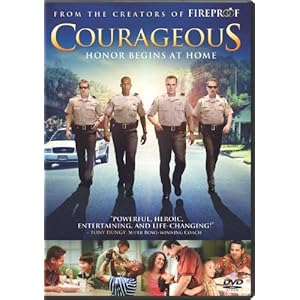
Courageous?


Review of the DVD Courageous first released at the end of last year.

If you are familiar with the work of the Kendrick Brothers and Sherwood Pictures (Flywheel, Facing the Giants, Fireproof) then you will know what to expect from their current DVD Courageous. The them this time is fatherhood with the focus on four different fathers, three of whom are in the local police department. Again there is the Albany, Georgia backdrop, the focus on several different characters, the gentle and attractive humour, people praying and getting converted and the positive small town American charm. Perhaps the effort to be multicultural and multisocial is more obvious. As ever, the acting is good, the storyline well written and the production values high. The budget was up fourfold this time, to $2 million dollars (but quickly recouped many times over at the box office). However, the project was, as ever, bathed in prayer, involved many extras from the local church, relied on volunteers and has a credit list that still includes people like babysitters and caterers, again from the local church. The film actually ends with what appears to be a Father's Day service at the Sherwood Baptist church.
So, a film made by Christians with the laudable aim of drawing attention to fatherhood and what a crucial role fathers can have on the rising generation. What's not to like? Well, it was a little long I thought. It is relentlessly didactic and even if you agree with the basic premise you might find it a little irritating. The fathers in the film decide to show what committed fathers they are by signing a pledge and making a public commitment. One father gives his teenager daughter one of those purity rings that have been so popular an controversial in the States. All very American and fair enough for an American film, perhaps. My real fear, however, is that with the title courageous the film is suggesting that all we fathers need to do is to try a little harder, spend a little more time with our kids and everything will be dandy. It is difficult to say whether the problem lies in the Kendrick brothers theology or the medium itself. When you write a story or make a film then you are in a sense acting as God. There is no failure on the part of the writers to introduce conflict or to suggest that being a father is easy. Nevertheless it would be very easy to watch it and even with the closing text in your head (Joshua 24:15) to think that all we need to do is try a bit harder.
When I was at university studying English I wrote essays that chiefly aimed to convert the lecturer. I now see that was a mistake. That is not what an academic essay is intended to do. Watching and making feature films is surely not a sin. However, we must always remember that Christ conquers sin and wins hearts to himself through preaching not through feature films. Perhaps next time the Kendricks, who are undoubtedly good story tellers, will try and be more subtle and aim more at entertainment rather than trying so hard to convert us all.
(An edited version of this piece can be found in the September Evangelical Times)

A Book on Boys

This review was in ET this month. I could only give it two stars I'm afraid.
Slugs and snails and puppy dogs' tails: Helping boys connect with God – IVP- Gary Brady
Slugs and snails and puppy dogs' tails
Carolyn Edwards
192 pages, Paperback, £8.99
ISBN: 9781844745234 (Published: 15/04/2011)

As a father of five boys and someone who is very involved in work with children and young people I was not surprised to be asked to review this book and indeed warmed to the task. However, I did not find the book easy to get into because of its ethos and methodology and the fact that, though the book is otherwise well written, we are 40 pages in before the main dish is served (Part 1 being given over to introductory matters). I can only give it a mild commendation.
Mrs Edwards is very well read and clearly highly competent in her field. She is senior lecturer in Children and Family Work at the Centre for Youth Ministry, Oxford. She also loves children. Her book grows out of an investigation into the spiritual expressions and preferences of boys ages 5-11 in three settings – an Anglican Junior church, a Scripture Union club and an RE class.
The main problem with it for me was its rather sociological approach and its lack of scriptural and theological grounding. When for example, on page 98, she wonders aloud if children's laughter has something to do with what Jesus meant when he said we need to be like children to enter the kingdom one is concerned. A few pages later she is naively commending the visual approach of the eastern orthodox churches. On page 81 she commends more rugged and manly pictures of Jesus without ever raising the question of whether we should be making pictures of Jesus at all.
Having said all this, there are plenty of good things to be had from this book. If you go through it finding the paragraphs beginning with with a large stylised “?!” you will find plenty of practical suggestions regarding working with boys in the areas of relationship and conversation, play and touch, story telling, pain and loss, humour, creativity, silence and prayer, good deeds, healthy risk and multimedia technology. There are also potentially useful “Things to think about” at the end of each of the ten main chapters of the book.
Gary Brady Childs hill

Special People

The April edition of Evangelical Times carries the third and final guest column in the series, this time on special people, ie the call to the ministry.

Today’s aversion to anything special is found among a growing number of evangelicals. It manifests itself in various ways. Take the antipathy some Christians have toward revival. Often behind this gut reaction is resistance to the idea that God ever does anything special or out of the ordinary.

Such Christians so emphasise that God works in ordinary ways among us that they leave no room for extraordinary visitations of the Spirit.

Or take the common argument that the Bible is to be read ‘just like any other book’. The very suggestion that the Bible is special and needs to be approached in a special way puts some interpreters in a fairy fit!

But consider too the antipathy found among some evangelicals to the idea of ‘special people’. Unlike the aversions we have considered in the last two months to ‘special days’ and ‘special times’, this phenomenon is not entirely new.

Confused
It manifests itself today chiefly as opposition to the whole idea of a ‘call’ to the Christian ministry. According to R. L. Dabney, ‘the church has always held that none should preach the gospel but those who are called of God’, but some are not so sure.

A recent survey of some 400 men thinking about ministry in the 21st century revealed that 40 per cent were confused as to what was a divine call. This is not surprising given the current climate.

Some are so impressed by the biblical doctrine of the sacredness or priesthood of every believer and are so taken up with the rediscovery of Reformation teaching on vocation that they run to the opposite extreme. They end up with something unbiblical and potentially damaging to churches and individuals.

One can understand people reacting against the wrong mysticism that is sometimes associated with ‘the call’. Agreed, that while there are analogies to the call to be a prophet or an apostle, the call to the ministry is not the same; Charles Bridges wrote long ago that ministers ‘having no extraordinary commission ... do not expect an immediate and extraordinary call’.

Agreed too, that a mystical experience of God’s call is not a firm enough foundation for it; desire, gifts and opportunity are all vital factors in a true call to the ministry.

But what we are protesting against is the idea that there is no such thing as a call, and that more or less any man will do for the ministry provided he is morally upright, reasonably educated and can speak in public.

‘Woe to me’
If anyone can be a minister of God’s Word and there is no call to the ministry, why in Acts 20:28 does Paul say to the Ephesian elders, ‘Keep watch over yourselves and all the flock of which the Holy Spirit has made you overseers’?

If anyone can be a minister of God’s Word and there is no call to the ministry, what does Paul mean when he says in 1 Corinthians 9:16, ‘Yet when I preach the gospel, I cannot boast, for I am compelled to preach. Woe to me if I do not preach the gospel!’?

If anyone can be a minister of God’s Word and there is no call to the ministry, why does Paul say in 1 Corinthians 12:28 that, ‘God has appointed first of all apostles, second prophets, third teachers...’?

If anyone can be a minister of God’s Word and there is no call to the ministry, why does Paul say of Christ in Ephesians 4:11-12, ‘It was he who gave some to be apostles, some to be prophets, some to be evangelists, and some to be pastors and teachers, to prepare God’s people for works of service, so that the body of Christ may be built up’?

Our concern is not to deny that each Christian must conscientiously use whatever gift he has to God’s glory. Rather, it is to say that to deny that there is a special call to the ministry is to make the mistake of supposing that just anyone can try for it. Such an attitude is bound to lead to disaster.

A Special Time

This month's Evangelical Times (March) carries the second article in the series of three guest articles that I have done

A special time
Last month, this column highlighted society’s nervousness about the idea of specialisation and noted how a growing number of evangelicals are nervous about special days, times and people.
How strange that those who believe God has singled out one special planet, one particular species on it and one special people from among them to receive his blessing should think like that!
We considered the fact that the New Testament marks out the first day of the week as special. It is the Lord’s Day, a day to be kept to him. This month we address the question, whether it is right to think in terms of special times of worship.
Is it right to put a notice outside a church building announcing ‘worship services’? Should we speak of ‘coming together to worship’? Or is that, as some suggest, a concept more Jewish than Christian, and one that has no New Testament basis?

Worship services?
For some years, various evangelicals have been advocating the idea that it is wrong to think of those times when God’s people gather together as times of worship. Their arguments are similar to those against a special day.
People who are not keen on keeping the Lord’s Day special often assert that every day belongs to the Lord. Similarly, those who say that our meetings are not primarily for worship often assert that all of life is worship, not just certain hours in the week.
They may then go on to give the impression that there is little difference between going fishing or having a family meal on one hand, and corporate prayer and praise on the other. More often the idea is developed, with reference to Hebrews 10:25 and 1 Corinthians 14, that the main purpose of our meetings is encouragement and edification.
The character of Christian meetings thus significantly shifts from a vertical to a horizontal focus — meetings are seen to be chiefly for teaching, rather than worship.
Certainly Romans 12:1 urges believers to offer their bodies ‘as living sacrifices, holy and pleasing to God’ and Paul calls it ‘your spiritual act of worship’. There is no suggestion, however, that those who live such lives will not take time apart, especially on the Lord’s Day, to worship.
John 4:24 says that worship in the new age is to be ‘in spirit and in truth’. Surely this does not mean forbidding the church to have any set times and places for public worship? Rather it points out that worship occurs, not automatically when one is in a certain place or following a certain ritual, but when one offers honour to God in accord with his standards.

Examples
Yet, just as some cannot see how one day needs to be special, so there are those who cannot see why Christians need special times to worship. Well consider these points:
If all of life is worship, and there are no special times of worship, why does Acts 13:2 say of the disciples that it was ‘while they were worshipping the Lord and fasting’ that the Holy Spirit told them to set apart Barnabas and Saul?
If all of life is worship and there are no special times of worship, what do we make of Jesus’ statement that when two or three come together in his name, he is there with them (Matthew 18:19-20)?
If all of life is worship and there are no special times of worship, what does Paul mean when he speaks, in 1 Corinthians 5, about God’s people being ‘assembled in the name of our Lord Jesus’ and ‘the power of our Lord Jesus’ being present?
If all of life is worship and there are no special times of worship, what about prayer? We are told to pray continually, but New Testament believers, clearly, still set aside times for prayer (e.g. Matthew 18:19; Acts 12:5; 1 Corinthians 14:23-25).
At times they were praying together; at times they were not. Surely the same is true of sung praise and hearing God’s Word.

God’s glory
What we are saying is not new. It is what believers have practised in all ages. This is not because they have unwittingly imbibed the idea from Jerusalem or Rome, but because it is there in the New Testament.
Some today are nervous about calling their meetings ‘services’ or ‘acts of worship’. This undermines such meetings and detracts from God’s glory. Rather, we should be setting aside regular times for the precise purpose of worshipping Almighty God.