The similar phrase 'Worldly Christianity' is one used by Bonhoeffer. It's J Gresham Machen that I want to line up most closely with. See his Christianity and culture here. Having done commentaries on Proverbs (Heavenly Wisdom) and Song of Songs (Heavenly Love), a matching title for Ecclesiastes would be Heavenly Worldliness. For my stance on worldliness, see 3 posts here.
Showing posts with label George Smeaton. Show all posts

Unusual words 05 Equipollent

I came across equipollent in Smeaton on the atonement. He speaks in a footnote of two Greek words "both referring to the idea of a sacrifice, and so nearly equipollent that the one involves the other". The word, as you may guess, simply means equal in force, power, effectiveness or significance.  Perhaps Smeaton has taken it from the world of logic.
Francis Bacon uses it in an essay "Only superstition is now so well advanced, that men of the first blood, are as firm as butchers by occupation; and votary resolution, is made equipollent to custom, even in matter of blood."

10 Characteristics of Scots atonement theologians by Donald Macleod

Good day looking at Smeaton yesterday with the other men at the John Owen Centre. Stumbled across this list from Donald Macleod on Scottish Atonement Theology (Dictionary of Scottish Church History and Theology) here. Such theologians are characterised by

1. A sustained, reverent reflection on the sufferings of Christ. 
2. A perception of the work of Christ in sacerdotal terms.
3. An insistence that the sufferings of Christ were penal.
4. A portrayal of the atonement as a satisfaction to divine justice.
5. The sufferings of Christ were vicarious.
6. The setting of the cross in a covenant framework.
7. The indispensable necessity of the atonement to salvation.
8. The unambiguous portrayal as a fruit and consequence of the love of God [the Father].
9. A prominence for the idea of victory not surpassed in any other Western tradition before Gustaf Aulen.
10. A belief in limited atonement, but stated very carefully.

Smeaton on the atonement

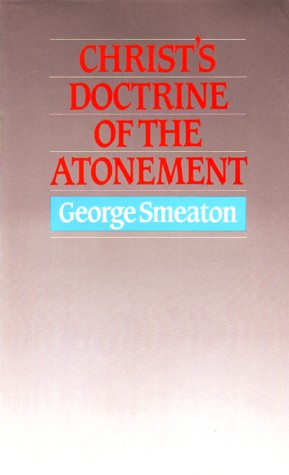
I'm planning to be at the John Owen Centre today where the Theological Study Group will be discussing George Smeaton's book Christ's Doctrine of the atonement. It's been good to read a book that has sat on my shelf unused too long. It is full of excellent insights.

George Smeaton


I have just finished reading John Keddie’s biography of the Scots theologian George Smeaton (1814-1889). People are aware of Smeaton chiefly through his helpful work on the Holy Spirit published by the Banner of Truth some years ago. Banner also publish his two volume work on the atonement, his other major work. This present volume draws together what little is known of Smeaton and presents it in a popular form in 16 fairly short chapters.
Beginning with his roots, his early years and his early preaching, it goes on to describe his parish ministry, the founding of the Free Church and then his commencement as lecturer first in Aberdeen then in New College, Edinburgh, in 1857, where he served alongside Principal Cunningham and Buchanan, Bannerman and Duncan.
We learn next about his stand on various issues including the establishment principle (very interesting reading for an ignorant Baptist like me), higher criticism and hymn singing (on which he parted with Horatius Bonar, leaving behind the church he had founded). Chapters 12-14 look at Smeaton’s writings, many still in print as indicated above, and two final chapters describe his death and heirs and giving a final summary assessment. A bibliography lists Smeaton’s various works including prefaces and magazine articles. Four relevant PhD theses are also listed.
We are indebted to Mr Keddie for his work in bringing this information to light. The story of the rise and fall of the Scots Free Church is one full of interest and instruction for all Christians as is that of Smeaton himself.