The similar phrase 'Worldly Christianity' is one used by Bonhoeffer. It's J Gresham Machen that I want to line up most closely with. See his Christianity and culture here. Having done commentaries on Proverbs (Heavenly Wisdom) and Song of Songs (Heavenly Love), a matching title for Ecclesiastes would be Heavenly Worldliness. For my stance on worldliness, see 3 posts here.
Showing posts with label Richard Sibbes. Show all posts

10 Doctors of the church


1. Doctor of Grace (Augustine of Hippo)
2. Doctor Angelicus or the angelic doctor (Aquinas)
3. Doctor Subtilis (Duns Scotus)
4. Doctor Invincibilis (William of Ockham)
5. Doctor Mellifluus (Bernard of Clairvaux)
6. Doctor Profundis (Thomas Bradwardine)
7. The heavenly doctor (Richard Sibbes)
8. Doctor Voluminous (John Gill)
9. Doctor Squintum (Whitefield)
10, The Doctor (Lloyd-Jones)

Izaak Walton's Cottage

As I sped off from the conference I came through Shallowford where I espied a nice thatched cottage signposted Izaak Walton's Cottage.
I learn from the associated website (see here) at Izaak Walton (1594-1683), the celebrated author of the 'Compleat Angler', owned this charming cottage that nestles in the tiny hamlet of Shallowford, between Stafford and Eccleshall.
The charming thatched 16th century half-timbered cottage (I think that should be 17th century) will be of interest, they suggest, to anglers and non anglers alike, offering as it apparently does a marvellous insight into the history of fishing and the literary talent of Stafford's famous son.
Izaak left the cottage in his will to the people of his home town of Stafford, and now the museum pays homage to his illustrious life. Inside we apparently learn about Izaak Walton the Merchant, Churchman, biographer (he wrote lives of Donne, Herbert, Hooker, Sanderson, etc), writer, angler, and Royalist and of his great contribution to the genre of biography and his influence as an early conservationist.
Walton's two respective wives (his first wife pre-deceased him) were related to Cranmer and Thomas Ken. Some of his personally owned books ended up in Salisbury Cathedral Library. They include a1 1650 copy of Richard Sibbes' The returning backslider. He was a Sibbes fan and on the flyleaf of the book he has written the famous couplet

Of this blest man let this just praise be given, 
Heaven was in him, before he was in heaven.

Within the cottage the period rooms are furnished to reflect the rural trappings of the 17th Century. There are also rooms dedicated to Izaak the writer and biographer and to the history and evolution of angling. It appears to open only from May to September on the Lord's Day.

10 Biographies of Puritans

1. Henry Smith: England's Silver-tongued Preacher by Ronald B. Jenkins
2. Richard Sibbes by Mark E Dever
3. The life and times of Arthur Hildersham by Leslie A Rowe
4. A life of Gospel Peace: A Biography of Jeremiah Burroughs by Philip Simson
5. John Owen: Prince of Puritans by Andrew Thomson
6. Glimpses of glory: John Bunyan and English Dissent by Richard Greaves
7. Thomas Manton A Guided Tour of the Life and Thought of a Puritan Pastor by Derek Cooper
8. The life and times of the Rev Philip Henry by Matthew Henry
9. Life and death of the Rev Joseph Alleine by Alexander Duff
10. Samuel Rutherford by Andrew Thomson

Carey Conference 2013 06

Mike Reeves' second session was on the Puritan Richard Sibbes (1577-1635). He gave some brief biographical background, pointing out that Sibbes saw that big problem not just outward sins but matters of the heart (see The Tender Heart). He gave us some great quotations
“There is more grace in Christ, than there is sin in us!” “When we are drawn therefore to duties … with foreign motives, for fear, or out of custom, with extrinsic motives, and not from a new nature, this is not from the Spirit. This performance is not from the true liberty of the Spirit. For the liberty of the Spirit is, when actions come off naturally without force of fear or hope, or any extrinsic motive. A child needs not extrinsic motives to please his father. When he knows he is the child of a loving father, it is natural.”
“Many say that an adamant cannot be melted with fire, but by blood. I cannot tell whether this be true or no; but I am sure nothing will melt the hard heart of man but the blood of Christ.”
“As when things are cold we bring them to the fire to heat and melt, so bring we our cold hearts to the fire of the love of Christ; consider we of our sins against Christ, and of Christ’s love towards us; dwell upon this meditation. Think what great love Christ hath shown unto us, and how little we have deserved, and this will make our hearts to melt, and be as pliable as wax before the sun … If thou wilt have this tender and melting heart, then … be always under the sunshine of the gospel.”
“The papists, after they have been at their superstitious devotion, are fittest for powder-plots and treasons, because their hearts are so much more hardened.”
“What will come of it if Christ be set in the highest place in our heart? If we crown him there, and make him 'King of kings and Lord of lords,' in a hearty submitting of all the affections of the soul to him? While the soul continues in that frame it cannot be drawn to sin, discomfort, and despair. The honours, pleasures, and profits that are got by base engagements to the humours of men, what are these to Christ? When the soul is rightly possessed of Christ and of his excellency, it disdains that anything should come in competition with him.”

Doddridge Practical Writers 1

§1 I shall first give you some general advices on the subject now before us. And, first, let some practical writer be daily read. Practical religion is important to ourselves and a practical strain of preaching is important to our people. We shall thus form ourselves to words and a proper way of expression.
§ 2 Read them at once with a view to your improvement as Christians and preachers. Make observations on their matter and style.
§ 3 Mingle authors of various strains. Otherwise you will learn a disagreeable imitation of one. Seem not to have any writer in view in the manner of your compositions. Water running through a bed of steel is apt to take a chalybeate (metallic) taste and tincture.
§4 Make references to remarkable passages, that you may review them a second time. Nor will it be amiss to mark them in the margin, if the book is your own. Keep a catalogue of such things as you would read before you preach upon any subject.
§5 Having made these general remarks, I proceed to give you the characters of several practical writers of our own nation, which may be divided into four classes:
The Puritans - the Nonconformist of the last age - those of the present - and the authors of the established church.
§6 I recommend to you, first, to form some acquaintance with the Puritans, though they are too often despised. There was good sense and learning in those days as well as ours. Our grandmothers had real beauty, though the change of fashions has made their dress ridiculous to us. I shall name but few:
§7 (Samuel) Bolton He had been a great and notorious sinner and was reclaimed by great terrors. He is therefore excellent both for conviction and consolation. His style is rather inclined to bombast yet there are many expressions truly great and magnificent. The beauties of imagination are most visible in his Four last things but his most useful treatises are Directions for comfortable walking with God and for Comforting distressed Consciences. There we see the traces of a soul most intimately acquainted with God.
§8 Bishop (Jospeh) Hall. The most elegant and polite writer of his age. He abounds rather too much with antitheses and witty turns. In some of his writings he seems to have imitated Seneca and Austin. His sermons are much the worse for a compliance with the taste of the age in which he lived. His Contemplations are incomparably valuable for language, criticism and devotion. Next to them his Meditations, his Letters and Balm of Gilead are worthy of your attention.
§9(Edward) Reynolds. A most elaborate writer. He has many surprising similes. His style is remarkably laconic. A world of things are gently touched upon, which shew his extensive acquaintance with human nature, as well as great labour. His works contain a judicious collection of scripture, both in the text and margin.
§10(Richard) Sibb(e)s His language is nervous and decent. His dedications are very handsome. His style pathetic and tender, especially so in his Bruised Reed and Soul's Conflict.
§11(Samuel) Ward Worthy to be read through. His language is generally proper, elegant, and nervous. His thoughts are well digested, and happily illustrated. He has many remarkable veins of wit. Many of the boldest figures of speech are to be found in him beyond any English writer; especially Apostrophes, Prosopopaeias, Dialogisms and Allegories. There is indeed a mixture of fancy in his writings but pardonable, considering his youth, and that many of his sermons were not prepared by himself for the press, but copied from his mouth while preaching. He died before he was 28 years old. Had he lived, he would probably have been the phoenix of British preachers.
§12(John) Hales of Eton. Generally called the ever memorable. He is remarkably witty; has many very uncommon thoughts and vast learning. There are many curious passages in his works fit for a commonplace book but little judgment. He has no good order and connection. Very little of a true unction appears in him, the mere scholar also is too apparent. He writes like one that knows not much of human life - with an affectation of driving things to the utmost, which, by overdoing, weakens the cause he designs to support. His Golden Remains and additional Tracts should be read. None show the man more than his Christian Omnipotence.
(Orton expresses surprise that Doddridge says nothing about Perkins, Preston, Burroughs and Hildersham. He also makes remarks on Thomas Jackson)

10 Puritans Called Richard


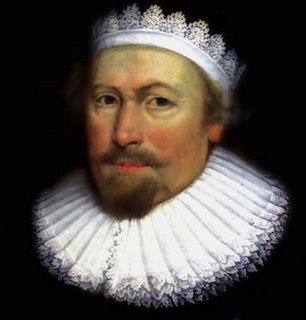
Pic shows Richard _______?

1. Richard Baxter, famous Puritan, prolific author
2. Richard Sibbes, also famous, works 7 vols
3. Richard Bernard, see my blog
4. Richard Alleine, author Heaven opened, etc
5. Richard Greenham, early puritan counsellor
6. Richard Rogers, wrote on Judges
7. Richard Gilpin, wrote
Treatise of Satan's Temptations
8. Richard Mather, New Englander, father of Cotton Mather

9. Richard Steele, author
The religious tradesman, etc
10. (Sir) Richard Baker, wrote on certain Psalms
[Pic drachir sebbis]