The similar phrase 'Worldly Christianity' is one used by Bonhoeffer. It's J Gresham Machen that I want to line up most closely with. See his Christianity and culture here. Having done commentaries on Proverbs (Heavenly Wisdom) and Song of Songs (Heavenly Love), a matching title for Ecclesiastes would be Heavenly Worldliness. For my stance on worldliness, see 3 posts here.
Showing posts with label Luke Jenner. Show all posts

Carey Ministry Conference 2020 Session 5


Our fifth session, our second men only one, was led by Luke Jenner on preaching the Gospels from 
His outline (kindly supplied) had four headings
1. The 'Irreducible Plurality'* of the Gospels (*Stephen Barton)
The view was put forward that the fourfold witness is not merely serendipitous.
Under this first heading he said something like this - 
The author Richard Burridge begins his work on the four biblical gospels by describing a visit to Chartwell, the country home of Sir Winston Churchill. The house contains many portraits and photographs of Great Britain’s war-time Prime Minister.
One picture is a photograph of Churchill, the statesman, sitting looking grim-face and determined with President Roosevelt. He is wearing a dark suit and tie. Serious and fateful work is afoot. The weight of the world is upon his shoulders.
A second picture is a painting of a happy family gathering entitled “Tea-time at Chartwell.” Here Churchill is dressed casually with friends and family around the table. It is his family enjoying tea together and the cares of the world do not impact in anyway.
A third picture shows Churchill riding in a camouflaged car surrounded by uniformed men. Churchill is also in uniform. He is “with the troops”, giving his “V for Victory” salute, the signature cigar is clamped between his lips. The men are smiling, war machines are pictured flying overhead. The picture propagates confidence and is intended to breathe life into weary hearts.
The final picture is a photograph of Churchill at rest. He is surrounded by easel and pots as he paints. He is on holiday in Switzerland in 1946. The election a year earlier has been lost and so he now has time to himself. Churchill appears relaxed and at peace.
Four pictures, all different, each evoking their own response yet each of the same man. Each displays the skill and aspect of the photographer or painter. Each gives us a distinctive icon of the same man.
We should not be surprised that the four gospels provide us with four distinct impressions of the same man, Jesus Christ. Four portraits are never the same, and through their diversity we can see different aspects of the one person. One would never superimpose these four images of Churchill one upon another, for it would create nothing but a blur. The gospel writers never intended us to do that either with their distinctive portraits. Each should be allowed to speak from its own frame.
We were also tested on where we will find the details of the Christmas story in the different Gospels.
2. The implications for 'Harmonistic Homiletics'
Stephen Barton says "That there are four gospels standing side by side in the canon, none of which has been subordinated to another, is an ... is irreducibly plural without being either incoherent or completely elastic."
"If each author has a unique story to tell, and the Holy Spirit inspired different aspects to be included in each, then we should respect the integrity of each story." (Mark Strauss)
3. The Spirit-dependent application of a 'Synoptic Reading'
Here he contrasted synoptic reading with harmonistic. We had helpful references showing how Mark stresses the humanity of Christ and Matthew the fact he is the divine king.
4. The inevitability of some unanswered questions

Midweek Meeting June 6 2018 etc


For quite a while I have been reporting on this blog what goes on at our regular meetings on the Lord's Day and on Wednesday nights. I didn't do this at first but as these loom so large in my weekly life it seemed strange to say nothing about them week after week.  There is an opitimum two or three day turn around time between each one and sometimes I am a little late with my updates.
We are quite late in the week for this one but I think that has turned to my advantage in the end. I say that because on Wednesday we had a visiting speaker. It was Robin Asgher from Cranford. Robin grew up in Pakistan and I first met him when I was a lecturer on the EMF course. He went on to do two years at the Seminary and was my assistant for a year before beginning as a church planter in Cranford, West London. He always speaks about me and that time very warmly.
It was great to have him back then and hear a little about the work in Cranford which now includes opportunities at nearby detention centre with immigrants interested in the Christian faith. The main topic was reaching out to Muslims. We are having a special focus on outreach in the area this month. He has a lot of experience in that area and had helpful things to say.
One reason I am not sorry to have left this report a little is that the next evening we had a visit from Luke Jenner, who had been lecturing on Acts at the Seminary. He is one of many students who, like Robin, were regularly with us during their time at seminary. Generally speaking I think these were positive times for the men involved. We certainly appreciated having them with us. (I am tempted to start listing them but I will leave someone out I'm sure. There are many. Robin, Mark Raines, Ian Middlemist and Andrew Lolley stand out as they also served as assistants). Most of these men are in ministry at present. I get rather discouraged sometimes and one bright spot that makes me confident it has not been as bad as I feel is these former members of the congregation.
The other reason I am glad that I have delayed is that Robin was encouraging us to be friendly to Muslims and to take time to get to know them. Well, today was the first day of door to door and a deacon and I knocked in one of the high rise flats near the church. Most people were out though those who were in were friendly enough. Then we knocked a door and the lady, a Muslim, I recognised from a local shop. She invited us in for a cuppa and we had a good chat while some Hindi gameshow played on a TV in the corner. She was very positive about Islam (though not fasting and unenthusiastic about some of its modern manifestations). One could think of several women in the congregation who might be able to befriend her and I must get hold of a bilingual New Testament for her. An encouraging start then.
We also had our second actual men's meeting. I must report on that elsewhere.


Carey Conference 2018 Day 2 Sessions 2-4

The rest of the day was taken up by talks from Robert Strivens and Luke Jenner and a lively question session with most of the speakers present. Lots of people wanted to talk about conscience as raised by John Benton but plenty of other subjecs were usefully covered under the chairmanship of Bill James
Robert Strivens offered a powerful plea for associations of churches quoting the 1689 Confession and John Owen. It was reminiscent of a paper by David Kingdon many moons ago.
In the final session of the day Luke Jenner, who has recently become a father once again, gave an impassioned plea for a full recognition of union with Christ and, in particular, of our church union with Christ. Stirring stuff.

Another wedding

Another weekend another wedding! This was the last of three in a row this summer (with one more to come) for us. This time we were just at the wedding itself and it was only up the road in Welwyn, where Luke Jenner has been the assistant to Mostyn Roberts since leaving LTS. He was assigned to us when in LTS. He was marrying Miriam, a member at Castlefields, Derby. Mostyn married them and the pastor from Derby, David Fielding, preached. It was a joy to be there and to meet various people we know and don't know from the various places where Luke and Miriam have connections (Welwyn, Derby, Halifax, London, Aber, etc).

Hebrew Noah


Spent a brilliant day at the John Owen Centre today looking at Genesis 6-9 with eight others (mostly recent ex-LTS) under the expert guidance of David Green. Previous days have been well attended but this was something of a test as we had to pay for the privilege this time. I think everyone would have agreed that it was money well spent. Once again it struck me that there are many things in the Hebrew text almosty impossible to detect by any other means. David works incredibly hard to prepare these days. By riding on his tails as we do a great deal of time is saved as although at a push I could possibly do the work myself I guess it would take me most of the week. The next one (on Abraham) is on March 16. Nice to have fellowship with the other men, all of whom I know to some extent. Ben Midgeley had a wonderful story of a recent conversion which I had only heard a slightly garbled account of.

Quiet Blog

It's been a bit quiet here of late but that's because I'm having a very busy week with lots of preparation to do for various things. Sunday went off okay, preaching from Mark 11 and Romans 1 still.
On Monday morning I was involved in a last minute interview at LTS. They started again this week. In the afternoon I chaired the Evangelical Library committee, following our final signing for the new building in Bounds Green. Still lots to do yet. We hope to have our new website up and running shortly. Watch this space.
Tuesday I was in the study working hard until the evening when we were joined by Rhodri, Sibyl and her family for a meal, marking the marriage. I don't think there's a proper name for your son's in-laws. There should be. We had a lovely time together.
Wednesday was all meetings, with visits to two old people's homes where I spoke from Genesis 2 and then the evening meeting in the church, looking at Deuteronomy 31. That was a good time with a decent number present. University is about to start though so we'll be less next week I guess. I also fitted in a lift from the hospital for one of our elderly members and took chance to be with Luke Jenner and his friend, Miriam, who were visiting the newly weds with us. Gwion went to see Chelsea v QPR in the Carling Cup that evening, with a new school friend. 1-0 it was and good fun.
During the day on Thursday, after dropping Owain off I spoke at a ministers fraternal just north of here in Welwyn, where Mostyn Roberts is the pastor. About a dozen ministers (most known to me) and wives gathered for two talks with discussion. I spoke on Christ at God's right hand and the intercession of Christ, which I have been trying to study. It brought home to me how little I understand so far. Picked up a copy of Who made God? by Edgar Andrews. After that we loaded up the car and, after tearful farewells at both homes, I drove Rhodri and Sibyl up to Aber. It was a long but pleasant journey towards a glorious sunset. We stopped at MacDonald's in Shrewsbury en route where Sibyl (vegetarian until 13 ) had here first ever Big Mac! The couple who will study in the University, are staying in the manse until the flat round the corner is available.

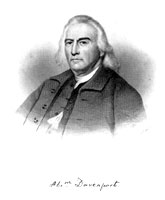
Davenport's Dark Day

Ralph Earle Public Domain via Wikipedia Commons

I was trying to recall an anecdote the other day and spoke to others about it. One of them, my good friend Luke Jenner, said he had just read it in (of all places) Christopher Hitchens' God is not great and very kindly sent me a photocopy of the relevant page (page 61). Hitchens likes Davenport's attitude. You can check it out here. I also found this fuller version with another story about Abraham Davenport the man in question here. The incident was popularised in an 1868 poem by John Greenleaf Whittier. See here.

ABRAHAM DAVENPORT, A long-time Councillor of the colony and later of the State of Connecticut, was a man distinguished by his vigorous understanding, uncommon firmness of mind and Christian integrity of character. A resident of Stamford, he was the grandson of the Rev. John Davenport, one of the founding fathers of the New Haven colony and a man who had played an important role in the "Great Shippe" disaster. Abraham Davenport was the central figure in two stories celebrated in literature and legend and traditionally cited to illustrate the constancy of Connecticut character.
As a matter of fact, one of the Davenport tales, the story of Connecticut's "Dark Day," has become so much a part of the state's lore that the event's bicentennial was remembered by special ceremonies in the House of Representatives of the Connecticut General Assembly on February 27, 1980. Although the memorial occurred somewhat prematurely because the legislature would not have been in session on the actual anniversary date, legislators were reported to have listened in hushed fascination as House Speaker Ernest Abate of Stamford recounted the legend of his illustrious fellow-townsman from an earlier time.
They say that during the first two weeks of May in 1780 the skies over much of New England had been so dark that people had difficulty conducting their daily affairs because of reduced visibility, even during the sunniest days. Many of the good Puritan folk saw in the lowering heavens a sign of God's displeasure. While the actual cause of the unnatural lack of light has been lost to history, both widespread and unchecked forest fires spreading their leaden smoke over the land and a complete eclipse of the sun, especially on the ultimate "Dark Day," have been cited by chroniclers as possible sources of the phenomenon.
Be that as it may, as the Connecticut General Assembly began their deliberations on May 19, 1780, the chambers of the State House in Hartford grew so dark that it seemed as if the sun had been turned off. Reports came from those who had been outside that the streets of Hartford, too, had been reduced to inky blackness. In many homes candles flickered in windows, birds were silent and disappeared, and fowl retired to their roosts. To many members of the legislature, devout Puritans as they were, it appeared that the promised Day of Judgment was at hand.
Probably as much out of general consternation as out of inability to conduct business in the dark, the House of Representatives adjourned. In the Council, however, it was a different story. There, advice on how to proceed under such trying circumstances was sought by the members from their most respected colleague, Abraham Davenport. With scarcely any hesitation, the worthy Stamford lawmaker answered: "I am against adjournment. The day of judgment is either approaching, or it is not. If it is not, there is no cause for an adjournment; if it is, I choose to be found doing my duty. I wish therefore that candles may be brought." That settled it. The candles soon dispelled the dismal gloom, deliberations continued, and a bill amending an act regulating the shad and alewife fisheries passed the Council that very day.
Needless to say, news of Colonel Davenport's decisive words received wide circulation. Not only did their repetition become a source of pride for his fellow citizens in Connecticut, but they also inspired John Greenleaf Whittier, one of New England's best-loved poets, to celebrate them in verse many years later, thus perpetuating the legend well beyond its time of origin. The final lines of Whittier's "Abraham Davenport" (1866) summed up the sentiment attached by the folk to Davenport's speech that black day: And there he stands in memory to this day, Erect, self-poised, a rugged face, half seen Against the background of unnatural dark, A witness to the ages as they pass, That simple duty hath no place for fear.
Revered throughout Connecticut for his courage and foresight during the famous "Dark Day" episode, Abraham Davenport spent his final years as Chief Justice of the Court of Common Pleas. In this capacity Davenport once again affirmed the value of devotion to duty, even under dire circumstances.
As the story goes, the venerable Chief Justice was "struck with death" (i.e. suffered a serious heart attack) while hearing a case in Danbury. Since the trial was only well-started at the time of his illness, the judge refused to be relieved from the bench until the case went to the jury. While in obvious and severe pain, he heard a considerable portion of the trial, gave the charge to the jury and even called the jury's attention to an article in the testimony which had escaped the notice of lawyers on both sides of the case. Once he had discharged his judicial obligations, however, Justice Davenport immediately retired to his chambers, lay down on a couch and died. The people of Connecticut would not soon forget the example of Abraham Davenport.


Grace Assembly 08 Day 3


On our final morning we had two younger men speaking. First, David Last looked at the question of why the Lord’s Supper is important. In a fresh and arresting way he gave us five reasons why we should consider this apparently strange practice as important.
1. Because it is an heirloom – something Christians have always done and that was originally commanded by Christ.
2. Because God and food go together. This striking biblical theological section took us through the Bible pointing out the importance of food in the way God has made us and relates to us.
3. Because it preaches about sin and salvation
4. Because in it we show that the Christians who make up the church are one
5. Because it teaches us humility and other person centredness
It would have been nice to have had a little time for discussion together but it was coffee next and then the closing sermon from Luke Jenner.
Luke took up where his father had left off at the beginning in Philippians 2, helpfully drawing our attention to Timothy and Epaphroditus who, he argued, are chiefly instances of the Christ-like humility Paul commends in the rest of the chapter – the first an example of service , the second of suffering. It was a young man’s sermon in that it was designed to leave us feeling uncomfortable with our commitment to Christ and did just that. We need to hear such sermons.
And so very quickly our time was over. We had lunch together (anothe excellent repast) and then departed. The Olivers very kindly gave Barry King and myself a lift to Derby Station – I hope they found their way home. I was on an earlier train than Barry and only made it just in time. It’s good to be back.

LTS at Banner


While at Banner Philip Eveson was keen to snap the many LTSers there together. This one shows over 30 former students, two present students and Robert Oliver (Bradford) and Mostyn Roberts (Welwyn) who are currently lecturers there. Robert Strivens is the Principal designate. Bernard Lewis (Brodgened) was my exact contemporary and Gary Benfold (Bournemouth) was a year ahead of us. Mark Rowcroft (Darlington), Andrew Rowell (Carlisle), Robin Asgher (later my assistant and now in Cranford) and Luke Jenner (Welwyn) attended here while in LTS. Four of us are Aberystwyth graduates (me, Mark, Luke and Ed Collier, now in Sheffield)