![]() |
| Messers Salter (seated) and Gibson (standing) |
Abraham Conference at John Owen Centre Day 2
Abraham Conference at John Owen Centre
SBM4 Tests of Abraham
Carey 04
Again we started with an apt quote from Luther. Yesterday it was the hammer of the law and today a reminder that we always have more to learn with regard to the matter of justification by faith. Again we had an excellent walk through interacting especially with the new perspective on Paul, acknowledging insights where possible but more often pointing out its misreadings. We also had a few anecdotes such as his wondering at one time why his Christian life was such a struggle and then remembering that we have no reservoir of strength but need to rely always on God and about praying for things with faith and realism. Abraham's perseverance in faith is a great example to us and reminds us that justification is only by faith.
There was time for a few questions on the new perspective and assurance and then it was time for coffee.
Children of Abraham
Often in John's Gospel we find Jesus and the Jews talking at cross purposes and misunderstanding each other. Jesus has spoken to them about being free. They have responded that they have always been free – though what was going on in Egypt on this basis is hard to see. Part of their claim to freedom is tied to their being descendants of Abraham. It is a nationalistic argument. What Jesus is talking about is spiritual freedom – freedom not to sin. He is quite happy to acknowledge that they are Abraham's descendants but they are also children of the devil as sure as he is the Son of God. Of course, they do not follow his argument and reassert that they are Abraham's children. But Jesus counters that if they were truly Abraham's children in the fullest sense then they would not be planning to kill Jesus but would embrace him and his teaching. Paul later takes up this point that the true children of Abraham are those with the same faith not those with a mere biological connection to him. An adopted son who truly loves his father can be much more of a son to him than one who is biologically linked yet opposes all that his father holds dear. What matters is not being a direct descendant of Abraham, Jewish or whatever, but doing the thngs that Abraham did, which sprang from faith in God.
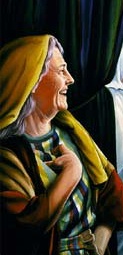
Sarah & Mary compared and contrasted
1. Both Sarah and Mary were women in Scripture unable to have children in the normal way but who did. (Sarah had a double disability. She was barren and had then passed childbearing age. Cf Gen 16:2, 18:12; Rom 4:19, Heb 11:11. Mary's problem was at the other end. She had reached mature enough years to conceive but was a virgin until after Jesus was born).
2. Both Sarah and Mary were reminded of God’s power to do the impossible. (Gn 18:14 Is anything too hard for the LORD? I will return to you at the appointed time next year and Sarah will have a son. Lk 1:37 Nothing is impossible with God.)
3. Both Sarah and Mary received special revelations that they would give birth to a special son. (Mary was visited by Gabriel, Sarah overheard the Lord talking to Abraham, cf Gen 18 and Lk 1)
4. Both conceived their first born sons in a supernatural way.
5. Both Sarah and Mary were women of faith and virtue and examples to people today, especially women. (Compared with Mary, Sarah lacks faith but Mary was not perfect. 1 Pet 3:6 commends Sarah's attitude to her husband. Heb 11:11 may commend her faith. Paul likens here to the Jerusalem above (Gal 4). Lk 1:38 shows Mary was a woman of faith and virtue.)
6. Both Sarah and Mary knew God’s grace and gave birth to sons, to children of promise. (Gen 21:1 Now the LORD was gracious to Sarah as he had said, and the LORD did for Sarah what he had promised. God’s grace to Mary is evident too. Cf Lk 1:50. Gal 4 calls Isaac a child of promise ie one promised before he was born. Believers are children of promise but Christ is particularly one in that he is the long promised OT Messiah.)
7. Both Sarah and Mary had their sons circumcised. (Gen 21:4, Lk 1:21).
8. Both Sarah and Mary travelled down into Egypt at one point. (Gen 12, Lk 2)
9. Both Sarah and Mary's sons were later taken by their fathers, made to carry wood and laid on it to be sacrificed on a mountain. (Cf Gen 22 and the Gospel accounts).
1. Sarah was an old woman, Mary was a young woman. (God uses all sorts).
2. Sarah tried her own means of securing a child, Mary only waited for the Lord to do his will. (Cf Gen 16)
3. Sarah’s husband was told about her son first, Mary was told about her child before her husband. (Why should that be? Perhaps because Mary was to be the mother of Christ in an exclusive way. Joseph had no part in the conception. It is typical of the Bible to subvert the order too.)
4.Sarah overheard what God said about her son, Mary was spoken to directly by an angel. (Gen 18; Lk 1. Mary is singled out for greater honour.)
5. Sarah laughed at the idea of giving birth, Mary believed what she was told. (Gen 18:12; Lk 1:38).
6. Sarah’s presence when pregnant closed wombs, Mary’s presence when pregnant enlivened a womb. (Cf Gen 20/Lk 1:39-45)
7. Sarah rejoiced after the birth of her son, Mary before the birth of her son. (Gen 18:6, 7 Sarah said, God has brought me laughter, and everyone who hears about this will laugh with me. And she added, Who would have said to Abraham that Sarah would nurse children? Yet I have borne him a son in his old age. Lk 1:46-49 My soul glorifies the Lord and my spirit rejoices in God my Saviour, for he has been mindful of the humble state of his servant. From now on all generations will call me blessed, for the Mighty One has done great things for me - holy is his name. Etc.)
8. Sarah went down to Egypt before Isaac was born, Mary went down to Egypt after Jesus was born. (Gen 12, Lk 2).
9. Sarah's son was taken to Moriah to be sacrificed, Mary's was taken from Moriah and actually sacrificed. (Gen 22, etc. Isaac was replaced by a lamb from the thorns; Christ is the Lamb of God crowned with thorns).
10. Sarah died before her husband, Mary probably died after her husband. (Gen 23).