The similar phrase 'Worldly Christianity' is one used by Bonhoeffer. It's J Gresham Machen that I want to line up most closely with. See his Christianity and culture here. Having done commentaries on Proverbs (Heavenly Wisdom) and Song of Songs (Heavenly Love), a matching title for Ecclesiastes would be Heavenly Worldliness. For my stance on worldliness, see 3 posts here.
Showing posts with label Darwin. Show all posts

Westminster Conference 2018 Session 3


Our third and final session of the day featured Phil Arthur on the Great War. Phil Artthur is a trained historian and a great raconteur and he was able to give us a fascinating and nuanced state of the art summary of the Great War of 1914-1918. He warned us against drawing our notions of the war from Balckadder or the war poets studied at GCSE level. He also touched on several other issues such as Israel, the end of African colonialism adn the rise of Christianity there, liberalism and the Downgrade, the doctrine of hell, Darwin, higher critcism, etc.
This all led to the question of whether, as is often asserted, the Great War proved fatal to Christianity in Britain. This was shown to be a myth, the faith of many being strengthened and even ignited during the war as often as it was extinguishhed. The real culprits are Darwinism, higher criticism and the flight from the doctrine of hell. This view was reflected in the discussion although some wanted to suggest that the war did have an adverse affect on the church - in the colossal loss of men for example that the war, together with the Spanish flu epidemic, brought about.

Creation

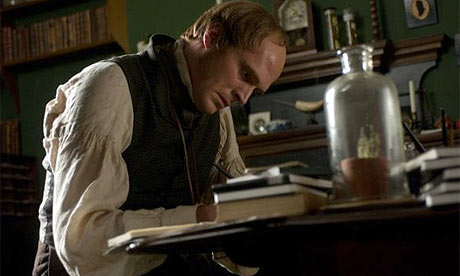
After the lectures yesterday I headed off to central London where I had agreed to watch a preview of a new film about Charles Darwin called Creation. I have agreed to review it for Evangelical Times but to be brief, for all its undoubtedly fine cinematographic traits, this is quite powerful propaganda suggesting Darwin was a flawed hero who nevertheless simply sought the truth regardless of consequences. Religion, on the other hand, is often cruel, likely to be weak and afraid , but if it will trust to science all will be well.
After the film I met up with Eleri and we walked down Oxford Street together. We walked over to All Souls, Langham Place, where we spotted a Pizza Express and had a meal together. That's how we celebrated our 21st wedding anniversary.

Darwin's mind

We have not mentioned Darwin for a while. I was pointed to this interesting passage in his autobiography recently. You can guess what I think was probably going on, although there can be different interpretations. From what I have read Darwin did seem to slowly but surely close down his openness to God.

I have said that in one respect my mind has changed during the last twenty or thirty years. Up to the age of thirty, or beyond it, poetry of many kinds, such as the works of Milton, Gray, Byron, Wordsworth, Coleridge, and Shelley, gave me great pleasure, and even as a schoolboy I took intense delight in Shakespeare, especially in the historical plays. I have also said that formerly pictures gave me considerable, and music very great delight. But now for many years I cannot endure to read a line of poetry: I have tried lately to read Shakespeare, and found it so intolerably dull that it nauseated me. I have also almost lost my taste for pictures or music. Music generally sets me thinking too energetically on what I have been at work on, instead of giving me pleasure. I retain some taste for fine scenery, but it does not cause me the exquisite delight which it formerly did. On the other hand, novels which are works of the imagination, though not of a very high order, have been for years a wonderful relief and pleasure to me, and I often bless all novelists. A surprising number have been read aloud to me, and I like all if moderately good, and if they do not end unhappily - against which a law ought to be passed. A novel, according to my taste, does not come into the first class unless it contains some person whom one can thoroughly love, and if a pretty woman all
the better.
This curious and lamentable loss of the higher aesthetic tastes is all the odder, as books on history, biographies, and travels (independently of any scientific facts which they may contain), and essays on all sorts of subjects interest me as much as ever they did. My mind seems to have become a kind of machine for
grinding general laws out of large collections of facts, but why this should have caused the atrophy of that part of the brain alone, on which the higher tastes depend, I cannot conceive. A man with a mind more highly organised or better constituted than mine, would not, I suppose, have thus suffered; and if I had to live my life again, I would have made a rule to read some poetry and listen to some music at least once every week; for perhaps the parts of my brain now atrophied would thus have been kept active through use. The loss of these tastes is a loss of happiness, and may possibly be injurious to the intellect, and more probably to the moral character, by enfeebling the emotional part of our nature.

Carey 05b

Stephen Lloyd also spoke of new landscapes with regard to
2. Creationism
Things have moved on since Whitcomb and Morris but there are still things to criticise. There are bad creationist books, etc. Often very negative, simply anti-evolutionary. Better to be positive. There are research journals and other efforts have been made simply to do research on a creationist model. New creationism (cf Paul Garner's book by that title) involves new people working in their own special fields. Eg John Baumgarten an expert in plate tectonics; Kurt Wise (who did his PhD with Stephen Jay Gould) a palaeontologist, etc. Such people are working as teams. They seek to be positive. Simply rubbishing evolutionists is not helpful. It is better to give a better model, one true to the Word. (A model is a story to explain something). Creationists have been developing various models. There are not only new models but also new questions. Eg carbon dating a diamond, looking for mica in the grand canyon where it is not supposed to be. It is real science. A model can only be consistent or inconsistent with the Bible, which is not a scientific textbook.
3. The Bible
There is a new landscape here too. We tend to think there is nothing new to say but some of the biblical arguments need developing, in part because we have been asking the wrong questions. There is a sense in which we can forget Genesis, which is pretty straightforward. Romans is perhaps more important. The Gospel Coalition helpfully emphasises Creation - fall - redemption - restoration in a way that sometimes has not been done in the past. We live in a biblically illiterate age and we need to press the story line. This is where we really come into conflict with Darwinism. Three crucial doctrines that are particularly pertinent to the matter of origins are whether
There was agony or death before Adam; Adam was a real human being; Noah's flood was a worldwide deluge
Dr Lloyd (as at the John Owen Conference back in September) concentrated on the first issue only (he has something in print soon). If we try and make the biblical story cohere with the Darwinian one the biblical story becomes incoherent and disjointed. For example, to say cancer is part of the original creation is problematic in many,many ways.

Carey 05a


2009 sees the 200th anniversary of Darwin's birth and the 150th of his Origin of Species and so it was appropriate to have pastor and scientist Dr Stephen Lloyd speaking on Darwin to Dawkins. He began by noting how nervous many evangelicals are about Darwinism. They feel intimidated scientifically and theologically. Also it is feared that the debate with Darwinism is divisive and a non-starter apologetically. Further, there is a fear that it may prove a distraction. Finally, creationism is thought of as dated. Yet, in the secular world they do not think Darwinism as dated. In the move from modernism to post-modernism it has remained intact. Dawkins etc are saying nothing new just asserting what has long been believed.
The media is interested in Darwinism because people are interested. Despite general apathy there is a great interest generally in the subject of origins. So we can't avoid it. Further we should turn it to our advantage. It can unite rather than divide. It is also not a problem evangelistically and can be helpful pastorally too. Now is a good time for debate. What Dr Lloyd did then was to helpfully update us on three areas of the debate where the cultural and scientific landscape has changed – the intelligent design movement, creationism and biblical understanding.
1. Intelligent Design
The movement began in the USA through lawyer Philip Johnson. On a sabbatical in Oxford, still then unconverted, he bought and read Dawkins' Blind Watchmaker and Michal Denton's Evolution - Theory in crisis). He saw that the debate was not a scientific one by definition. He pointed out the circularity of evolutionary arguments. The debate is set up in terms of a religion/science debate but it is not. Evolution is always the assumption. Naturalism rules. Dawkins is determined to take this view regardless of facts. Religion is put in the non-real realm. Evolutionary theory is not so much anti-God as anti-science. Johnson argued that we must be more scientific and follow the facts wherever they lead (Darwin on trial 1991 also note Reason in the balance 1995). At first the ID movement was not so much anti-evolution but a reaction to new science and discovery.
We were shown a clip of Michael Behe (Darwin's Black box) and Scott Minnich speaking of the complexity in humanity (as discovered since the fifties) and how it speaks so clearly of design. Darwinism has no way of explaining such things. The cell is outrageously complex - the opposite of what 19th Century scientists expected.
Mathematician William Dembski wrote The Design Inference in 1998 seeking to set out a rigorous mathematical way of detecting design. His publishers CUP were happy with the idea but became nervous about the application to biology. Dembski speaks of evidence of design very narrowly and certainly does not seek to identify the Designer. (Dembski would not see a snowflake as designed). CUP also published (2004) Debating Design.
Anthony Flue is one who has now moved, because of ID arguments, to a belief in a God. ID has had a high media profile. Christians are unclear what to think. The media often lump it in with creationism but it is only a scientific theory and not necessarily biblical. It is useful for puncturing the naturalism bubble. Unlike creationism some scientists are at least willing to consider ID. It cannot save but it is our friend. ID is like the airforce and creationism the ground forces!
(To be continued)


Summer Reading 03


Another book I got to read this summer was David Quammen's The reluctant Mr Darwin in the Great Discoveries series subtitled "an intimate portrait of Charles Darwin and the making of his theory of evolution". Reluctant is a contentious epithet as although he showed a certain amount of reticence, an eagerness to avoid any sort of confrontation (he avoided funerals like the plague) there was also a driving desire to be first with his idea in print
Quammen is a journalist so his book is easy to read and probably as accurate as any although hardly anything like neutral in its treatment. Skipping over the voyage of the Beagle, largely he presents a man who comes over as a thorough scientist and a hopeless sceptic, his agnosticism and atheism growing over the years. In the anniversary year of the Origin of Species here this 2006 biography is a good one to get hold of and read.

Darwin's unbelief

I have been reading a biography of Darwin recently. If there is any doubt in anyone's mind as to his spiritual standing, his autobiography makes clear that by the time h wrote his famous Origin of species he was full of unbelief. He stands as a warning to all who depart from the truth. I think this passage is particularly striking:

Thus disbelief crept over me at very slow rate, but was at last complete. The rate was so slow that I felt no distress, and have never since doubted even for a single second that my conclusion was correct. I can indeed hardly see how anyone ought to wish Christianity to be true; for if so the plain language of the text seems to show that the men who do not believe, and this would include my Father, Brother and almost all of my friends, will be everlasting punished.
And this is a damnable doctrine
For the whole section see here.

Note to Charles Darwin


I've been reading about Darwin. You can find this interesting document here. It is a note from his wife Emma.
The state of mind that I wish to preserve with respect to you, is to feel that while you are acting conscientiously & sincerely wishing & trying to learn the truth, you cannot be wrong, but there are some reasons that force themselves upon me & prevent my being always able to give myself this comfort. I dare say you have often thought of them before, but I will write down what has been in my head, knowing that my own dearest will indulge me. Your mind & time are full of the most interesting subjects & thoughts of the most absorbing kind, viz following up yr own discoveries — but which make it very difficult for you to avoid casting out as interruptions other sorts of thoughts which have no relation to what you are pursuing or to make it possible for to be able to give your whole attention to both sides of the question.

There is another reason which would have a great effect on a woman, but I don't know whether it wd so much on a man — I mean E (Erasmus Alvey Darwin, Charles's elder brother. Emma refers to Erasmus 'going before' Charles in doubting religion. See Correspondence vol. 1, pp. 171-2) whose understanding you have such a very high opinion of & whom you have so much affection for, having gone before you — is it not likely to have made it easier to you & to have taken off some of that dread & fear which the feeling of doubting first gives & which I do not think an unreasonable or superstitious feeling. It seems to me also that the line of your pursuits may have led you to view chiefly the difficulties on one side, & that you have not had time to consider & study the chain of difficulties on the other, but I believe you do not consider your opinion as formed. May not the habit in scientific pursuits of believing nothing till it is proved, influence your mind too much in other things which cannot be proved in the same way, & which if true are likely to be above our comprehension. I should say also that there is a danger in giving up revelation

which does not exist on the other side, that is the fear of ingratitude in casting off what has been done for your benefit as well as for that of all the world & which ought to make you still more careful, perhaps even fearful lest you should not have taken all the pains you could to judge truly. I do not know whether this is arguing as if one side were true & the other false, which I meant to avoid, but I think not. I do not quite agree with you in what you once said — that luckily there were no doubts as to how one ought to act. I think prayer is an instance to the contrary, in one case it is a positive duty & perhaps not in the other. But I dare say you meant in actions which concern others & then I agree with you almost if not quite. I do not wish for any answer to all this — it is a satisfaction to me to write it & when I talk to you about it I cannot say exactly what I wish to say, & I know you will have patience, with your own dear wife. Don't think that it is not my affair & that it does not much

signify to me. Every thing that concerns you concerns me & I should be most unhappy if I thought we did not belong to each other forever
I am rather afraid my own dear Nigger will think I have forgotten my promise not to bother him, but I am sure he loves me & I cannot tell him how happy he makes me & how dearly I love him & thank him for all his affection which makes the happiness of my life more & more every day.

[In ink, in Charles Darwin's hand:]
—When I am dead, know that many times, I have kissed & cryed over this. C. D.


In the manuscript of the Autobiography (CUL-DAR26.1-121), Darwin added a pencil note about Emma's letter:
Mem: her beautiful letter to me, safely preserved, shortly after our marriage.
Charles and Emma were married on 29 January 1839.

Stapleford, etc


On Monday we were meeting again at the Evangelical Library near Baker Street where we are still inching towards a sale of the property. Further developments look to be in the right direction. Watch this space!
Then I was out all day Tuesday. Bright and early Eleri took me to the London Gateway Services near the bottom of the M1 (did you know that the M1 has no Junction 3?) where I met up with Jeremy Walker (Maidenbower Baptist) to travel to Stapleford, just off the M1 between Derby and Nottingham. In a chapel there I was at my first full committee organising upcoming Westminster Conferences. It was good to be amongst august company. One of the EP directors was able to give me a first glimpse of my book on regeneration, which Jeremy told me he also had a copy of. I'm still yet to have one of my own.
The next Westminster Conference (2008) is all set. I have listed the subjects here
. Speakers are to be Iain Murray (Lessons from the Puritans), John J Murray (Recovering the Reformed vision), Paul Brown (Kevan and law), American Professor Robert Godfrey (Tradition good and bad), Jonathan Watson of Banner (Thomas Brooks) and Faith Cook (Grimshaw).
The conference is becoming a little nomadic. Having begun in Westminster Chapel and been in the Friends House near Euston for a short while, this year's conference (December 9, 10) will be at the American Church in Tottenham Court Road.
As for 2009 (December 8, 9) things are shaping up well. We are hoping to have papers on Calvin (two of these), one on the 1859 Revival, one concerning Darwin and Darwinism, one on the Elizabethan settlement of 1559 and, to round off, one on the Moravians. It is shaping up to be a very good conference. Do come along.
The church kindly made us hot drinks and given us a light lunch. One of the ladies said that they had had a baptism last Sunday of the husband of a church member, a man they had been praying for, for some 32 years! Praise the Lord!
After the committee those who wished were kindly invited to have a meal at the nearby home of a former committee member now retired. We had a lovely time chatting and enjoying hospitality there, sharing news and anecdotes, etc. This man has preached some 700 sermons since he retired 10 years ago, which shows that life is hardly over just because you retire.
We then headed home. I was back by 9 pm but Jeremy took another 2 hours to get through London. It was my suggestion to head through the city I hope that wasn't what made him so late.