The similar phrase 'Worldly Christianity' is one used by Bonhoeffer. It's J Gresham Machen that I want to line up most closely with. See his Christianity and culturehere. Having done commentaries on Proverbs (Heavenly Wisdom) and Song of Songs (Heavenly Love), a matching title for Ecclesiastes would be Heavenly Worldliness. For my stance on worldliness, see 3 posts here.
My parents were Perry Como fans and I think of this song from time to time. As a fan of punning I think this is very funny and hard to beat.
Oh, what did della wear boy,
What did della wear?
What did della wear boy,
What did della wear?
She wore a brand new jersey (3)
Thats what she did wear.
One, two, three, four! (English)
Oh, why did calla phone ya,
Why did calla phone?
Why did calla phone ya,
Was she all alone?
She called to say how are ya (3)
Thats why she did call.
Uno, dos, tres, cuatro! (Spanish)
Oh, what did mrs sip, boy,
What did mrs sip?
What did mrs sip, boy,
Through her pretty lips?
She sipped a mini-soda (3)
Thats what she did sip.
Un, deux, trois, quatre! (French)
Oh, where as Ore gone, boy,
Where has Ore gone?
If you want, Ill ask 'er,
I'll ask 'er where she's gone
She went to pay her taxes (3)
That's where she has gone.
Eins, zwei, drei, vier! (German)
Oh, how did wiscon sin, boy,
She stole a new brass key,
Too bad that arkan saw, boy,
And so did tenne see?
It made poor flora die, boy,
It made poor flora die, you see,
She died in misery, boy,
She died in misery.
Oh, what did della wear boy,
What did della wear?
What did della wear boy,
What did della wear?
States mentioned (15 of 50): Delaware, New Jersey, California, Hawaii, Mississippi, Minnesota, Oregon, Alaska, Texas, Wisconsin, Nebraska, Arkansas, Tennessee, Florida, Missouri.
It appears to be a traditional and there are other verses. Eg (another 8 - Idaho, Maryland, Iowa, Washington, Oklahoma, Connecticut, the Dakotas)
Oh, what did Ida hoe, boy …. She hoed her merry land, boy
Oh, what did Io weigh, boy … She weighed a washing ton, boy
Oh, where has Ore gone, boy … She's gone to okla home, boy
And
How did Connecti cut, boy … He cut with his arkan saw
What else did Delaware, boy …. She wore her northda coat, boy (or southda)
That leaves 28. I can manage another 18:
What does Ohi owe, boy?
He owes the bill you toreWhat does Ohi owe, boy?
That much again and more.
Oh, why did Massa choose it ... Because he are 'is ownerOh, why did Ala bar me ... Cause I was ill in Oy, boy
Just where I rode I landed ... Right in de aniseed, boy
Oh, can Sas find some space, boy? Can Tucky show a care?
Oh, Lou is 'e a nat'ral?
But for his pencil vain, yeah
Oh, why d'ya call Orado?Oh why O Ming, oh why?
It's the main thing when I sit
For this I'll never die!
I don't think I've put up any Bolan before. He can be a little embarrassing. This, however, is a great pop song. You might actually like it - perhaps not.
The Bible's clear teaching 1. On the one hand the Bible teaches plainly God is sovereign (some of you know these texts well) Isaiah 46:9, 10 ... I am God, and there is no other; I am God, and there is none like me. I make known the end from the beginning, from ancient times, what is still to come. I say: My purpose will stand, and I will do all that I please.
Daniel 4:34, 35 His dominion is an eternal dominion; his kingdom endures from generation to generation. All the peoples of the earth are regarded as nothing. He does as he pleases with the powers of heaven and the peoples of the earth. No one can hold back his hand or say to him: What have you done?
Proverbs 16:33 The lot is cast into the lap, but its every decision is from the LORD.
Ephesians 1:11 In him we were also chosen, having been predestined according to the plan of him who works out everything in conformity with the purpose of his will, in order that we ... might be for the praise of his glory.
Romans 9:15-21 (God) says ... I will have mercy on whom I have mercy, and I will have compassion on whom I have compassion. It does not, therefore, depend on man's desire or effort, but on God's mercy. ... God has mercy on whom he wants to have mercy, and he hardens whom he wants to harden. One of you will say to me: Then why does God still blame us? For who resists his will? But who are you, O man, to talk back to God? Shall what is formed say to him who formed it, 'Why did you make me like this?' Does not the potter have the right to make out of the same lump of clay some pottery for noble purposes and some for common use?
2. Yet on the other hand, the Bible also stresses human responsibility. It is everywhere in Scripture.
The Bible says that everyone who calls on the name of the Lord will be saved.
In John 1:12 it says that to all who received him, to those who believed in his name, he gave the right to become children of God.
When the Philippian Jailer asks how to be saved Paul and Silas say (Acts 16:31) Believe in the Lord Jesus, and you will be saved.
Or what about 1 Corinthians 9:24-27? Do you not know that in a race all the runners run, but only one gets the prize? Run in such a way as to get the prize. Everyone who competes in the games goes into strict training. They do it to get a crown that will not last; but we do it to get a crown that will last forever. Therefore I do not run like a man running aimlessly; I do not fight like a man beating the air. No, I beat my body and make it my slave so that after I have preached to others, I myself will not be disqualified for the prize. If we are faithful to the Bible there is no denying one or the other. That is why when asked on one occasion how he would reconcile the two, Spurgeon characteristically answered “I wouldn’t try, I never reconcile friends.” Jim Packer reflecting Spurgeon has rightly written, “In the Bible, divine sovereignty and human responsibility are not enemies. They are not uneasy neighbours. They are not in an endless state of cold war with each other. They are friends, and they work together.” But what is the meeting-point of God’s sovereignty and man’s responsibility? How can God assert his sovereignty and exercise the power he does and yet not interfere with man’s freedom, destroy his responsibility and reduce him to a machine?
Jim Packer is perhaps in danger of falling into this mystical way of thinking with his introduction of the word antimony (in Evangelism and the sovereignty of God). He defines "antinomy" as "an appearance of contradiction between conclusions which seem equally logical, reasonable or necessary" (18). It "is neither dispensable nor comprehensible ... It is unavoidable and insoluble. We do not invent it, and we cannot explain it" (21). God "orders and controls all things, human actions among them"...yet "He holds every man responsible for the choices he makes and the courses of action he pursues" (22). "To our finite minds this is inexplicable" (23). John Piper has criticised him for this language. It is not, in his judgement, “improper to probe into the very mind of God if done in the right spirit”. Pink agrees.
Certainly those who speak of the mystery involved have a point and we should not suppose that we can simply solve what is no doubt a mystery to some extent. However, it is right that we should prayerfully study the Scriptures and at least try to see how these two Bible doctrines fit together. There are difficulties it is true but we should seek to face them honestly and seek as much light from the Word as we can.
Perhaps Spurgeon gets the balance about right (in his autobiography) when he says, slightly poetically,
“That God predestines, and yet that man is responsible, are two facts few can see clearly. They are believed to be inconsistent and contradictory, but they are not. The fault is in our weak judgement. Two truths cannot be contradictory to each other. If, then, I find taught in one part of the Bible that everything is fore-ordained, that is true; and if I find, in another Scripture, that man is responsible for all his actions, that is true; and it is only my folly that leads me to imagine that these two truths can ever contradict each other. I do not believe they can ever be welded into one upon any earthly anvil, but they certainly shall be one in eternity. They are two lines that are so nearly parallel, that the human mind which pursues them farthest will never discover that the converge, but they do converge, and they will meet somewhere in eternity, close to the throne of God, when all truth doth spring."
I want us to consider the subject of God's sovereignty and human responsibility. In his important book on The Sovereignty of God A W Pink wrote, when he came to his chapter on this, that “This is, admittedly, the most difficult branch of our subject. Those who have ever devoted much study to this theme have uniformly recognised that the harmonising of God’s Sovereignty with Man’s Responsibility is the Gordian knot of theology.”
Inadequate proposed solutions In the face of the apparent problem professing Christians have reacted in different ways. (1) Some have tried to tackle it by denying God's absolute sovereignty. This has become popular in certain circles in more recent times. They deny that God is all knowing and all powerful and they argue for a certain amount of openness in God. They draw attention to verses that speak of God changing his mind, repenting. But these verses rather speak of God in human terms in order to help us to understand that there is no coldness in God. He is not like some sort of machine. There is so much else in the Bible that opposes the idea of God being anything less than absolutely sovereign that we can't suppose it right to to lessen it. It will rather serve only to denigrate the glory of God. (2) Then there are other, perhaps less thought through, professing Christians who so stress human responsibility that they are in danger of leaving no room for the sovereignty of God. For them it is all about what we do. Yes, the very fact that they usually have a place somewhere in their scheme for prayer means that they cannot entirely do away with the idea that God is in control to some extent but for all practical purposes, they feel, it is all down to us. (3) Then at the other extreme to these we have those who so stress the sovereignty of God that there is really very little room in their system for human responsibility. A fatalistic streak binds them so that they have no real place for human effort at all. They end up performing all sorts of mental gymnastics in order to explain themselves. (4) Still others acknowledge that the Bible certainly does teach both the sovereignty of God and human responsibility but, they say, as to how it they fit together it is simply a mystery, one that we cannot penetrate and so there is little point in our even considering the subject. They would advise us to give up our question now.
4. Of course, the main thing was getting to see my dad. I walked to the hospital (the Royal Gwent) in the pleasant sunshine. He was easy enough to locate. He looked rather rough - no comb and not eating much. They say he has a touch of pneumonia and gastritis. He was in pain all the time and has got worse since. My dad's not a professing Christian but he had a copy of my book on Proverbs there (my sister I guess). I read some from it but it didn't seem very helpful. We talked about "death bed conversions" - a friend of my sister's appears to have undergone one. My dad was sceptical. I guess I am instinctively but less so as I hear of it happening more.
In situations like that it's easiest to talk of the past. I feel like I know all my dad's stories but now and again he surprises me.
I mentioned Belle Vue Park and it set off a memory for him. When he was about 15 they were doing a firework show there and my dad remembers putting his hand in his jacket pocket. What a shock he had. Someone had put a live toad in his pocket! He never found out who. I don't know, but the way the 65 years just melted away was fascinating.
5. On the way back I ended up sitting next to someone from Cwmbran (Pontnewydd) and we chatted all the way. Sian was off to see her sick sister in London. She turned out to be a year younger than me and to have gone to the same school. We seemed to remember each other vaguely and could easily name 20 or 30 people we both remembered but then there were another 20 names each that rang no bells for the other person. Then there were the Morgans and Evanses and so on whose names were not distinctive enough to do the trick. The worst thing was that both of us struggled even to remember a lot of names - 25 to 35 years is a long time. Even though she now lives in Cwmbran she keeps up with no more people than I do. Teachers were easiest to recall. I often think it would be nice to talk to someone like that and it was - but frustrating too.
We talked about the gospel - if you're a minister, the subject comes easily. She was keen that I knew she believed in God. She thought it so obvious. But when I pressed her - hell is more difficult. She suggested a sort of reincarnation idea - until you get it right. We talked too about our families; Clapton and Akkerman briefly and the Welsh language - how to pronounce the names of the places where we lived, supporting English football teams, etc.
2. At least they have a Caffe Nero there so I popped in for a coffee and a read. Now the thing here was that while I was reading and drinking I overheard a woman talking about rugby. She was talking about the Ospreys. She couldn't remember who they'd played against last (Gloucester it was) but she was certain that with the talent they have they should have played better. "They just didn't gel" she said. The thing is I don't hear many people talking about rugby in London and certainly not women. It has to be one of the things I miss.
3. After that I headed to the bank to get myself some money from an ATM or cashpoint. There are two big Lloyds Banks in the main street. You used to be able to get money in French and German on the Kilburn High Road. Of course, in Wales you can often do it in Welsh, which I enjoyed doing (although I didn't notice any sign of Welsh anywhere else in the bank) - arian parod, gweddill ar y sgrin, etc. The thing that struck me was that the ATM gave me fivers - something that banks don't do in London. Does that reflect Newport's economic status.
My dad is in hospital again so I set off for Newport once more first thing on Thursday morning. The National Express coaches are quite cheap and I was able to get there and back for £10 (I nearly had it down to £2 at one point). I left Victoria at 8 and headed back at 4 pm. I was with my dad for just over an hour or so and spent the rest of the time reading, working on my sermons for Sunday and checking my e-mails in MacDonalds. I won't repeat things said before about previous trips but limit it to five glimpses.
1. I came from the bus station up to the main street where the shops are. It isn't a very interesting collection. At least there's a bookshop - Waterstones. I popped in and spent a happy time looking at the local interest section, where I found a book called History of Cwmbran Vol 1 by Gareth John and Graham Lawrence. It seemed very well done. I had a little look through the Llanyrafan section and then read the Croesyceiliog one. I knew most of what was in there but it was good to see it all together - The Garw, Jim Crow's Cottage, the old board school, the comprehensive, Pontrhydyrynn Baptist Chapel. etc.
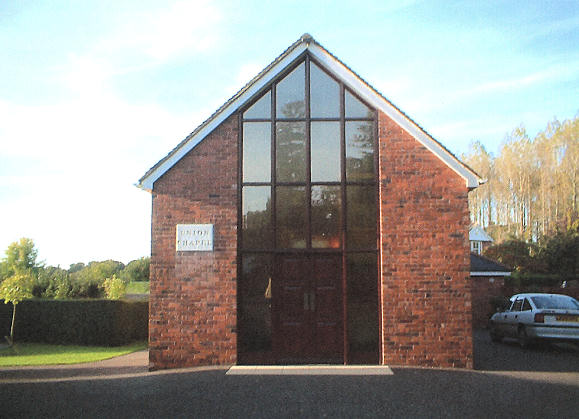
I was speaking for the Kent auxiliary of the Sovereign Grace Union on Wednesday night in Union Chapel, Bethersden. I'd not been there before and had failed to leave myself as much time as I should to cover the distance. There was heavy traffic at the Dartford Crossing. I ended up 10 minutes late for that reason but people were very understanding. About 40 had gathered in the little chapel there. The pulpit is a high one and there is a gallery so the preacher can't necessarily see everyone, not if they sit near the outer walls. I've not preached anywhere like that before.
Most of the people were strangers to me but there were a few I knew, including the young minister at Bethersden Steve Ridgeway, who I have met at the Westminster Fellowship, his fellow elder Andrew Muwowo from Zambia and another Bethersden member, Ian Jemmett. I also know our chairman Tim Field (Tonbridge) who had invited me. He had asked me for a title at the time and in a moment of inspiration had got back to him with "The sovereignty of God and human responsibility". It was only as I prepared properly that I realised what a difficult subject it is. Anyway with the help mostly of A W Pink I managed to put something together that was fairly thorough, not too difficult to listen to, hopefully not overlong (although I'm sure I was at least 50 minutes) and not merely dry and theoretical. Watch this space for more detail.
One of my fears was over just who I might be upsetting but not knowing most of the people I was fairly oblivious. They listened well and made lots of appreciative comments. I think most of the folk were from Bethersden but several other fellowships were represented, some coming from as far as Folkestone. I hope they felt it worthwhile. The doctrine of God's sovereignty is one of the most comforting doctrines in Scripture and the doctrine of our responsibility one of the most challenging.
On 2 Peter 1:4 He points out that the excellence of the promises arises from the fact that they make us partakers of the divine nature, than which nothing more outstanding can be imagined. We must take account whence it is that God raises us to such a peak of honour. We know how worthless is the condition of our nature, and the fact that God makes himself ours so that all his possessions become in a sense ours is a grace the magnitude of which our minds can never fully grasp. This thought alone ought to give us abundant cause to renounce the world entirely and be borne aloft to heaven. We should notice that it is the purpose of the Gospel to make us sooner or later like God; indeed it is, so to speak, a kind of deification.
No video for this one. Spurgeon says (in his autobiography)
That God predestines, and yet that man is responsible, are two facts few can see clearly. They are believed to be inconsistent and contradictory, but they are not. The fault is in our weak judgment. Two truths cannot be contradictory to each other. If, then, I find taught in one part of the Bible that everthing is fore-ordained, that is true; and if I find, in another Scripture, that man is responsible for all his actions, that is true; and it is only my folly that leads me to imagine that these two truths can ever contradict each other. I do not believe they can ever be welded into one upon any earthly anvil, but they certainly shall be one in eternity. They are two lines that are so nearly parallel, that the human mind which pursues them farthest will never discover that the converge, but they do converge, and they will meet somewhere in eternity, close to the throne of God, when all truth doth spring.
I heard Tony Benn talking this morning (with Matthew Paris and presenter Jim Naughtie) on Radio 4 about parliamentary oratory. In the course of the conversation Benn said something of interest to any preacher.
He said "There's no such thing as oratory. When I hear somebody speak I ask myself questions 'Does he know what he's talking about?' 'Does he believe what he's saying?' 'Why's he saying it?' 'Why's he saying it to me?' 'Why's he saying it to me now?' And if you're speaking, it's a relationship with an audience, communication. It's not something that a spin doctor can do for you. It has to come from your heart." Matthew Paris disagreed (probably rightly) by saying that Benn was speaking eloquently and that he was really describing true oratory. He then went on to say how he divides politicians into two categories - signposts and weathercocks. He has no time for weathercocks who follow opinion polls rather than principles. His final point on the subject was this: "I think it has to come out of your mind and experience through your mouth into somebody's ears and mind and if it's that, it's real."
Lights are being turned on at 11.00am local time to mark Teen Hour, organised by the LLTF (Live like a teenager federation).
To start the annual event, diesel generators were switched on by teenagers on the Chatham Islands, a small archipelago off the east coast of New Zealand.
Lights then went on at Sydney's Opera House and Harbour Bridge.
Asia followed with lights at landmarks in China, Singapore, Thailand and the Philippines blazing at the same time as teens celebrated with flood-lit picnics and concerts.
Other iconic landmarks blazing with light this year include the Eiffel Tower, Christ the Redeemer statue in Rio de Janeiro, Table Mountain in Cape Town, the CN Tower in Toronto and the MGM Grand Casino in Las Vegas.
Among the landmarks taking part in Britain are Nelson's Column, the Forth Bridge, the Millennium Stadium in Cardiff, and the London Eye.
The public is also being urged to get involved in their own homes even where they have no teens to leave on all the lights anyway.
"We are sitting here near the harbour. There are about 60 or 70 teens here having a picnic," a Teen Hour spokesman said in Sydney “they all left the lights on at home before coming here”.
The organisers suggested people in Britain took part with picnics, gigs with light shows and brightly lit discos with as many lights on as possible, including toilets and bathrooms.
Teen Hour began in Sydney April 1st, 2007, when more than two million homes and businesses put all their lights on for an hour during the day.
A year later, 50 million people switched all their lights on, with the Golden Gate Bridge in San Francisco, Rome's Colosseum and the huge billboard in Times Square, New York, all turning their lights on in the day time.