The similar phrase 'Worldly Christianity' is one used by Bonhoeffer. It's J Gresham Machen that I want to line up most closely with. See his Christianity and culture here. Having done commentaries on Proverbs (Heavenly Wisdom) and Song of Songs (Heavenly Love), a matching title for Ecclesiastes would be Heavenly Worldliness. For my stance on worldliness, see 3 posts here.
Showing posts with label Evolution. Show all posts

10 Things about climate change


Just before lockdown I read a little booklet on climate change. At least ten things come out of it. Here they are.
  1. The climate is changing
  2. The climate has changed in the past
  3. There is no universal agreement on what is causing climate change
  4. There is no universal agreement on what to do about climate change
  5. There is a difference between observable science and historical science. Your view of historical science will affect how you interpret observable science
  6. Calculating an average global temperature is very difficult
  7. No global temperature figures are available from before 1880
  8. In the 1970s the media was concerned about global cooling rather than global warming!
  9. Some 31,000 scientists agree that there is no convincing scientific evidence greenhouse gases are causing or will cause catastrophic heating of earth's atmosphere or disruption of earth's climate
  10. It cannot be proved that the and the rise in temperature are related

Three Books


These three books have nothing in common beyond the fact that I have read them recently.

1. The band played on by Steve Turner has sat on my shelf for some time. It is a beautiful hardback full of pictures that came out a few years ago on an anniversary of the Titanic disaster. (It must have been as far back as 2011, the centenary). Anyway it focuses on the band and is full of human interest. It is published by Thomas Nelson and is written by a Christian but does not stress that. Great read. I like Steve Turner's stuff.
2. A pocket guide to Climate Change. This little guide from Answers in Genesis written by various authors does not toe the accepted line, as you might expect but takes a creationist and moderate approach, accepting that the climate is changing but urging no panic. It's a complex subject but the writers are all scientists and it was good to get some scientific light on the subject. It is interesting to know that 31,487 American scientists,including 9,029 with PhDs, have signed a petition opposing the Kyoto agreement. It would seem that people don't decide on this issue simply by looking at the science.
3. The boy, the mole, the fox and the horse by Charlie Mackesy. This hardback is a work of art with writing rather than a book in the usual sense. It came into our house as a present from one son to another recently. There was great disappointment on the part of my dyslexic son that he had been given a book but once he sat down he had it read in no time. (It only took me 15 or 20 minutes I would guess - it is there to be savoured). One has mixed feelings about it. On its own terms it is lovely and kind but maybe God (the creator of all boys, moles, foxes and horses) is conspicuous by his absence and there is a certain starkness, even loneliness that stalks the book, despite its positivity. A little research reveals, however, that Charles Mackesy is an atheist turned evangelical so perhaps this is just overhang from his past rather than anything else or perhaps I am just far too harsh on people, always expecting too much.

Great quote - Thomas Carlyle on Charles Darwin


Subsequent to my trip to Carlyle's house I came across this. Fascinating.

Thomas Carlyle made the the following biting remarks to a friend who visited him a short time before his death:
"The so-called literary and scientific classes in England now proudly give themselves to protoplasm, origin of species and the like, to prove that God did not build the universe. I have known three generations of the Darwins - grandfather, father, and son, atheists all. The brother of the present famous naturalist, a quiet man, who lives not far from here, told me that among his grand-father's effects he found a seal engraven with this legend: Omnia ex conchis  (everything from a cockle shell)! I saw the naturalist not many months ago; told him that I had read his Origin of Species and other books; that he had by no means satisfied me that men were descended from monkeys, but had gone far towards persuading me that he and his so-called scientific brethren had brought the present generation of Englishmen very near to monkeys. A good sort of man is this Darwin, and well-meaning, but with very little intellect. Ah! It is a sad and terrible thing to see nigh a whole generation of men and women professing to be cultivated, looking around in a purblind fashion, and finding no God in this universe! I suppose it is a reaction from the reign of cant and hollow pretence, professing to believe what in fact they do not believe. And this is what we have got. All things from frog-spawn; the gospel of dirt the order of the day. The older I grow - and now I stand upon the brink of eternity - the more comes back to me the sentence in the Catechism which I learned when a child, and the fuller and deeper its meaning becomes: ' What is the great end of man? To glorify God and enjoy Him for ever.' No gospel of dirt, teaching that men have descended from frogs through monkeys can ever set that aside."

Stephen Lloyd Adam and death

It was good to be at the Westminster Fellowship again yesterday. There was a good turn out to hear Stephen Lloyd on creation issues. The bones of what he had to say can be found here. This article has now been produced as a booklet called Adam or death: which came first? Stephen Lloyd is always worth hearing. He is constantly thinking over these issues with a theological and scientific apporach that is both accessible and thought provoking. For more on such matters see here.

The Darwin Effect by Jerry Bergman

Another book I have read not so long ago, this time on kindle is, The Darwin Effect by Jerry Bergman. There are a lot of positive things to say about this book. It is enlightening, well researched and a stark reminder of the insidious effects of Darwin and evolutionary theory. Sadly, the book could do with a good editor who would cut out the clutter and repetition.
A wide field is covered including the eugenics movement, racism, H G Wells, the Tasmanian genocide, the Ku Klux Klan, the exploitation of non-westerners, the case of Ota Benga (the pygmy in the zoo), the exploitation of deformed humans, sexism, ruthless capitalism, the Communist holocaust, the Totalitarian holocaust, etc.
In each case modern evolutionists would no doubt condemn what went on in the past but Bergman's thesis is that evolutionary theory has served to promote and perpetuate bad ideas and the reason is that evolutionary theory itself is a problem.
Well worth a read.

10 Unpopular things that I believe in

It is easy to feel isolated and unpopular to some extent. I suppose some of us should expect this considering what we believe. Here are ten unpopular things that I basically line up with. Not many of you will agree with me on all ten, I guess.
 
1 The inerrancy of Scripture
2 Six day creation
3 The independency of the local church
4 The baptism only of believers
5 An educated ministry
6 The sanctitiy of the first day of the week
7 The priesthood of all believers
8 Male headship in the home and the church
9 The preferability of a republican state government
10 The disestablishment of the Church of England

The quest for the historical Adam

This big tome from William Vandoodewaard, a church history professor at Puritan Seminary, is a very thorough text book borne of much study that meticulously charts the history of the exegesis of the opening chapters of Genesis from the early church to the present day, seeking in particular to plot the existence of a continuous acceptance of the traditional view.
It demonstrates well Vos's contention that heresy only comes in when people deliberately raise the so-called results of science to a place above Scripture. Meanwhile a multiplicity of interpretations have grown up, especially in the last 150 years that have clearly been suspect if not actually heretical in Vosian terms. Vandoodeward cites and demonstrates encouraging evidence that there is a return to a more traditional approach but there is no shortage of candidates (Alexander and Sailhamer for example) keen to find a new way through.
It is interesting that where an institution such as Southern Baptist Seminary has faced a fight with liberalism it has tended to move into a more conservative position on creation as well as everything else. This can be seen on a smaller scale at Westminster Seminary following the Enns saga. Certainly the idea that creationism is the preserve of fundamentalists is quietly debunked in this book. Whitcomb and Morris get perhaps surprisingly little coverage and are even criticised to some extent. Oh yes, and great title! (Someone very kindly passed this volume on to me so I'm not sure if it is expensive).

Sounds like design to me

An item on the BBC news this morning said that scientists have recently found that eyelashes on animals all appear to conform to the same ratio (a third of the width of the eye). They didn't suggest it was due to their being designed that way but it makes you wonder, eh? (If you have an open mind that is). More here.

Politicians

These are not easy times in our democracy for those who love the truth. The big topic at the moment is schools and extremism. Many things being said leave one uneasy.
For example, former Home Secretary and education secretary David Blunkett sought to end an interview on the subject on Radio 4 on Monday with a reassuring note by saying "... After all we had to take on the issue of creationism and people who wanted to set up trusts and sponsor chains whose aim was to teach a particular completely bizarre form of Christianity ..."
Meanwhile, last Saturday The Times told us that "the Conservatives will go into the next election pledging to eradicate illiteracy within a generation, ... A commitment in the party’s manifesto would ensure that all children leave school with strong reading and maths skills." It trails a speech by education secretary Michael Gove in which they say he would frame his plan as a moral crusade to “save lives which are currently wasted”. Salvation by education then. I thought that had been tried.

Evangelical Seepage

I think of myself as rather cynical but now and again I catch myself out being naïve. I am always surprised by departures from evangelical truths by evangelical men, even though they come at regular intervals. I was just reading the review article in the June Banner of Truth magazine by Bill Schweizer of Bruce Waltke's collection of articles The Dance between God and Humanity. Schweizer is particularly concerned with Waltke's concessions on the matter of evolution and women ministers but is also anxious about the whole drift in Waltke's approach which does not bode well.
Even more disturbing to read is a review article in the current Themelios (here) by Bob Yarbrough of a work edited by Wheaton scholars Christopher Hays and Christopher Ansberry (Evangelical Faith and the Challenge of Historical Criticism) that is even more radical in its concessions to liberal scholarship. It is depressing to know of such slippage. Yet it is the sort of thing that has happened down the years and the very thing we are warned about again and again in Scripture.

The Dawkins Proof

I got home this week to find that a copy a of a new book had been left with us. It is by my friend and former deacon Rick Barns. The cover itself will tell you what it is about. A large format paperback, it is 130 pages long. The 230 endnote references betray its painstaking approach.
In the foreword Rick writes
"I tried to be a consistent atheist and I believed the conclusions that atheism led to. But I found that what consistent atheism led to was something utterly unworkable. It was, paradoxically, my desire to be a thorough atheist that drove me towards God."
In the book he seeks to show that Dawkins himself inadvertently provides evidence for the existence of God. Even Dawkins lives as though there were a God.
There are nine chapters culminating with the Dawkins Proof of the title.
The book is available either a free download or in a good quality paperback format at about £4. More details can be found here.

Westminster 09 2b

It was my privilege to chair in the afternoon the session on Darwin. Ken Brownell spoke on the attitudes of C and A A Hodge and Warfield (no time for Machen) to evolution. It was a fascinating, informative and challenging paper. The discussion was rather wide ranging and ran over slightly but was very stimulating. Here are Ken's five concluding principles.
1. Like old Princeton we must be committed to a high doctrine of Scripture and as infallible and inerrant word of God. The Bible is in the end our touchstone but while we must have the same high view of Scripture we will have differing legitimate interpretations. In relation to science we may have to revise our interpretations as the church has done before, but only cautiously and after long reflection. As Charles Hodge said there will be a struggle in this, but we can trust the Holy Spirit to guide us. But here we need to do better than the Princetonians. In this area they were strangely weak in their exegesis of the relevant Biblical passages in spite of having such a high view of Scripture.
2. Like old Princeton we must be robustly and enthusiastically Calvinistic in theology, not only in understanding how God saves, but also in how he works in the world. The Princetonians’ doctrine of providence and the absolute sovereignty of God helped them in their assessment of the idea of evolution. Likewise a Calvinistic view of reality will help us face many of the challenges of science today.
3. Like old Princeton we should have a deep respect for the scientific enterprise.
I sometimes get the impression that some Christians are deeply suspicious of science. That is not something Hodge and company could understand. Perhaps they had a too high an estimation of the objectivity of scientists, but some Christians may have too low an estimation. While sin affects the scientific enterprise as much as everything else, God’s common grace is operative. There needs to be respect for scientists, support for Christians working in science and respectful dialogue particularly in this area of evolution.
4. Like old Princeton we must engage in this dialogue with courtesy and respect for those with whom we disagree. Nothing brings more discredit on evangelical Christianity than the intemperate way in which we sometimes deal with our opponents. The Princeton theologians always dealt with those they opposed with courtesy and respect; they were gentlemen controversialists and we should be as well. Among other things that means being fair in the way we assess the views of those we oppose. A good example of this in another area of controversy is the way John Piper evaluated N T Wright’s views in his book on justification.
5. Like old Princeton we must remember that the big battle is not on the details of how God created things, but with naturalistic materialism that has no place for God. This was the big issue for old Princeton and it must be for us. Whatever our specific views on many aspects of the evolution debate all Christian theists need to stand together to contend for the Christian worldview. He closed with a quote from Kuyper on evolution
Evolution is a newly conceived system, a newly established theory, a newly formed dogma, a newly emerged faith. Embracing and dominating all of life, it is diametrically opposed to the Christian faith and can erect its temple only on the ruins of our Christian confession… And therefore against that system of the aimlessly and mechanistically constructed cosmos we set our full-fledged resistance. We must not only defend ourselves against it but attack it… Over against Nietzsche’s Evolution-law that the strong must tread the weaker we cling to the Christ of God who seeks the lost and has mercy on the weak. Over against the undirected mechanism of evolution we present faith in that Eternal Being who “has worked and continues to work all things after the counsel of His will” [Eph. 1:11]. Over against the selection that selects the species and neglects the individual, we cling to Election… Over against the annihilation of the individual person in the grave we continue to testify to the coming judgment and of an eternal glory. And over against the altruism that is nothing more than a “transformed” and therefore disguised egoism we raise up the fire of eternal love that burns in God’s Father-heart, a holy spark of which has leaped to our own… And so I conclude by returning to what was, is now, and ever will be the starting point of the Confession for the entire Christian church on earth, by maintaining over against Evolution the first of all articles of faith: I BELIEVE IN GOD ALMIGHTY, CREATOR OF HEAVEN AND EARTH.

Darwin's monstrous fable

I recently came across this from Darwin's autobiography here.

One little event during this year has fixed itself very firmly in my mind, and I hope that it has done so from my conscience having been afterwards sorely troubled by it; it is curious as showing that apparently I was interested at this early age in the variability of plants! I told another little boy (I believe it was Leighton, who afterwards became a well-known lichenologist and botanist), that I could produce variously coloured polyanthuses and primroses by watering them with certain coloured fluids, which was of course a monstrous fable, and had never been tried by me. I may here also confess that as a little boy I was much given to inventing deliberate falsehoods, and this was always done for the sake of causing excitement. For instance, I once gathered much valuable fruit from my father's trees and hid it in the shrubbery, and then ran in breathless haste to spread the news that I had discovered a hoard of stolen fruit.

Darwin's son Francis writes a note just before thi saying
Rev. W.A. Leighton, who was a schoolfellow of my father's at Mr. Case's school, remembers his bringing a flower to school and saying that his mother had taught him how by looking at the inside of the blossom the name of the plant could be discovered. Mr. Leighton goes on, "This greatly roused my attention and curiosity, and I enquired of him repeatedly how this could be done?" - but his lesson was naturally enough not transmissible.

The more one learns about Darwin the less attractive a character he becomes.

Flagle's Law etc

cogdogblog, CC BY 2.0 <https://creativecommons.org/licenses/by/2.0>, via Wikimedia Commons


I have been noticing recently how incredibly tangled headphone wires become when you put them in a pocket. It strikes me as a clear warning against believing what evolution teaches. It's probably related to what someone recently described to me as the perversity of inanimate objects, also known as Flagle's law.

Flagle's Law of the Perversity of Inanimate Objects
Any inanimate object may be expected at any time to behave in a manner that is entirely unexpected and totally unpredictable for reasons which are completely unknown or thoroughly obscure.

More laws here.

Review of Creation


I haven't seen my copy of October's Evangelical Times yet but I believe a review by me similar to this one appears there

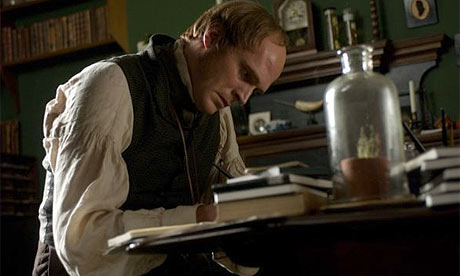
Creation is the title of a new feature film currently showing in British cinemas, a film that undoubtedly will catch the attention of many thoughtful people. The “creation” of the title is not God's creation as such but the creation of a book written 150 years ago this year that continues to have a tremendous effect around the world to this day. The book, The origin of species was written by Charles Darwin and the film, based on the book Annie's Box by Randal Keynes, traces the story of its writing.
While using flashbacks to build up the biographical picture, the film focuses chiefly on the final year or so of writing the book and sending the manuscript off. Darwin is pictured as an attractive even heroic, though flawed, individual. Various factors combine to first delay then spur him on to publication. Though encouraged to publish by friends like Hooker and Huxley, the blessing of a wife, finally reconciled to the idea is much more hard won. A letter from Alfred Wallace outlining the same theory, what seems to be a psychosomatic illness and the fear that he is unleashing something that would destroy society and even God himself are also strong factors in Darwin's decision. Interwoven with this is his relationship with a favourite daughter whose death profoundly affects him.
A film about a man writing a book is a potentially dull subject but those involved in this production are seasoned professionals, such as Jon Amiel. The combination of skilful writing full of drama, fine acting, especially from lead actors, husband and wife team Paul Bettanny and Jennifer Connelly, beautiful sets, excellent filming, good music and very high production standards make this a powerful film indeed.
One may want to quibble with certain anachronisms, doubtful dramatic devices and even straight errors in the film but a production of this sort is intended to create an impression rather than to get every detail just right. No, the film needs to be criticised chiefly for its thesis regarding the theory of evolution. It appears to be saying that, yes, there are extremists in the scientific world and among evolutionists. Thomas Huxley, for example, is presented in a very unattractive way. But then there are extremists among those who follow religion, too. Rev Innes, the vicar of Downe, is caricatured as a man who eventually will not even speak to Darwin and who at one point makes Annie kneel in rock salt, scarring her knees, as a penance for believing that dinosaurs existed!
But most of us, so the thesis goes, are somewhere in the middle. On one hand, there are people like Darwin himself and his close friend Joseph D Hooker, who are eminently reasonable. They have no desire to cause trouble. They simply want to know the truth. Sometimes they are fearful of public reaction and can suffer greatly for their commitment to truth but they often show a quiet courage that does not lead to murder in the streets but to a great deal of enlightenment.
Then on the other hand, there are people like most readers of this newspaper, no doubt, - religious people, gentle and pious people, who respect the minister and read Pilgrims Progress to our children, as Darwin's wife does in the film. Yes, we may feel quite estranged from the scientists and their strange ideas at times but if we will only consider then we will see that they are right. Like Mrs Darwin, who reads the manuscript of Origin of Species right through when it is finished then gives her husband her blessing, we too ought to see the truth of evolution and stop carping about it being evil and untrue.
Well, that is how, it seems to me, the film wants us to see it. It is important to remember, however, that life as portrayed on the screen, is often inaccurate and untrue. The fact is that though Charles Darwin, by God's common grace, no doubt had many attractive features, his theory of evolution was wrong. Not only is it wrong but it has an evil anti-God core and many of the terrible things that Darwin no doubt dreaded have come to pass, partly fuelled by acceptance of evolutionary theories.
What the late Henry Morris referred to, in a book about the history of evolutionary theories, as The long war against God is continuing and this film is simply the latest widespread piece of propaganda in that war. We need to point out to the uninitiated what is going on and resist the false caricatures that people this piece.

Creation

After the lectures yesterday I headed off to central London where I had agreed to watch a preview of a new film about Charles Darwin called Creation. I have agreed to review it for Evangelical Times but to be brief, for all its undoubtedly fine cinematographic traits, this is quite powerful propaganda suggesting Darwin was a flawed hero who nevertheless simply sought the truth regardless of consequences. Religion, on the other hand, is often cruel, likely to be weak and afraid , but if it will trust to science all will be well.
After the film I met up with Eleri and we walked down Oxford Street together. We walked over to All Souls, Langham Place, where we spotted a Pizza Express and had a meal together. That's how we celebrated our 21st wedding anniversary.

Weird thing

[Keith, no Ken Turner]
I haven't mentioned that while we were in High Leigh there was another conference taking place. This was the Genesis Kinds conference organised by Bryan College's Centre for Origins Research and others. We were invited to attend any of their sessions when we were free (not something I was able to do).
Anyway shortly after they arrived I looked across the room and had that strange experience when you unexpectedly see someone you know and can't quite place them. The extra weird thing here was that as I began to think I was seeing my wife's cousin's husband Keith Turner I slowly realised it was in fact his twin brother Kenneth.
Kenneth Turner is Associate Professor of Bible at Bryan College, Tennessee, where he primarily teaches Hebrew, Old Testament and theology courses (those boys have a thing for language - should hear Keith's Welsh!). Kenneth's main interest is Old Testament Theology. We've only met twice before but it was good just to shake hands and chat a bit.

John Owen Centre Conference Day 01


It was good to be one of around 150 present at the John Owen Centre, Finchley, to hear this year's Dr Lloyd-Jones memorial lecture by Philip Eveson on Gospel and Creation - the significance of a theology of creation for preaching. A very full paper, it considered what a theology of creation should include (making some 12 points including the fact that there can only be one universe, that creation is the work of the triune God, who is also a relational God and insisting on the distinction between Creator and creation, creation and providence); the message of the gospel; the centrality of Christ and the significance of all this for preaching. Relying heavily on the work of Herman Bavinck, both creation and the gospel were expounded and asserted in the face of Muslim, Hindu, atheist and other deviant views to the contrary. It closed with an alliterative admonition to adore our Maker, appreciate his creation, understand the ache or groan that we presently know, anticipate the new creation and being active in making the message known.

The lecture came at the end of a busy first day of lectures and discussion under the title of Creation, the Bible and Science. About a hundred, mostly men and most of them ministers, had listened to three papers. The first was by Dr John Currid from RTS, Charlotte, Virginia, on Interpreting Genesis 1 & 2. This focused almost exclusively on Genesis 1 and was perhaps rather narrow as it simply sought to show that Genesis 1 is not poetry. Other interesting matters were raised in the paper and in discussion, however, and it was good to hear and discuss this paper.

Dr Robert Letham from WEST spoke next. Billed as Genesis 1 & 2 - the History of Interpretation this was inevitably boiled down to a history up until the Westminster Assembly and so did not interact at all with post-Darwin reactions. Indeed we may get through the whole conference saying very little about Darwin or Darwinism. Dr Letham's agenda was to suggest that there has never been much of a consensus on anything beyond the fact that the Bible teaches an ex nihilo creation by the triune God. He made a great deal of the popularity of Augustine's idea of instantaneous creation for hundreds of years.

The third paper of the day was Genesis 1 & 2 - a Scientist’s Perspective. Because Professor Stuart Burgess was the chosen speaker this was really an engineer's perspective. This was the most conservative, the warmest, the easiest and perhaps the most interesting paper of the day. He spoke of God's power, skill and goodness in creation and then spoke briefly in favour of "a young Adam" and a "young earth" and against the possibility of extra-terrestrial forms of life.

The day was a very stimulating one with lots of good questions and good answers and many expressions a genuine desire not to demonise fellow believers, seriously grappling with the biblical text and the scientific data but coming to differing conclusions to our own but within the biblical requirements. As ever, it was good to talk over the meals about these issues and others.

Hopefully tomorrow will be an equally stimulating day.

Creation Evolution Link

While Darwin and Creation etc are fresh in our minds you might like to check this interesting link here on my friend Mike's blog.