The similar phrase 'Worldly Christianity' is one used by Bonhoeffer. It's J Gresham Machen that I want to line up most closely with. See his Christianity and culture here. Having done commentaries on Proverbs (Heavenly Wisdom) and Song of Songs (Heavenly Love), a matching title for Ecclesiastes would be Heavenly Worldliness. For my stance on worldliness, see 3 posts here.
Showing posts with label Hymn writing. Show all posts

Bulkington Church History Lecture Anne Steele

It was good to be in Bulkington Congregational church up in the Midlands last night once again. It is remarkable how they are able to gather a score or two people from various churches in the area with an interest in church history. The pastor Peter Mckenzie chaired and I spoke on Anne Steele and got over the story quite well, I hope. It was good to chat with people over a cuppa afterwards as well. It was a pleasant drive up in the sunshine too.

Broughton in Hampshire


Had a nice afternoon down in Broughton last week.

Ten Hymns by Philip P Bliss

Bliss was the author of many tunes still used today (With harps and with viols, It is well, etc) and some of his words are still sung too such as these
 
1. Almost persuaded now to believe
2. Dare to be a Daniel, dare to stand alone
3. Free from the Law, O happy condition
4. Man of sorrows (Hallelujah! What a Saviour)
5. I am so glad that Jesus loves me
6. More holiness give me, more strivings within 
7. I will sing of my Redeemer
8. Seeking to save, seeking to save
9. Whosoever will, whosoever will 
10. Wonderful words of life (Sing them over again to me)

CYSK 05 Frances Ridley Havergal

http://www.hymntime.com/tch/htm/a/l/l/h/allhappy.htm
Frances Ridley Havergal (1836 – 1879) was a Worcestershire born poet and hymn writer born in an Anglican rectory. Take My Life and Let it Be is one of her best known hymns. She also wrote hymn melodies, religious tracts and works for children. More here.

On this day Dudley Tyne

It was on this day in 1858 that episcopal minister Dudley Tyne, burdened for the salvation of husbands and fathers, spoke to a rally of 5,000 men in Philadelphia and said "I would rather this right arm were amputated at the trunk than that I should come short of my duty to you in delivering God's message". Over 1,000 men were reportedly converted. Two weeks later, Tyne lost his right arm in a farming accident, and he died soon after. His last words, "Stand up for Jesus, father, and tell my brethren of the ministry to stand up for Jesus," inspired George Duffield's hymn "Stand Up, Stand Up for Jesus".

Easter Hymns

We sang nine of the 20 Easter hymns in the new Christian Hymns yesterday. Some (especially the modern ones we don't know). It struck me again how far superior Charles Weslety is to them all. it's hard to beat words such as

Christ, the Lord, is risen today, Hallelujah!
Sons of men and angels say, Hallelujah!
Raise your joys and triumphs high, Hallelujah!
Sing, ye heavens, and earth, reply, Hallelujah!

Love’s redeeming work is done, Hallelujah!
Fought the fight, the battle won, Hallelujah!
Lo! the Sun’s eclipse is over, Hallelujah!
Lo! He sets in blood no more, Hallelujah!

Vain the stone, the watch, the seal, Hallelujah!
Christ hath burst the gates of hell, Hallelujah!
Death in vain forbids His rise, Hallelujah!
Christ hath opened paradise, Hallelujah!

Lives again our glorious King, Hallelujah!
Where, O death, is now thy sting? Hallelujah!
Once He died our souls to save, Hallelujah!
Where thy victory, O grave? Hallelujah!

Soar we now where Christ hath led, Hallelujah!
Following our exalted Head, Hallelujah!
Made like Him, like Him we rise, Hallelujah!
Ours the cross, the grave, the skies, Hallelujah!

Hail, the Lord of earth and Heaven, Hallelujah!
Praise to Thee by both be given, Hallelujah!
Thee we greet triumphant now, Hallelujah!
Hail, the resurrection, thou, Hallelujah!

King of glory, Soul of bliss, Hallelujah!
Everlasting life is this, Hallelujah!
Thee to know, Thy power to prove, Hallelujah!
Thus to sing and thus to love, Hallelujah!

Hymns of praise then let us sing, Hallelujah!
Unto Christ, our heavenly King, Hallelujah!
Who endured the cross and grave, Hallelujah!
Sinners to redeem and save. Hallelujah!

But the pains that He endured, Hallelujah!
Our salvation have procured, Hallelujah!
Now above the sky He’s King, Hallelujah!
Where the angels ever sing. Hallelujah!

Jesus Christ is risen today, Hallelujah!
Our triumphant holy day, Hallelujah!
Who did once upon the cross, Hallelujah!
Suffer to redeem our loss. Hallelujah!

This is Wesley's most famous resurrection hymn. There are at least 15 others.

Bunhill Fields 02

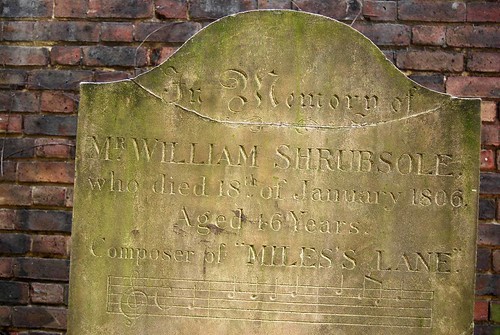
One grave I'd never noticed before in Bunhill is that of William Shrubsole (1760-1806). Not to be confused with the hymn writer fo the same name this one was a chor­ister at Can­ter­bu­ry Ca­thed­ral for se­ven years. He be­came or­ganist at Bango­r Ca­thed­ral around 1780, but his sym­pa­thies for the “dis­sent­ers” were not well re­ceived there, as ev­i­denced by these re­cords:
October 1783. Mr. Will­iam Shrub­sole, the or­gan­ist of the Church, hav­ing giv­en great of­fence to the Dean and Chap­ter, by his close con­nex­ion with one Ab­bot, late of this place, as by his fre­quent­ing con­vent­i­cles, that Mr. Dean be im­pow­ered to dis­charge the said Will­iam Shrub­sole from his place of or­gan­ist, if the said Ab­bot (who is sup­posed to have gone to re­side in Dub­lin), shall at any time here­af­ter re­turn in or­der to abide in the town of Bang­or, or the neigh­bour­hood there­of, or if the said Will­iam Shrub­sole shall be found to frequent any con­vent­i­cle or re­li­gious as­sem­bly, where any­thing is taught which is con­tra­ry to the Doc­trine or Dis­ci­pline of the Church of Eng­land.
December 1783. That Will­iam Shrub­sole be em­ployed to play on the or­gan of our Ca­thed­ral Church till Lady-day next and no long­er; that in case it should not be con­ven­ient for him to con­tin­ue in that em­ploy­ment till La­dy-day next, he shall be at lib­er­ty to leave it be­fore that time, and shall be paid the full al­low­ance to Lady-day next not­with­stand­ing. (Lightwood, pp. 167, 168)
After de­part­ing Bang­or, Shrub­sole be­came or­gan­ist at Spa­fields Cha­pel, Lon­don, in 1784, and re­mained there unt­il his death. As the gravestone notes he was the composer of Miles' Lane (which I associate with "All hail the power").

Bunhill Fields 01

Grave Joseph Hart
(Edwardx, CC BY-SA 3.0 <https://creativecommons.org/
licenses/by-sa/3.0> via Wikimedia Commons)


I made a trip to Bunhill Fields with my son and daughter in law yesterday. It was a beautiful day and we got to see and remember (or learn about) several worthies. This granite obelisk was raised in 1875. On it you may read these words

East side:

Erected by lovers of Hart's hymns, published in 1759, and still highly prized by the Church of God. The author's remains were interred on this spot, as the original stone yet remains to show.
JOSEPH HART, minister of the Gospel, died May 24th,1768, aged 56.

South side:
JOSEPH HART was by the free and sovereign Grace and Spirit of God raised from the depths of sin, and delivered from the bonds of mere profession and self-righteousness and led to rest entirely for salvation in the finished atonement and perfect obedience of Christ.

"Mercy is welcome news indeed
To those who guilty stand;
Wretches who feel what help they need
Will bless the helping hand."


North side:
"Though I am a stranger to others and a wonder to myself, yet I know Him (Christ), or rather am known of Him. Where sin abounded Grace did much more abound."

"O! bring no price!
God's grace is free
To Paul, to Magdalene and me."

"None but Jesus
Can do helpless sinners good."

Why Johnny can't sing hymns


Why Johnny can't preach rather passed me by but now T David Gordon has another book out on the problem of modern singing in church. Called Why Johnny can't sing hymns, it is subtitled "How Pop Culture Re-Wrote the Hymnal".

The book is quite personalised and chiefly descriptive but there is a clear agenda - to decry the modern trend for using exclusively contemporary praise. (I was staggered, by the way, that at the Extra Time meeting we sang Before the throne of God to the modern tune - a song that has been done to death even for me with my sheltered existence. There was also a Townend/Getty and one by the Cooks).

I would be broadly in agreement with Dr Gordon's outlook although because the book is written from a sociological point of view and has little by way of exegesis few would want to line up with every statement he makes. The book's strength is in the alarm call it gives to those immersed in the contemporary praise movement, to consider again just what they are doing. If Dr Gordon is right that the modern idiom is ill equipped to convey serious and soul-searching messages then the sooner we back away from this the better. I particularly liked the way he argued not against pop music as such but against its use (or certainly its over-use) in worship. As he suggests, I think that the folk idiom is the one best suited to Christian worship with some limited room for classical and pop.
Do get hold of a copy if you can and read it. It is an easy read and a good contribution to the current debate (or lack of it as is too often the case).

John Langford


I recently came across a name unknown to me before - that of an 18th century minister called John Langford. He was apparently connected with the early Methodists but afterwards joined the Baptist Church in Eagle Street, London, under the pastorate of Dr Andrew Gifford. From 1766 he was pastor of several London churches, especially Blackfields in Southwark. He died about 1790. He preached a sermon on the death of Whitefield (1770) that was printed. It was called The exalted state of the faithful ministers of Christ, after death, described and considered. He also published a hymn collection (1776), which included his own hymns (A collection of hymns and spiritual songs). He was long remembered as a man of great spirituality and Christian meekness.

Christmas Books 2007


Among other gifts, I received a few books this Christmas - all secular and all spot on for me. I suppose people think I've enough Christian books. My sons gave me QI: The book of general ignorance by Lloyd and Mitchinson (more here) and Grumpy old Christmas by Stuart Prebble, which I've started - in the midst of the humour there are some serious points made.

My wife got me Philip Ardagh's Book of absolutely useless lists (more here) and a small AA pocket guide book to Tenerife (as we're off there next month), which it turns out is written by our neighbour Andrew Sanger (see here and here).

From my parents-in-law there was a nice hardcover I Never Knew That About Wales by Christopher Winn and a Sudoku puzzle book.

While in Aber I also treated myself to Cleopatra's face fatal beauty by Michelle Lovric and two Welsh books in Oxfam. One was Llais y doctor Welsh language pieces by Lloyd-Jones, which I'll probably never be able to read and the other was the second volume of the works of Pantycelyn, which at least contains all his English hymns as well as his Welsh ones. (More here and here).

10 short lived hymnists

https://www.findagrave.com/memorial/108144867/william_ralph-featherston


Ten hymn writers who died young

1. Michael Bruce 21 (1746-1767) Where high the heavenly Temple stands, etc
2. Henry Kirke White 21 (1785-1806) Oft in danger, oft in woe
3. Edith Gilling Cherry 25 (1872-1897) We rest on Thee, etc
4. Mary Lundie Duncan 26 (1814-1840) Jesus, tender shepherd, hear me
5. William Ralph Featherston 28 (1842-1870) My Jesus I love Thee
6. Joseph Anstice 28 (1808-1836) O Lord! How happy should we be, etc
7. Joachim Neander 30 (1650-1680) Praise to the Lord, the Almighty, etc
8. Joseph Swain 35 (1761-1796) Come ye souls, by sin afflicted, etc [See pic]
9. Samuel Miller Waring 35 (1792-1827) [Anna Laetitita's uncle]
Now to him who loved us, gave us
10. Augustus Toplady 38 (1740-1778) Rockof ages, etc, etc
For details, see the cyberhymnal (except for the last writer)

Anne Steele

The Strict Baptist Historical Society Annual Lecture will take place on March 16 7 pm at Bethesda Baptist Church Kensington near Notting Hill Tube. The speaker is Sharon James who will speak on the hymn writer Anne Steele (1717-1778). Mrs James has an excellent book on this hymn writer and three other women called "In trouble and in joy". See here for the book, here for the SBHS.
Fellow hymn writer Benjamin Beddome took a shine to Miss Steele at one point Mrs James tells us. See here for details.
PS Anyone in the Westerleigh area, Robert Oliver, I note is speaking on Beddome this Saturday. Payment required. See here.