The similar phrase 'Worldly Christianity' is one used by Bonhoeffer. It's J Gresham Machen that I want to line up most closely with. See his Christianity and culture here. Having done commentaries on Proverbs (Heavenly Wisdom) and Song of Songs (Heavenly Love), a matching title for Ecclesiastes would be Heavenly Worldliness. For my stance on worldliness, see 3 posts here.
Showing posts with label resurrection. Show all posts

10 Things achieved by the resurrection

Ian Scott, CC BY-SA 2.0 <https://creativecommons.org/licenses/by-sa/2.0>, via Wikimedia Commons


1. Confirms all Jesus said and all the prophecies.
2. Confirms Jesus is who he claimed to be.
3. Vindicates his suffering and death.
4. Shows death and the devil are conquered.
5. Manifests God's justice.
6. Frees people from their sins.
7. Displays the power of God.
8. Demonstrates that Christianity is true and unique.
9. Gives believers a living hope.
10. Guarantees the resurrection of God's people in the world to come.

Thomas Browne Religio Medici XLVIII

National Portrait Gallery, Public domain,
via Wikimedia Common
Came across this recently


How shall the dead arise, is no question of my Faith; to believe only possibilities, is not Faith, but meer Philosophy. Many things are true in Divinity, which are neither inducible by reason, nor confirmable by sense; and many things in Philosophy confirmable by sense, yet not inducible by reason. Thus it is impossible by any solid or demonstrative reasons to perswade a man to believe the conversion (turning) of the Needle to the North; though this be possible, and true, and easily credible, upon a single experiment unto the sense. I believe that our estranged and divided ashes shall unite again; that our separated dust, after so many Pilgrimages and transformations into the parts of Minerals, Plants, Animals, Elements, shall at the Voice of GOD return into their primitive shapes, and joyn again to make up their primary and predestinate forms. As at the Creation there was a separation of that confused mass into its species; so at the destruction thereof there shall be a separation into its distinct individuals. As at the Creation of the World, all the distinct species that we behold lay involved in one mass, till the fruitful Voice of GOD separated this united multitude into its several species; so at the last day, when those corrupted reliques shall be scattered in the Wilderness of forms, and seem to have forgot their proper habits, GOD by a powerful Voice shall command them back into their proper shapes, and call them out by their single individuals. Then shall appear the fertility of Adam, and the magick of that sperm that hath dilated into so many millions. I have often beheld as a miracle, that artificial resurrection and revivification of Mercury, how being mortified into a thousand shapes, it assumes again its own, and returns into its numerical (individual) self. Let us speak naturally and like Philosophers, the forms of alterable bodies in these sensible corruptions perish not; nor, as we imagine, wholly quit their mansions, but retire and contract themselves into their secret and unaccessible parts, where they may best protect themselves from the action of their Antagonist. A plant or vegetable consumed to ashes to a contemplative and school-Philosopher seems utterly destroyed, and the form to have taken his leave for ever; but to a sensible Artist the forms are not perished, but withdrawn into their incombustible part, where they lie secure from the action of that devouring element. This is made good by experience, which can from the Ashes of a Plant revive the plant, and from its cinders recall it into its stalk and leaves again. What the Art of man can do in these inferiour pieces, what blasphemy is it to affirm the finger of GOD cannot do in these more perfect and sensible structures! This is that mystical Philosophy, from whence no true Scholar becomes an Atheist, but from the visible effects of nature grows up a real Divine, and beholds not in a dream, as Ezekiel, but in an ocular and visible object, the types of his resurrection.

Banner 2013 06

And so very quickly it seems we have come to the last day of the conference. First up today was Jeremy Walker who took us to 1 Corinthians 15 to speak on the resurrection and the security and hope of the church. He spoke about the vital importance of the fact of the resurection. If it is not so then preaching is pointless and so is faith. Because it is so, our resurrection is guaranteed. This is not only a promise but the setting of a pattern. He sought to encourage us to preach Christ.

Candlish on the resurrection

You see to what your notion about there being no resurrection leads you. It forces you to deny the resurrection of Christ. And if you deny that, you are landed, for yourselves and for those who have gone before you, in the cheerless and hopeless gloom of absolute despair.
Robert S Candlish on 1 Cor 15:20-23

Lord's Day March 31 2013

It was great to have so many people in church yesterday. We were swollen chiefly by former members coming back to see relatives but there were others too and yet still some away as well. I never mentioned the word Easter once but all the hymns and readings and sermons were related to the subject of the resurrection. I preached on John 2:19-21 in the morning where Jesus speaks of them destroying the temple nad he raising it again in three days and in the evening on the Sadducees' question about the resurrection in Mark 12. It was good to be looking at central themes but from less obvious texts.
(I also had one, now removed, for last Lord's Day - "It was unseasonably cold yesterday (I'm dreaming of a white Easter!) and that probably affected attendance. There were a few visitors, however, from Holland and Romania and less far afield. We carried on with 1 Corinthians and preaching the gospel, reaching 2:5 at last, in the morning and in Numbers (28) in the evening. My main points in the evening were about being thankful that we don't need to know the details of that chapter well today and how it teaches us about Christ's sacrifice and our own since that time".)

10 Texts in John re Pre- and Post-resurrection

Don Carson says on John 2:12
John is often accused of anachronism, of reading back into the time of Jesus events and beliefs that developed only later. This is singularly unlikely. No evangelist is more persistent than John (at least sixteen times) in carefully distinguishing what the disciples understood back then (during Jesus’ ministry) and what they understood only later.

Here are 10 such texts:

1. Joh 2:22 After he was raised from the dead, his disciples recalled what he had said. Then they believed the scripture and the words that Jesus had spoken.
2. Joh 12:16 At first his disciples did not understand all this. Only after Jesus was glorified did they realize that these things had been written about him and that these things had been done to him.
3. Joh 13:7, 19  Jesus replied, "You do not realize now what I am doing, but later you will understand." ...  "I am telling you now before it happens, so that when it does happen you will believe that I am who I am.
5. Joh 13:24, 25 Simon Peter motioned to this disciple and said, "Ask him which one he means." Leaning back against Jesus, he asked him, "Lord, who is it?"
5. Joh 13:36 Simon Peter asked him, "Lord, where are you going?" Jesus replied, "Where I am going, you cannot follow now, but you will follow later."
6. Joh 14:5 Thomas said to him, "Lord, we don't know where you are going, so how can we know the way?"
7. Joh 14:29 I have told you now before it happens, so that when it does happen you will believe.
8. Joh 16:4 I have told you this, so that when their time comes you will remember that I warned you about them. I did not tell you this from the beginning because I was with you
9. Joh 16:17, 18 At this, some of his disciples said to one another, "What does he mean by saying, 'In a little while you will see me no more, and then after a little while you will see me,' and 'Because I am going to the Father'?" They kept asking, "What does he mean by 'a little while'? We don't understand what he is saying."
10. Joh 20:9 (They still did not understand from Scripture that Jesus had to rise from the dead.)

Wesley on Easter

This is another Wesley hymn for Easter

All ye that seek the Lord who died,
Your God for sinners crucified,
Before the earliest dawn, now come
To worship at His sacred tomb.

Bring the sweet spices of your sighs,
Your contrite hearts, and streaming eyes,
Your sad complaints, and humble fears;
Come, and embalm Him with your tears.

While thus ye love your souls to employ,
Your sorrow shall be turn'd to joy:
Now, now let all your grief be o'er!
Believe; and ye shall weep no more.

An earthquake hath the cavern shook,
And burst the door, and rent the rock;
The Lord hath sent His angel down,
And he hath roll'd away the stone.

Easter Hymns

We sang nine of the 20 Easter hymns in the new Christian Hymns yesterday. Some (especially the modern ones we don't know). It struck me again how far superior Charles Weslety is to them all. it's hard to beat words such as

Christ, the Lord, is risen today, Hallelujah!
Sons of men and angels say, Hallelujah!
Raise your joys and triumphs high, Hallelujah!
Sing, ye heavens, and earth, reply, Hallelujah!

Love’s redeeming work is done, Hallelujah!
Fought the fight, the battle won, Hallelujah!
Lo! the Sun’s eclipse is over, Hallelujah!
Lo! He sets in blood no more, Hallelujah!

Vain the stone, the watch, the seal, Hallelujah!
Christ hath burst the gates of hell, Hallelujah!
Death in vain forbids His rise, Hallelujah!
Christ hath opened paradise, Hallelujah!

Lives again our glorious King, Hallelujah!
Where, O death, is now thy sting? Hallelujah!
Once He died our souls to save, Hallelujah!
Where thy victory, O grave? Hallelujah!

Soar we now where Christ hath led, Hallelujah!
Following our exalted Head, Hallelujah!
Made like Him, like Him we rise, Hallelujah!
Ours the cross, the grave, the skies, Hallelujah!

Hail, the Lord of earth and Heaven, Hallelujah!
Praise to Thee by both be given, Hallelujah!
Thee we greet triumphant now, Hallelujah!
Hail, the resurrection, thou, Hallelujah!

King of glory, Soul of bliss, Hallelujah!
Everlasting life is this, Hallelujah!
Thee to know, Thy power to prove, Hallelujah!
Thus to sing and thus to love, Hallelujah!

Hymns of praise then let us sing, Hallelujah!
Unto Christ, our heavenly King, Hallelujah!
Who endured the cross and grave, Hallelujah!
Sinners to redeem and save. Hallelujah!

But the pains that He endured, Hallelujah!
Our salvation have procured, Hallelujah!
Now above the sky He’s King, Hallelujah!
Where the angels ever sing. Hallelujah!

Jesus Christ is risen today, Hallelujah!
Our triumphant holy day, Hallelujah!
Who did once upon the cross, Hallelujah!
Suffer to redeem our loss. Hallelujah!

This is Wesley's most famous resurrection hymn. There are at least 15 others.

Scandalous


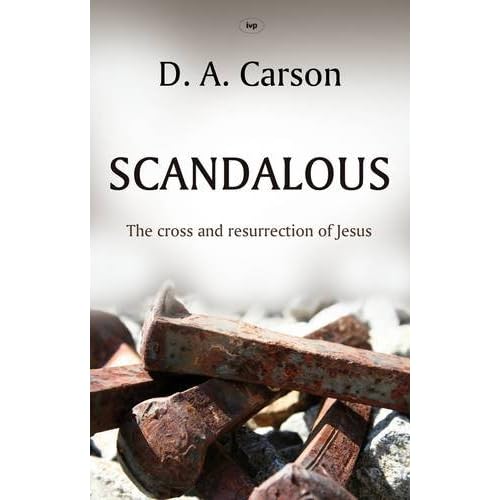
Don Carson's various books are always appreciated. His latest, the seasonal Scandalous The cross and resurrection of Jesus is no exception. Dedicated to his wife, its 170 pages contain a five sermons on New Testament texts, originally delivered at the end of 2008 at the Resurgence Conference in Seattle. They look at Matthew 27:27-51a, Romans 3:21-26, Revelation 12, John 11 and John 20:24-31. Typically they contain careful exposition, interesting background, mature reflection and always application. Inevitably the sermons vary in quality but they tackle big and important themes, such as propitiation, Christ's resurrection and biblical eschatology in an orthodox but fresh way and are all useful. Not all will share Dr Carson's penchant for poetry but a nose for a good illustration and helpfully told background material is appreciated. Unexpected nuggets include his exposition of John 11 (p 131ff) rejecting the common English translation and a slightly tangential exploration of six kinds of doubt (143-148). Clear headings and two indices add to the book's value.

The resurrection

One does not cheer everything Tom Wright says but this is good in today's Times

Private Eye ran a cartoon some years ago of St Peter standing in front of Jesus's Cross and saying to the other Disciples: “It's time to put this behind us now and move on.” It was a satire not on Christian belief, but on politicians and counsellors, and their trivialising mantras. It depended on Jesus's death being not just an odd, forgettable event - and that it was His Resurrection, rather than a shoulder- shrugging desire to “move on”, that got the early Christians going.

Easter was the pilot project. What God did for Jesus that explosive morning is what He intends to do for the whole creation. We who live in the interval between Jesus's Resurrection and the final rescue and transformation of the whole world are called to be new-creation people here and now. That is the hidden meaning of the greatest festival Christians have.

This true meaning has remained hidden because the Church has trivialised it and the world has rubbished it. The Church has turned Jesus's Resurrection into a “happy ending” after the dark and messy story of Good Friday, often scaling it down so that “resurrection” becomes a fancy way of saying “He went to Heaven”. Easter then means: “There really is life after death”. The world shrugs its shoulders. We may or may not believe in life after death, but we reach that conclusion independently of Jesus, of odd stories about risen bodies and empty tombs.

But “resurrection” to 1st-century Jews wasn't about “going to Heaven”: it was about the physically dead being physically alive again. Some Jews (not all) believed that God would do this for all people in the end. Nobody, including Jesus's followers, was expecting one person to be bodily raised from the dead in the middle of history. The stories of the Resurrection are certainly not “wish-fulfilments” or the result of what dodgy social science calls “cognitive dissonance”. First-century Jews who followed would-be messiahs knew that if your leader got killed by the authorities, it meant you had backed the wrong man. You then had a choice: give up the revolution or get yourself a new leader. Going around saying that he'd been raised from the dead wasn't an option.

Unless he had been. Jesus of Nazareth was certainly dead by the Friday evening; Roman soldiers were professional killers and wouldn't have allowed a not-quite-dead rebel leader to stay that way for long. When the first Christians told the story of what happened next, they were not saying: “I think he's still with us in a spiritual sense” or “I think he's gone to heaven”. All these have been suggested by people who have lost their historical and theological nerve.

The historian must explain why Christianity got going in the first place, why it hailed Jesus as Messiah despite His execution (He hadn't defeated the pagans, or rebuilt the Temple, or brought justice and peace to the world, all of which a Messiah should have done), and why the early Christian movement took the shape that it did. The only explanation that will fit the evidence is the one the early Christians insisted upon - He really had been raised from the dead. His body was not just reanimated. It was transformed, so that it was no longer subject to sickness and death.

Let's be clear: the stories are not about someone coming back into the present mode of life. They are about someone going on into a new sort of existence, still emphatically bodily, if anything, more so. When St Paul speaks of a “spiritual” resurrection body, he doesn't mean “non-material”, like a ghost. “Spiritual” is the sort of Greek word that tells you,not what something is made of, but what is animating it. The risen Jesus had a physical body animated by God's life-giving Spirit. Yes, says St Paul, that same Spirit is at work in us, and will have the same effect - and in the whole world.

More here

Then Aslan stopped

My last post was on death. In the car yesterday I had the radio on very quietly when I recognised there was some C S Lewis on so I turned it up. (It turned out to be Brian Sibley's Shadowlands on Radio 2). It includes this extract from The Silver Chair.
Then they saw that they were once more on the Mountain of Aslan, high up above and beyond the end of that world in which Narnia lies. But the strange thing was that the funeral music for King Caspian still went on, though no one could tell where it came from. They were walking beside the stream and the Lion went before them: and he became so beautiful, and the music so despairing, that Jill did not know which of them it was that filled her eyes with tears.
Then Aslan stopped, and the children looked into the stream. And there, on the golden gravel of the bed of the stream, lay King Caspian, dead, with the water flowing over him like liquid glass. His long white beard swayed in it like water-weed. And all three stood and wept. Even the Lion wept: great Lion-tears, each tear more precious than the Earth would be if it was a single solid diamond. And Jill noticed that Eustace looked neither like a child crying, nor like a boy crying and wanting to hide it, but like a grownup crying. At least, that is the nearest she could get to it; but really, as she said, people don't seem to have any particular ages on that mountain.
"Son of Adam," said Aslan, "go into that thicket and pluck the thorn that you will find there, and bring it to me." Eustace obeyed. The thorn was a foot long and sharp as a rapier. "Drive it into my paw, Son of Adam," said Aslan, holding up his right fore-paw and spreading out the great pad towards Eustace. "Must I?" said Eustace. "Yes," said Aslan. Then Eustace set his teeth and drove the thorn into the Lion's pad.
And there came out a great drop of blood, redder than all redness that you have ever seen or imagined. And it splashed into the stream over the dead body of the King. At the same moment the doleful music stopped. And the dead King began to be changed. His white beard turned to grey, and from grey to yellow, and got shorter and vanished altogether; and his sunken cheeks grew round and fresh, and the wrinkles were smoothed, and his eyes opened, and his eyes and lips both laughed, and suddenly he leaped up and stood before them - a very young man, or a boy. (But Jill couldn't say which, because of people having no particular ages in Aslan's country. Even in this world, of course, it is the stupidest children who are most childish and the stupidest grown-ups who are most grownup.) And he rushed to Aslan and flung his arms as far as they would go round the huge neck; and he gave Aslan the strong kisses of a King, and Aslan gave him the wild kisses of a Lion.

Daniel and Resurrection

On Easter Sunday I preached on the resurrection as I usually do. Unusually I preached morning and evening from the OT. The evening sermon on Jonah was perhaps less unusual but I think the morning one on Daniel 6 was quite unusual and yet justifiable.
Here is an outline.


Out of the lions' mouths - resurrection in Daniel

1. Learn from Daniel and his entrance into the lions' den
and from Jesus and his burial in the graveA. Learn from the popularity and success of Daniel and of Jesus
B. Learn from the jealousy and opposition against Daniel and against Jesus
C. Learn from the plotting and trickery against Daniel and against Jesus
D. Learn from the watching, accusing and arrest of Daniel and of Jesus
E. Learn from the innocence of Daniel and of Jesus and their judges' ineffectiveness
F. Learn from the stone and seal and the restless sleep in the story of Daniel and of Jesus
Cf Dan 6:17 A stone was brought and placed over the mouth of the den, and the king sealed it with his own signet ring and with the rings of his nobles, so that Daniel's situation might not be changed.
Restless sleep - Darius and Pilates' wife as reported Matthew 27
(also note refs in Ps 22 to lions)

2. Learn from Daniel and his escape from the jaws of the lions
and Jesus and his escape from the jaws of deathA. Learn from Daniel's escape and Jesus' resurrection
Cf esp Dan 6:19 At the first light of dawn, the king got up and hurried to the lions' den
B. Learn from God's judgement on those who opposed Daniel and Jesus
ie Dan 6:24 and what happened in AD 70
C. Learn from the proclamation that followed Daniel's escape and Jesus' resurrection
Dan 6:25ff and Acts 2 and all the preaching that has followed

Suffering and resurrection

After his suffering, he showed himself to these men and gave many convincing proofs that he was alive. He appeared to them over a period of forty days and spoke about the kingdom of God. Acts 1:2 The opening of Luke's second, less obvious, book about Jesus begins by summarising the 'period of 40 days' between 'his suffering' and ascension. There is, then, the period of suffering then the 40 days, in which he proved he had risen and spoke of God's kingdom.
Jesus, the Second Person of the Trinity, was always with the Father before his incarnation. He has now ascended again to God's right hand. Between these two points are his years of suffering and the 40 days of showing himself to his disciples and teaching them.
The suffering began with his birth, circumcision and flight from Herod. Next came poverty and obscurity in Nazareth then constant opposition and attempts to take his life culminating in his arrest and the cruelty and indignity of flogging, crucifixion, death and burial. Many things happened over the 33 years before resurrection but Luke sums them up as 'his suffering', enduring the penalty for sin to save his people.
His death and burial were not the end of the story. After three days he arose. He remained on earth in a resurrection body some six weeks to do two things. First, to show himself - not to everyone but to the Apostles, chosen in the time of suffering. He gave them 'many convincing proofs that he was alive' - eating; allowing them to touch him, perhaps. It was important they be convinced that he who suffered and died then rose again.
He also spoke about God's kingdom. There were things they could not understand in the time of suffering and that could only be clarified after his resurrection. They are reflected in the New Testament, which, though not always speaking in such terms, is concerned with God's rule and its extension.
We know Christ suffered to save his people and triumphed over death to rise again. We know he taught about God's Kingdom - that entrance is by new birth, is through many hardships and is a matter not of eating and drinking, but righteousness, peace and joy in the Holy Spirit (Rom 14:17). We must live in light of these truths.