The similar phrase 'Worldly Christianity' is one used by Bonhoeffer. It's J Gresham Machen that I want to line up most closely with. See his Christianity and culture here. Having done commentaries on Proverbs (Heavenly Wisdom) and Song of Songs (Heavenly Love), a matching title for Ecclesiastes would be Heavenly Worldliness. For my stance on worldliness, see 3 posts here.
Showing posts with label Review. Show all posts

David Copperfield


At long last I have finished Charles Dickens' David Copperfield. I am a very slow reader and so my Dickens intake has been very limited down the years. I think its only Christmas Carol, Great Expectations and Hard Times plus pretty much all of Oliver Twist that I've managed. I've now got through the biggest novel (880 pages). I mostly enjoyed it but Dickens really has all the time in the world. Quite autobiographical, it really is a masterpiece full of very memorable characters (Micawber, Uriah Heep, Mr Dick, etc). I'm sure a re-read would reveal all sorts of things I missed. I've also watched a version of the story that was on BBC many Christmasses back (Daniel Ratcliff, Maggie Smith, Trevor Eve,  etc, etc). Such productions can only sketch over the story. Traddles, for example, disappears.

Good News and Bad News from Banner of Truth


The February Banner Magazine is now out, at least in electronic format. From my point of view, it is good to see there an article on four sermons on Lot's wife. I hope people find it interesting. But then I turn to the book reviews and what do I find? A rather mean spirited review of Pastorals for Pastors that will do nothing to increase sales. It would have been better if they had sent me the review and I could have asked them not to run it. The reviewer knows I paid for it myself but instead of cutting me some slack, he wants to make sure I end up out of pocket. Cruel man.

Book Reviews in Foundations and Banner

My reviews of Dominion and a book on Fuller's ordination sermons can be found here and here. This review also occurs in the current Banner (Do get your copy of the magazine).

Glory to the Three Eternal: Tercentennial Essays on the Life and Writings of Benjamin Beddome (1718-1795) (Monographs in Baptist History, Volume 13)
Michael A. G. Haykin, Roy M. Paul and Jeongmo Yoo (eds.)
Pickwick Publications, 2019
182pp., paperback, £21.00 / $25.00

In the eighteenth century several hundred people were attracted to the Cotswold village of Bourton from the surrounding countryside to hear the faithful preaching of Benjamin Beddome. He was the Baptist pastor in the village for fifty-five years until his death in 1795. Early on in his ministry in 1741 there was a spiritual awakening. By 1766 over two hundred had been baptised and added to
the church.
Beddome was a faithful man who stood firmly in the Puritan and Particular Baptist tradition established by his forefathers. Gary Brady says of him, ‘while never a giant of Particular Baptist history he was certainly a shining light.’ This slim volume containing six essays by six different authors will go a long way toward remedying his relative obscurity. They form the first critical study of Beddome’s writings.
Following a biographical sketch, we have three essays that deal with his convictions regarding the Trinity, the person and work of Christ, and the Holy Spirit. the remaining two essays focus on his hymns and his answers to ‘the Modern Question’ (concerning the free offer of the gospel and whether it is the duty of sinners to repent and believe). It is clear that Beddome was no hyper-Calvinist. There is some repetition in these essays, mostly of a biographical nature - almost inevitable when there are six different authors. Beddome is best remembered today for his hymns, used widely by contemporaries, but not published in their entirety until over twenty years after his death. One of his best known hymns runs:

God in the gospel of his Son,
Makes his eternal counsels known;
’Tis here his richest mercy shines,
And truth is drawn in fairest lines.

Another of his legacies is A Scriptural Catechism (reprinted in 2006). Beddome had been a student in Bristol Baptist Academy, and the use of his catechism there helped the Academy to maintain its Calvinistic theology during the eighteenth century and the first decades of the nineteenth century.
This volume has been a long time coming, but I hope that readers will conclude that it was worth the wait. It deserves a wide readership and is warmly commended.
AUSTIN WALKER
(See link here)

Another Christmas album from Kate Rusby


Once again Kate Rusby has released a December Christmas album. This is the fifth one and it is called Holly Head (hard not to say that in a North Walian accent for some of us). It follows a similar format to previous albums and so seemed a little tame at first but I am getting into it.
We kick off with Salute The Morn an eighteenth century hymn with some nice guitar work from husband Damien O'Kane. Christmas Is Merry is the first of three originals but with a traditional tune.  The Holly King is very much on the pagan side of things. Hippo For Christmas revives a forgotten novelty hit from the fifties, complete with tuba accompaniment.
There are four traditional carols on the album next. Yorkshire Three Ships, Lu Lay (or the Wexford or Coventry carol) and a laudable sixth version of While Shepherds Watched follow each other in swift succession and are done well. We have to wait one track until the great Victorian hymn Bleak Midwinter done to a Yorkshire tune.
The Mistletoe Bough turns to an 1844 song apparently published in Songs, Ballads and Other Poems. By Thomas Haynes Bayly (of Home Sweet Home fame) and Sir Henry Bishop it is based on the sad story of The Mistletoe Bride which, first related in 1823, tells of how a young bride suffocated on her wedding day unable to get out of a large chest where she had hidden in an ill-fated game of hide and seek. The legend has been ascribed to several different counties, this one is about Lovell Hall, Oxfordshire. It is a jolly song despite the tragic content.
Celestial Hearts is a Yorkshire variant of ‘New Celestial’, arranged by Rusby and O’Kane and I Am Christmas is a simple treatment of a 2010 song written by Bill Meek and John Conolly,
The album closes with another episode in the story of Barnsley's own Big Brave Bill B.B.B.B is Bill, Beryl, Belinda and Bob this time. This time he gets rescued.
Sorry not to hear any banjo this time. The brass and guitars, etc, are here still. Great arrangementss but it is the voice that wins it. The Barnsley lass seems to have pulled it off again. We are looking forward to seeing her soon.

The Polka King


I recently saw on Netflix the film The Polka King starring Jack Black. Black is a brilliant comic actor and he is excellent in this biopic based on the life of a Polish immigrant to the USA called Jan Lewan(Dowski). Like The Wizard of lies (Starring Robert de Niro) the film presents a character who engages ina Pnzi scheme that eventually unravels and leads to a prison sentence. The previous one is full of swearing and other unhelpful material, sadly, but this one is a lot more user friendly. In both cases, we see a charming man full of good intentions but just below the surface an evil willingness to deceive.

Book Review The Art of Turning


I had meant to inclue this review which I wrote for EN towards the end of last year


THE ART OF TURNING From sin to Christ for a joyfully clear conscience
Kevin deYoung
10Publishing
40 pages. £1.00 ISBN 9781911272212
This briefest of books can be read in no time but its five short chapters are crammed with good things. It looks at the rather neglected subject of conscience.
It begins topically enough in this this anniversary year of Luther nailing the 95 theses to the door of the church of the castle of Wittenberg. We are taken four years further on to Worms and Luther's stand for the truth before Emperor Charles V. He famously said there that his conscience was captive to the Word of God, raising the question for all of us as to whether ours are too
Chapter 2 takes a further step backwards, to the Scriptures themselves, and especially to 2 Corinthians 1:12 and a dozen other places where Paul talks about conscience. Our author points out that Paul like Luther treasured his conscience and so should we.
In Chapter 3 we come to a definition: the moral faculty within human beings that assesses what is good and what is bad. We should recognise the role conscience plays both for the prosecution and the defence (or defense as it is here, the book uses American orthography). The chapter closes with an almost irresistible reference to Pinocchio.
Chapter 4 deals with misfiring consciences. It keeps to four examples only – the evil, the seared, the defiled and the weak conscience. It deals with these very cogently. The closing chapter is on the way to a clear conscience. It calls for repentance, faith and for Christians to live the life they were meant to live. The final point is to remember that conscience should be our friend.
The only possible slight criticism of the book would be that it may appear to give a higher position to conscience than the New Testament warrants. One would have appreciated more on the importance of love. In such a brief book, however, it is difficult to avoid some measure of imbalance. This really is a great little book, one that everyone should read.
Gary Brady Pastor of Childs Hill Baptist Church and author of Candle in the wind on the conscience

Book Review How to live as a Christian

A review based on this one can be found in this month's EN.

HOW TO LIVE AS A CHRISTIAN
Ed Joel Beeke
Evangelical Press
116 pages. £5.99 ISBN 9781783971923

A collection of 36 short articles that originally appeared in The Reformation Heritage KJV Study Bible this book was written by 28 different authors under the editorship of Dr Joel Beeke. The helpful articles cover many practical aspects of the Christian life, from being Assured and persevering to Worship and the means of grace. Some subjects covered are basic and obvious, such as Reading the Scriptures, How and why to pray and Fellowship with believers.
Others are perhaps less obvious or more neglected – How we regard ourselves, Godly contentment and Using leisure time well. It was a pleasant surprise to see, alongside articles on being a Christlike husband or godly wife, on raising children and on honouring your parents, one on Being a Christian grandparent. The chapter on How to kill pride is potentially redundant next to the one on Humility.
The style is very concise and the best contributions make a series of numbered points. For example, early on seven points are made on The fear of God – respect and reverence God as holy, worship him as he instructs, hate and flee from sin, live out of the forgiveness promised in Scripture, be spoiled and ruined as far as this world is concerned, long to commune with other God fearers and always desire to know God better.
Half way through the book we find another nine points on coping with criticism. We are urged to consider its inevitability, source and timing and our prayers (wait 24 hours before responding if possible), Consider also - yourself, the content, Scripture, Christ, love and eternity.
This book would make a fine resource for a new or young Christian but would also make for valuable reading for those more mature in the faith or a pastor looking for help on what to include in a course on Christian basics. All Bible quotations are from the KJV.
Gary Brady Pastor Childs Hill Baptist Church, London

God's not dead 2

This new release from Pure Flix directed by Harold Cronk is a very watchable court room drama with high production values and excellent acting. With great skill a number of themes have been woven together in order to provide what is both an enjoyable movie and a thought provoking piece of Christian apologetics.
Reflecting on more than twenty cases against Christians that have gone through the American court system in recent years, it presents us with the fictional case of a state school teacher (Melissa Joan Hart) who runs into trouble when she talks about Jesus in the classroom. The court room provides the opportunity to have the apologists Lee Strobel and former homicide detective J Warner Wallace take the stand as expert witnesses. We also have brief cameos from Gary Habermas and Rice Brooks on a show with Senator Mike Huckabee.
On the matter of cameos and similar elements, older viewers will no doubt appreciate the role played by Pat Boone, now 82 years old, and may be younger viewers will appreciate the presence of rock band Newsboys who perform the song My God's not dead.
As a product of the Arminian decisionistic-tending side of evangelicalism, thoroughly committed to evidentialist apologetics, the film makes as strong a case for Christ as one can imagine.
As for it making a dent in the world it is aimed at, Rotten Tomatoes described it, not entirely unfairly, as “Every bit the proselytizing lecture promised by its title, God's Not Dead 2 preaches ham-fistedly to its paranoid conservative choir” while Bill Zwecker of the Chicago Sun-Times felt that while the underlying issues presented in the film are relevant in today's world, it lacks subtlety and “comes off as a two-hour, jazzed-up movie version of a sermon.”
As for the idea that Christians are not really under pressure in the public square, that is certainly not the case. It may be that this film will do most good in raising awareness among professing Christians of such issues.
This article or something similar is in the current edition of Evangelical Times

Review of my book by Paul Wells

This review is in the February Evangelical Times and first appeared here last November
I enjoyed everything about this book. It is a great read on an issue seldom addressed in recent years. Perhaps the absence of books (as well as preaching) on this subject is the reason why some evangelicals have a superficial view of the uses of conscience, and are reticent regarding the function of divine law in the Christian life.
Be that as it may, reading Gary Brady’s book will do anyone the world of good. It is a page-turner; a mine of information, filled with wisdom from the Puritans and beyond, as well as being biblical and pastoral, to boot.
Behind the apparent simplicity of the presentation lies Brady’s deep reflection. He is never unclear. I found myself enjoying pages that I thought I would flip through quickly, such as the chapter on children and the conscience. It’s so easy to forget that ‘the child’s controversy is always with God’ (p.161).
When ‘correcting’, we need to get beyond outward issues to heart concerns. Questions of conscience do not ultimately deal with inbred values or social disciplines; rather, we are facing our ultimate moral regulator, God himself.
Brady examines his subject from every angle, beginning with some general biblical definitions. ‘When we speak of conscience, we are really speaking of an aspect of the heart or the soul, though the word is useful for speaking of a specific function of the soul, namely its moral workings’ (p.24).
Chapters present: the biblical background; the conscience bound by sin; conversion as a conscience awakening, convicting and enlightening work; and the connection with true faith and assurance.
Then follow questions concerning the function of conscience in the Christian life, good, bad or weak. If you did not know that a weak conscience is more likely to accuse you than a strong one (p.120), you had better read Brady. Light will also be shed on those chapters in 1 Corinthians about the weak and strong in relation to idol-meat.
There is a useful chapter regarding the development of conscience in the civil sphere. Perhaps a little more could have been made here of the theoretical impact of Luther and Calvin’s two reigns, and the right of private judgement in, say, Charles Hodge.
Finally, Brady correctly argues that, because conscience is a function of the soul, it is the accuser even down in hell. Moreover, its peaceful disposition will be enjoyed in heaven.
Overall, I enjoyed this book except for one thing: the title. Why did an evangelical publisher inflict this on me? Every time I saw it on my desk, I had horrible images of Elton John behind a piano! ‘Candle of the Lord’ (p.184) would have been more fitting.
Paul Wells Eastbourne
Author Gary Brady
Publisher EP Books ISBN 978-1-78397-042-1
PS The publishers are not to be blamed for the title. I did insist. I wanted to redeem the title1
Pages 242

John Knox Documentary


KNOX Trailer from Trinity Digital Film on Vimeo.
The November issue of Evangelical Times has a review of the documentary on Knox from Trinity Digital trailed above.

Knox is a documentary produced by Murdo MacLeod, marking the five hundredth anniversary of the birth of the influential Scots Reformer, John Knox, which occurred some time around 1514.

The documentary is presented in a manner that we have grown used to. Philip Todd, the film's youthful presenter (in dark jeans, loose narrow tie, open velvet collared Chesterfield coat and leather gloves) moves from location to location (Edinburgh, Perth, St Andrews, Stirling, Berwick, Geneva, etc) telling Knox's story from his birth to his death and beyond. This is interspersed with a number of talking heads (ministers and academics such as Rev Maurice Roberts, Professor John McIntosh and Knox biographer Jane Dawson), cartoon images backed with actors reading the actual words of Knox (Stuart Falconer) and others plus a sprinkling of other appropriate images ancient and modern. Throughout, music (Charlie Wilkins) and other audio is used to enhance the presentation.

It is all done to a high standard, although Amanda Aiken's cartoons are not really up to the standard one could desire. (This is the point where the senior youth group start to snigger, if they get to see it). The documentary has, understandably, a very Scottish feel, which may limit its use in some places. Far from being a hagiography, it seeks rather to give a rounded picture.

The chief aim of the documentary appears to be to give us clear and accurate history but from time to time some of the talking heads make statements that are no doubt intended to encourage true faith in Christ and to challenge believers today. Such instruction comes over in the quotations from Knox too.

In the final section the conviction is very clearly expressed that Scotland needs a new Reformation. The final words are those of Knox himself calling on us to know God, to be faithful and to seek blessing for Scotland. It is encouraging to know that such materials are being made.

Crazy Busy Late

I got hold of Crazy Busy by Kevin Deyoung last year but was too crazy busy to read it, although I did manage to read his book Taking God at his word (though not hole in our holiness which has been hanging around the house too). Anyway having met Mr Deyoung the other week I was stimulated to get CB read (my wife also has a copy uncompleted). I know you've all read it but I don't mind being late - I was often last boy out of school as child.
The book is pretty free of earth shattering new ideas. One book he footnotes is Ordering your private world which I remember reading years back. (I'd never heard of Tim Chester's book on the same subject). There are helpful things here on pride, using the Internet and not resting (not really my problem although the way things are no longer divided up day/night, work/leisure, etc, set me thinking). What he says about not getting too worried about your kids I'd already worked out a while ago I guess but then I am at quite a different stage to young Kevin with five (now six) kids still at home and some of them in diapers/nappies. (He also has a church of 700 so there's not much the same at all in our lives). I thought the final point about getting the quiet time right was well made. If you are busy and haven't found time for this book I would recommend it.

True Happiness

It's good to get back to a bit of Dr Lloyd-Jones every now and again. True Happiness contains four lightly edited sermons (they have been put into book form but are clearly sermons and might have been better for being left more as such) preached in January of, well, it doesn't say what year. That info is not available at the site where the sermons can be heard either (see here). It would be nice to know. I am assuming these were evening sermons as they are pretty evangelistic. More homiletic then exegetical they are very helpful. This 110 page edition is produced by CFP and Bryntirion together and is uniform with other volumes on Psalms 51, 73 and 107. There is a foreword by Tulliam Tchividjian (lost on me but worth having in there if it connects with a younger generation). Worth checking out.

A handful of pebbles

Something else I picked up at the Banner was Peter Barnes' little book A handful of pebbles - Theological Liberalism and the church. A useful little book it simply sets out the history of liberalism (and a little bit beyond that) and explains its insidious nature and how it is condemned in the Bible. Liberalism itself is not the threat it once was, of course, but there are always dangers and this little book succinctly warns us regarding a great number of them.
The books title relates to something Francis Schaeffer was told by Jim Pike, “When I turned from being agnostic, I went to Union Theological Seminary, eager for and expecting bread; but when I graduated, all that it left me was a handful of pebbles.” Barnes adds "Liberal theology offers us a handful of pebbles; the God of the Bible offers us Jesus Christ – ‘the Bread of life’.”

Fesko on the Tabernacle

While I was at the Affinity conference in February where J V Fesko was a speaker I picked up his Christ and the Desert Tabernacle which I have now read. It is an excellent little resource that looks at the closing chapters of Exodus and over the course of 13 chapters gives some excellent messages drawn from the various pieces of furniture in the tabernacle and associated matters. He talks about baptism, communion, prayer, keeping the Lord's Day and various other matters in a way that is clear, uncluttered and theologically literate. As Philip Eveson notes there are no fanciful interpretations but rather a consistent biblically based exposition drawing on Genesis, Revelation, Hebrews and other relevant places with consummate skill. Loved it.

Exodus Gods and Kings Review

As promised this is my brief review of the Exodus film (a similar review is in the February Evangelical Times)
Hollywood's current fascination with biblical epic continues and hot on the heels of Noah comes a film based on Exodus directed by the acclaimed Ridley Scott. By no means as bad as the attempt on the Genesis narrative, this current offering takes a similar approach and falls way short of what one would have hoped for.
The broad details are followed, of course – a man called Moses grows up close to the Pharaoh and his successor in Egypt; he is sympathetic to the Israelite slaves in that place; he flees to Midian and marries and settles there; God speaks to him from a burning bush; he returns; there are ten plagues; he leads the people out; they cross the Red Sea; the Ten Commandments are received.
However, at every point there are differences, major and minor, from the biblical text. As in The Prince of Egypt which came out some years ago, Moses is assumed to be a close brother of the man who becomes Pharaoh. This time Moses is presented as being unaware of his Hebrew roots and as attempting to organise a guerilla movement before God steps in. His love affair with Zipporah is far more prominent than in the Bible. Presumably we end up with this sort of thing because film makers are eager to give us someone that most people today can relate to. This does not really work here.
As for why Moses is up to his neck in mud when he meets with God at Sinai or why part of Pharaoh's army is killed in a landslide rather than in the Red Sea, who knows? All this means that when we talk to people about Exodus they will have picked up many ideas that are extraneous to the original text. At least the crossing of the Red Sea is dealt with in a fairly accurate manner (although even here is there is plenty of room for improvement), the ten plagues scene is powerful though slightly garbled and the loss of Pharaoh's firstborn comes across well.

Noah

(Paul Gamston or Russell Crowe?)
I was able to see the new film Noah yesterday afternoon. I have sent this review to Evangelical Times.
 
Noah 12A, a Paramount Pictures production in cinemas from April 4
 
One of my pet hates is the dinky sort of “Noah's ark” you see in toy shops and in children's books. The ark in Paramount Pictures new film Noah is nothing like that. It is a hulking great thing and when the animals come into it and it floats on the surface of the water in a worldwide flood, it is a great sight to behold. However, that is probably the best that can be said for a film that most Christians will be very disappointed with. The very fact I need to use the term spoiler alert here will give a hint at how far from the Bible account Darren Aronofsky's film strays.
Turning biblical narrative into a cinematic experience is fraught with difficulties. The very statement “12A Contains moderate violence, injury detail, threat” seems a little weird. We know that a feature film will never simply follow a narrative but needs to build in its own dramatic tensions. We were pleased not to have to hear an actor giving the voice of God and we were not surprised to see Noah's wife (Jennifer Connolly) given such a big part. We were willing to allow a large part to Shem's wife (Emma Watson, famous from the Harry Potter films) too and we can see that there is some room for argument on how Methusaleh, Lamech and Ham are presented and on whether Noah became a grandfather while on the ark. (The film takes us from Noah's childhood to his drunkenness and repentance with backward glances to the earlier chapters of Genesis). We can even overlook inaccuracies such as ignoring the 120 year gap between the command to build the ark and the flood.
What is much harder to stomach is the blatant rejection of the biblical narrative in favour of a wholly fictitious presentation of Noah (Russell Crowe) as a man with a death wish against humanity and an ark containing seven people not eight, one of them a villainous Tubal-Cain (Ray Winstone – who else?) who stows away for months only to be murdered before the Ararat denouement!
One of the problems with suggesting, as the film does, that Noah wanted to kill his own grandchildren and so leave the human race with no future is that far from creating dramatic tension, anyone who is thinking about the plot will be utterly unphased by all the drama that those playing Noah, his wife and daughter-in-law pour into their parts as the very fact that we are here watching the film dictates the eventual outcome.
Perhaps we simply have to accept that when those who are unwilling to treat God's Word as sacred are let loose on the Scriptures they will almost inevitably go wrong, sometimes, as here, spectacularly wrong. The theological problems with this film are there from the outset and throughout. We open with the hopeful words “In the beginning there was nothing”. Everything in the believer cries out “actually, in the beginning there was God” but you say “okay this is as near as we are likely to get from such a source”. A few frames in, however, we are introduced to “The watchers” an angel-like race who are fallen and yet redeemable and who help Noah build his ark. This is highly problematic as is the makers inability throughout to distinguish between the miraculous and the magical. Even when we get a count down of creation the idea that the sun and moon were made on the fourth day is firmly rejected, regardless of what Genesis may say on the matter.
Perhaps the biggest problem with the film is the way the Bible's chief theme of Messiah has been completely removed. The chief characters in the film come over as clones of 21st century man in all his ignorance and arrogance not as antediluvians who are longing for Messiah to come. This is both anachronistic and verging on the blasphemous.
I was able to see this film ahead of time thanks to the efforts of an organisation called Damaris Media. Led by Nick Pollard, it seeks to capitalise on the existence of films such as this one by encouraging discussion of the gospel with people who see it. (See their website here http://www.damaris.org). The groups aims are most laudable and they have produced excellent materials to accompany the film. I just wonder if the task of getting from the fiction that is the film Noah to the story in Genesis will be a step too far in most cases. We do not have to tie our hands behind our backs before we evangelise. Of course, some people will see the film anyway and Damaris may be a help in highlighting how to take discussion forward.

Prince among the Puritans

The life and times of Arthur Hildersham | Preachers and Pastors The Life and times of Arthur Hildersham, Prince among Puritans by Lesley A. Rowe (Reformation Heritage Books) ISBN: 978-1601782229

This new work on Arthur Hildersham is superb in every aspect and is a must read for anyone with an interest in 17th century Puritanism or in the doctrines that the Puritans believed and taught.
Hildersham lived from 1563 to 1632. His name is less well known than that of John Owen, Richard Sibbes and others whose works were reprinted in the 19thand 20th centuries and which continue to be available in various formats today. In his day, however, Hildersham was a leader of the Puritans and deserves to be better known than he is.
The book is a beautifully produced 210 page, Bible-black, gold-embossed hardback. The glossy black dust wrapper features a colour portrait of the man in question; the clear white pages, the simply drawn maps on the endpapers and the who's who, bibliography and index all add to the book’s attractiveness. The author is well qualified to write this biography which is clearly the fruit of countless hours of careful research. Not only is she a professional historian, currently based at Warwick University, but she is also very sympathetic to her subject while never abandoning her critical faculty.
The book is made up of 14 fully footnoted and well written chapters, largely following a chronological order. The chapters not only provide an intimate portrait of a hero of the faith but also, as the title intimates, give an idea of the times in which Hildersham lived, thus providing a useful tool for the study of the period as well as the man. The book charts Hildersham's life from his birth to his death taking in his education, call to ministry, arrival in Ashby de la Zouch, his message and circumstances, his suspension, suffering and years of enforced silence and his final years. A final chapter suggests ten lessons that can be learned from this quite remarkable life.
(This review also appears here)

Life of Pi

This review of the movie is in the February ET along with lots of interesting articles on Anne Bronte, etc.

At the end of 2012 the feature film Life of Pi hit the cinema screens. The film is based on the prize winning 2001 book by Yann Martel first published in Canada in 2001, after a series of rejections. The film and the book tell the unlikely story of Piscine Molitor "Pi" Patel, an Indian boy who suffers shipwreck and survives 227 days on a lifeboat in the Pacific Ocean with a Bengal tiger. The film's director is Ang Lee. It is beautifully shot and a cinematic triumph.

In 2010 Barack Obama wrote to the author of the novel calling his book “an elegant proof of God, and the power of storytelling”. On one level the book is very positive. In one place for example the question is asked quite reasonably “If you stumble about believability, what are you living for? Love is hard to believe, ask any lover. Life is hard to believe, ask any scientist. God is hard to believe, ask any believer. What is your problem with hard to believe?” There is a recognition that as attractive as doubt may seem “to choose doubt as a philosophy of life is akin to choosing immobility as a means of transportation.” The film creates interest on several levels and evangelical Christians will find many topics to discuss among themselves or with unbelievers who have read the book or seen the film.

The narrative itself can be divided into three parts. The central and dominating part of the film is the shipwreck and Pi's experiences at sea. This is in turns gripping, shocking and thought provoking. Man's instinct for survival and our utter dependence on God come to the fore here. It is to God that Pi apparently cries in the midst of his desperate need and where else could he have turned?

At the beginning, Pi describes his early life, growing up in Pondicherry, French India, where his father owned a zoo. Of particular interest is the way he is raised as a Hindu by his mother, while constantly being challenged by his agnostic father. In his teens he is introduced first to Catholic Christianity and then Islam. Despite his father's scepticism, he claims to follow all three religions as he “just wants to love God”. Typical of many today, he wants to accept all the religions and reject none, an utter impossibility in reality.

In the closing part of the film, officials speak to Pi about why the ship sank. They are sceptical about his story so he gives them an alternative, an altogether more prosaic and much less attractive version of events. He asks which of the stories they prefer and claims that the truth does not matter, given that he was clearly been shipwrecked and survived. Thinking Christians will immediately baulk at his statement “and so it goes with God”.

Crafting stories is a difficult and serious business. Authors are always trying to push the envelope. However, to have any credibility they have to deal with reality and that is, perhaps, what makes the film most interesting. Despite the author's postmodern outlook, which he projects on to the protagonist, he has to deal with reality. Bananas do float, for example, but a carnivorous island seems less likely. The role of the tiger is particularly interesting in this respect. He is utterly realistic and so is both a great help and a disappointment to Pi in the end. At the same time there is a measure of sleight of hand at play and we must be alert to that. In the book Martel actually confesses that he believes that fiction is “the selective transforming of reality” and “the twisting of it to bring out its essence”. So when he says, “I challenge anyone to understand Islam, its spirit, and not to love it. It is a beautiful religion of brotherhood and devotion” we know that as well structured statement as it may be, it is simply false.

Focus X Reviewed

So amazingly Focus reach double figures with their tenth album. I have held back from writing about it until now as I know by experience that initial impressions can be wrong. Certainly the presence of familiar titles was offputting – a nod backwards in the opening title Father Bacchus (good joke though), yet another Focus track, Le Tango in its umpteenth incarnation, Message Maqique was on a solo album (that also featured Talk of the Clown, there called Pierrot). Van Leer insiders also know that the curiously titled Amok in Kindergarten was directly inspired by the Dunblane incident way back in 1996. Even the title All hens on deck made me nervous as I feared a re-hash of Hurkey Turkey. It turns out to be one of the most attractive numbers on the album.
In fact this is as good a post-Akkerman album as Focus have come up with so far. The only real problem is an over-dependence on Van Leer for the writing and performance, a Van Leer almost shorn of one of his attributes, his voice (his keyboard and flute work are better than ever). Van Der Linden's drumming is of a high order throughout but good drumming though important is a relatively small component in a rock album's make-up.
The opening track is a fine effort from the new guitarist Menno Gootjes, spoiled only by Van Leer announcing the band's name as if in a live setting. The track Focus 10 is fine, though since Focus 5 I feel that particular strand has not been working so well somehow. The third track is currently my favourite. Quite what inspired Victoria I don't know but the result is quintessential Focus. Superb! Amok in Kindergarten is contemplative and an adequate track for inclusion. After the up tempo All hens full of Van Leer scat we have an interesting version of Le Tango that justifies its inclusion by being re-titled Birds come fly over and featuring the veteran Brazilian musician Ivan Lins singing lyrics by Van Leer's ex-wife Roselie Peters (she also provides the spoken lyrics for Crossroads). The decision to hand over the mike to Lins was wise. Presumably there was a similar plan with Van Leer's daughter Berenice for the last track (she is credited but I do not hear her unless she is doing backing vocals). Hoeratio is better known as Horace in the English speaking world. Someone has spotted his reference to the flute in his ars poetica. Van Leer reads this in Latin over a slow Bobby Jacobs written piece that is again only adequate as far as I can see. May be it will grow on me. We then have the two tracks lifted from the 1986 solo album Renaissance. The use of acoustic guitar on the first of these tracks and on Le Tango is refreshing. So there it is a rock album with a lot of jazz or Latin influences but no obviously classical ones. Great guitar work from Gootjes and a solid rhythm section, Van Leer at the height of his powers for the most part.
The CD comes as a little book with artwork from Roger Dean, which adds to the overall enjoyment.

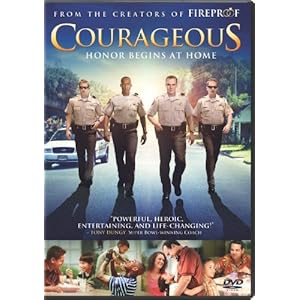
Courageous?


Review of the DVD Courageous first released at the end of last year.

If you are familiar with the work of the Kendrick Brothers and Sherwood Pictures (Flywheel, Facing the Giants, Fireproof) then you will know what to expect from their current DVD Courageous. The them this time is fatherhood with the focus on four different fathers, three of whom are in the local police department. Again there is the Albany, Georgia backdrop, the focus on several different characters, the gentle and attractive humour, people praying and getting converted and the positive small town American charm. Perhaps the effort to be multicultural and multisocial is more obvious. As ever, the acting is good, the storyline well written and the production values high. The budget was up fourfold this time, to $2 million dollars (but quickly recouped many times over at the box office). However, the project was, as ever, bathed in prayer, involved many extras from the local church, relied on volunteers and has a credit list that still includes people like babysitters and caterers, again from the local church. The film actually ends with what appears to be a Father's Day service at the Sherwood Baptist church.
So, a film made by Christians with the laudable aim of drawing attention to fatherhood and what a crucial role fathers can have on the rising generation. What's not to like? Well, it was a little long I thought. It is relentlessly didactic and even if you agree with the basic premise you might find it a little irritating. The fathers in the film decide to show what committed fathers they are by signing a pledge and making a public commitment. One father gives his teenager daughter one of those purity rings that have been so popular an controversial in the States. All very American and fair enough for an American film, perhaps. My real fear, however, is that with the title courageous the film is suggesting that all we fathers need to do is to try a little harder, spend a little more time with our kids and everything will be dandy. It is difficult to say whether the problem lies in the Kendrick brothers theology or the medium itself. When you write a story or make a film then you are in a sense acting as God. There is no failure on the part of the writers to introduce conflict or to suggest that being a father is easy. Nevertheless it would be very easy to watch it and even with the closing text in your head (Joshua 24:15) to think that all we need to do is try a bit harder.
When I was at university studying English I wrote essays that chiefly aimed to convert the lecturer. I now see that was a mistake. That is not what an academic essay is intended to do. Watching and making feature films is surely not a sin. However, we must always remember that Christ conquers sin and wins hearts to himself through preaching not through feature films. Perhaps next time the Kendricks, who are undoubtedly good story tellers, will try and be more subtle and aim more at entertainment rather than trying so hard to convert us all.
(An edited version of this piece can be found in the September Evangelical Times)