The similar phrase 'Worldly Christianity' is one used by Bonhoeffer. It's J Gresham Machen that I want to line up most closely with. See his Christianity and culture here. Having done commentaries on Proverbs (Heavenly Wisdom) and Song of Songs (Heavenly Love), a matching title for Ecclesiastes would be Heavenly Worldliness. For my stance on worldliness, see 3 posts here.

Archive 6b Chapel Names

In some instances you learn something about a chapel from its name. Enon has to be a Baptist church. Enon you recall was where John the Baptist baptised because there was much water there. Tabernacles, like God’s house in the Old Testament, are relatively large as are the rarer Temples. Babell Apostolic in Aberdare, South Wales, gets its name from the Welsh word for tent not the place where the tower was built! Bethel means house of God and Zoar (meaning ‘Little place’) should be smaller, just as Rehoboth should be larger, or an extension work, as the name means ‘Room’. It was the name given to a well by Isaac following a time of strife. Perhaps in some instances that thought is in the background. Zoar is, of course, where Lot fled from Sodom and Gomorrah and so suggests a place of refuge from wickedness.
The idea of refuge is also there in the popular Elim, ‘Place of rest’, and the unusual Cave of Adullam, where all in distress, debt or despair resorted to David. The Ark clearly suggests a welcome for all creatures great and small. The name Lighthouse or Beacon, like The Bridge, though not directly from Scripture, make similar points. The name Hebron was probably selected with a similar thought. It was a city of refuge. City of Refuge spells out the point. Gilead, of course, is the place for soothing balm. Welsh Noddfa, like the French L’Abri (used by Francis Schaeffer), both mean shelter or refuge.
The name Elim, the name of an oasis where Israel stayed in the desert, is one of many examples where biblical place names have been adopted. Use has been made of Bethany, where Jesus loved to stay; Bethlehem, perhaps with the thought of its meaning, house of bread; Calvary, Latin for the place of the skull, where Christ died; Emmaus, where after his resurrection he broke bread and Jerusalem, Caersalem (in Wales) or Salem, which means peace. Galilee and Gethsemane also exist. Gilgal, interestingly, is where the Israelites rededicated themselves to God in Joshua’s time. Peniel is where Jacob met God face to face yet lived. Nazareth and Goshen are understandable choices too, as is Eden for there Adam and Eve met with God. Why Ramah or Shiloh should be chosen is not immediately clear, though the latter was where the Tabernacle used to be.
Last part to follow.

Cessationism

Cessationism (the belief that supernatural gifts have ceased to be given to the church) is not a subject we've touched on in these pages but I am a cessationist and the recent post on it by John Kilpatrick here is worth casting an eye over whichever side you are on.

Archive 6a Chapel Names

[This article originally appeared in Grace Magazine]
Amazingly Apt Alliteration


What’s in a name?
If your church meets in a chapel, does it have a name? I have belonged to two or three Baptist churches in my time, each named after its location. However, many chapels do have names, especially where there is more than one in a town. Some have quietly dropped these names in recent times, feeling their work is not helped by issuing invitations to ‘Come to Ebenezer’ or ‘Join us at Zion’. Most, however, continue to use these ancient, and often well loved, names. Some new churches have even incorporated a name into the title of the church itself, such as Cornerstone, Immanuel, Gateway, Grace, Lifeline, Trinity, Vineyard or Church of the Good Shepherd. Meanwhile, Rehoboths, Hopes and Providences continue to abound.
Until 1689 Baptists had no chapels as such. Before the Restoration of Charles II in 1660 they had made use of parish churches and other public buildings where possible and then, under threat of persecution, had resorted to using private homes. This arrangement created its own difficulties and so where possible, like other Nonconformists, they built or bought chapels in which to meet. Sometimes congregations would share facilities but more often each church became identified with one specific building. From the 1740s at least the practice began of identifying these buildings with names. As Nonconformity flourished in the 19th Century so each new chapel erected often bore a particular name to distinguish it from others. Soon potentially confusing phrases such as ‘I belong to Hope’ or ‘I’m going to Emmaus’ became common place.
Parish churches have for long ages been traditionally connected with the names of saints, as in St Luke’s, St Philip and St James’s St Michael and All Angels or All Saints. At least one church in Wales bears Peter’s Aramaic name (Cephas) but most Nonconformists in England and Wales eschewed this practice and struck out on different paths. In America they, unimaginatively, speak usually of First Baptist, Second Baptist, Ninth Presbyterian, Tenth. Here names were chosen, mainly from the Bible, for usually obvious reasons. Bethel is ‘House of God’; Emmanuel, ‘God with us’. Providence acknowledges God’s provision of a meeting place, Jireh is ‘The Lord will provide’ and Ebenezer ‘Up until now the Lord has helped us’.

To be continued

Grace Magazine May 07


The current edition of grace Magazine is now out and looks at the biographies of several women (mostly by women writers). How many of the nine women on the cover can you name? There is also an interesting title - Will there be computers in heaven?
I am a trustee of the magazine and will be meeting with the other trustees here in Childs Hill this month. It's a privilege to be involved.

Beddome Sermons

Over at my Benjamin Beddome blog I have started to add some sermon outlines from the good man. See here.

Short Poem 11


Unknown, Public domain, via Wikimedia Commons


I first discovered the poetry of Emily Dickinson doing an American Studies course at University.
Though virtually unknown in her lifetime, she has come to be regarded, along with Walt Whitman (not my cup of tea at all), as one of the two quintessential American poets of the 19th Century. Although she wrote around 1,789 poems, only a handful of them were published during her lifetime, all anonymously. Some may have been published without her knowledge. She wrote short poems with lots of dashes that pack a punch. This is one of the best known. More here.

Because I could not stop for Death -
He kindly stopped for me -
The Carriage held but just Ourselves -
And Immortality.
We slowly drove - He knew no haste
And I had put away
My labor and my leisure too,
For His Civility -
We passed the School, where Children strove
At Recess - in the Ring -
We passed the Fields of Gazing Grain -
We passed the Setting Sun -
Or rather - He passed Us -
The Dews drew quivering and chill -
For only Gossamer, my Gown -
My Tippet - only Tulle -
We paused before a House that seemed
A Swelling of the Ground -
The Roof was scarcely visible -
The Cornice - in the Ground -
Since then -'tis Centuries -and yet
Feels shorter than the Day
I first surmised the Horses' Heads
Were toward Eternity -

Favourite Puns 08


2B or not 2B, that is the question

10 Things about Wilberforce

Anton Hickel, Public domain, via Wikimedia Commons

This may be a little old hat by now but I stumbled across this just now and thought it worth repeating here.
It was provided by Tearfund (2/23/2007).

1. He became England’s youngest ever MP. Aged 21 he was elected MP for his native Hull. During an election campaign he was pelted with a snowball as he tried to pacify a mob from a bedroom window in the opulent family home. Today the city is twinned with Freetown, Sierra Leone, which Wilberforce helped to found as a colony for free Africans.
2. His childhood vicar wrote Amazing Grace. His Methodist aunt introduced him to John Newton, a slave-trader-turned-cleric. William spent two spiritually seminal years with an uncle and aunt in Wimbledon after his dad died. But his mother called him back up north, worried about the influences on him.
3. He became a playboy second only to William Pitt, learning the finer points of gambling and drinking with the future prime minister at Cambridge University. An about-turn came later on a holiday to the south of France, when he felt touched by ‘the unspeakable mercies of my God and Saviour’. Now an MP, he quickly sobered up, applying himself to improving conditions for factory workers.
4. He had a defining moment (while chatting to William Pitt) under a tree near Croydon. William Pitt, now prime minister, persuaded him to read an exposé of the slave trade. Merchants denied accounts of overcrowding, sickness and sub-human misery on ships, spinning yarns of comfortable journeys to new and exciting lives.
5. He rendered Nelson “armless.” Admiral Nelson didn’t like ‘the damnable doctrines of Wilberforce and his hypocritical allies’. Wilberforce was assaulted outside the Houses of Parliament and faced death threats. Later Nelson’s Column in London’s Trafalgar Square would be built more than a third taller than the almost identical Wilberforce Memorial in Hull. But slavery-wise, victory had been Wilberforce’s.
6. He was the best-selling author of ‘Practical View of the Prevailing Religious System of Professed Christians in the Higher and Middle Classes in This Country Contrasted with Real Christianity’. It was reprinted five times in six months and translated into French, Italian, Dutch and German. And it’s one of the longest titles you’ll find on Amazon.
7. He had a nervous breakdown at 37. Getting the Abolition Bill through Parliament was hard graft despite his endless, eloquent speeches. Wilberforce’s poor health was not helped by Parliament defeating his Bill 20 times in 30 years. John Newton likened his fight against the slavers to the biblical story of Daniel in the lions’ den. The reformer and preacher John Wesley was also supportive. He urged him, ‘Go on, in the name of God.’
8. He got Josiah Wedgwood to design an anti-slavery brooch. Here was the top pottery designer of his day creating a brooch with a black figure in chains and the line ‘Am I not a man and a brother?’ It became a must have. Wedgwood also sent a few to an appreciative Benjamin Franklin. A founding father of the USA, Franklin became a keen supporter. Wilberforce also commissioned the poet William Cowper to write verse exposing the slave trade.
9. He thought Clapham was really cool. He was part of a group of wealthy evangelicals called the Clapham Sect and nicknamed ‘The Saints’. They campaigned for Abolition alongside remarkable former slaves such as Olaudah Equiano, Ottobah Cugoano and Ignatius Sancho. They also helped to reform the penal system, and founded of the British and Foreign Bible Society and the Church Missionary Society. Oh, and Wilberforce co-founded the Royal Society for the Prevention of Cruelty to Animals.
10. He was cheered in the House of Commons – illegally. On February 23, 1807, the House of Commons debated abolition – again. This time speech after speech praised Wilberforce. The House of Commons gave him a loud standing ovation, even though applause is forbidden there. Wilberforce bowed his head and wept with emotion. That night MPs voted to abolish the slave trade by a vote of 283 to 16. Prime Minister Lord Grenville described Wilberforce’s victory in 1807 as "a measure … for which his memory will be blessed by millions yet unborn." On March 25, 1807 the act became law. But Wilberforce hadn’t finished: he needed to secure the release of slaves throughout the British Empire. After another 26 years’ of work, he lived to see this second act passed – and died three days later.

Bonus fact‘Wilberforce’ was the name given to the cat at 10 Downing Street from 1973 to 1987. It served tirelessly as chief mouser under four British Prime Ministers: Edward Heath, Harold Wilson, Jim Callaghan and Margaret Thatcher.

10 Scots Christian Biographies

I am currently reading Iain Murray's new book A Scottish Christian Heritage and so was interested to see over at Highland Host there is a series that begins here - Free St. George's - on Scottish Christian biography. The ten are

1. John Knox
2. Richard Cameron
3. James Sharp
4. John Brown (Haddington)
5. Haldane Brothers
6. William Hanna
7. R M M'Cheyne
8. John Kennedy
9. 'Rabbi' Duncan
10. Principal Rainy

How blessed are the Scots in this respect. A Welsh list would be much more difficult to compile.

Akkerman Tour


The inimitable Jan Akkerman arrives in the UK this week for a short nine day tour of the UK. I'm hoping to catch him. You can hear him doing Paul Weller's 'You do something to me' over on the website here. (What do you think Guy?). [Gone now]. This one's with the band. In July he comes for an even shorter solo tour.

Short Poem 10

John Masefield (1878-1967) was an English poet and writer, Poet Laureate from 1930 until his death. He is remembered as the author of the classic children's novels The Midnight Folk and The Box of Delights, two novels "Captain Margaret" and "Multitude and Solitude" and a great deal of memorable poetry, including "The Everlasting Mercy" and "Sea-Fever", from his anthology Saltwater Ballads. See more at Wikipedia.
 
Sea-Fever
I must go down to the seas again, to the lonely sea and the sky,
And all I ask is a tall ship and a star to steer her by;
And the wheel's kick and the wind's song and the white sail's shaking,
And a gray mist on the sea's face, and a gray dawn breaking.

I must go down to the seas again, for the call of the running tide
Is a wild call and a clear call that may not be denied;
And all I ask is a windy day with the white clouds flying,
And the flung spray and the blown spume, and the sea-gulls crying.

I must go down to the seas again, to the vagrant gypsy life,
To the gull's way and the whale's way, where the wind's like
a whetted knife;
And all I ask is a merry yarn from a laughing fellow-rover,
And quiet sleep and a sweet dream when the long trick's over.

The Bloggy Man 30

Easter with a bang

I'm not making any point here except that it is weird world in which we live. This article is the beginning of from yesterday's Times and can be accessed here.
Once a year during Greek Orthodox Easter, on the night of the resurrection of Christ, the parishioners of two churches in the town of Vrodandos on the picturesque eastern Aegean island of Chios become for a short time, opponents in a war like no other. It is called the Chios rocket war – a friendly battle between the churches of Agios Markos and Panagia Erithiani.
The rocket war is a tradition that dates to the early 19th century at the time of the Ottoman occupation. Although its origin has been lost over time, the most popular legend is that of seafarers from the island, who used to battle pirates with cannons on their ships. When they returned home they brought their cannons, and began a custom of firing them at the Easter holiday. In 1889, the Ottoman occupiers banned it and confiscated the cannons, fearing they would be used in a revolt.
This resulted in the locals replacing the cannons with homemade rockets. The parishioners of the two churches, who always had a friendly rivalry, added the competition that has evolved and continues today.
As Easter mass takes place to mark the resurrection of Christ on the Saturday evening, rival gangs from the parishes fire thousands of homemade rockets across a valley at each other’s churches. The objective is to hit the bell-tower of the “enemy’s” church. What ensues is a spectacle of streaking lights whizzing toward each other across the sky, filling the valley between with smoke.
Air raid sirens wail across the town to inform the inhabitants, churchgoers and spectators of the approaching rockets, and thousands of people gather to watch as the rockets strike the churches.
Inside, the Easter mass takes place and churchgoers light candles despite the smashing of rockets against the walls. The devout run to reach the church for mass and watch the opposing side’s rockets approach from behind protective fine wire mesh that has been wrapped around the church.
The climax comes as church bells ring to announce Christ's resurrection at midnight, immediately drowned by the whizzing sounds of the barrages of rockets and exploding multi-coloured fireworks.
However, the tradition does not come without its dangers. Small fires can break out in the valley between the two churches, and the island’s fire brigade rushes to smother any fires ignited by stray rockets. Firefighters and volunteer watch teams spend the evening patrolling the area as stray rockets can set fire to trees, bushes and homes.
The rocket war has also caused injuries in the past, such as the loss of eyes or limbs and even deaths during production of the rockets, etc.

Another chance to see 03

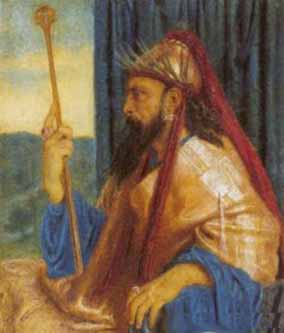
This was the first post in our long running series on King Solomon. It first appeared December 07 2006.
Solomon is one of the great characters of the Bible. His name is well known. He had a very important role in the story of God’s people. He is quite familiar to some but ought to be better known to more people. There are many, especially Jews and Christians, who know Solomon’s name but are largely unacquainted with the facts about him. He is a figure to whom certain legends have attached themselves, especially in regard to his vast wealth, his great wisdom and, in particular, the fascinating story of the Queen of Sheba’s visit to him, a subject which has spawned at least one Hollywood film and endless legends.
Why the shortage of studies? However, take a look along the shelves of your local Christian Bookshop or evangelical library and the section marked Bible Biography. What do you find? You will probably see plenty of material on Abraham, Moses, David, Elijah and New Testament characters such as John the Baptist or Paul. You will even find books on Job, Jacob, Elisha or Luke. What you are unlikely to find, however, is a biography of Solomon. Why is that? There seem to be a number of problems. 1. Solomon lived a rather pedestrian life. He was not in the habit of going out to fight wars. He made no great journeys. He had no difficult rebellions to put down and was confronted by few real crises that we know of. As for inner struggles, we know very little about them. On the face of it, Solomon’s life may seem a little dull, a little mundane. It does not seem to be the stuff of adventure or excitement. 2. It is true to say that Solomon’s greatest achievement was probably the building of the Temple that bore his name. Although this was certainly a great accomplishment, unless we have a bent for architectural detail, the descriptions of it in Scripture do not immediately strike most of us as gripping literature. The difference between reading such passages and the narrative, say, of David fighting Goliath or on the run from King Saul or Absalom could not be more stark. It is a little like the difference between the front or back page of the newspaper and the stock exchange listings tucked away in the business section. For most people there is no competition. 3. Another problem for many is the way Solomon presided over what came to be a divided nation. Shortly after his son Rehoboam succeeded, the nation was permanently split into southern and northern factions, precipitating war and idolatry for years to come. Many see the seeds of this destruction in certain of Solomon’s policies and so aspersions are cast with regard to his worthiness to be thought of as a truly great king. 4. The major problem, however, seems to be whether Solomon is a man that we want to encourage people to emulate at all. There is clear evidence that at a certain point he lost his way and fell into idolatry under the influence of his many pagan wives. Evidence of his repentance is not easy to come by and some are convinced that he continued to follow these misguided ways and was never recovered for the truth. With such a black question mark hanging over him many prefer simply to move on to other characters. Abraham, despite his faults, was clearly a man of faith. Moses may have lost his temper with the people but what a man of God. David, for all his iniquity, certainly knew all about repentance. Elijah was a sinner like us but he knew how to pray. As for Solomon, as far as many are concerned, the jury is still out.
Next Chapter

Favourite Puns 07


May the thirst be with you!
(If you miss an opportunity to use this today don't worry in three days time you can say May the fourth be with you and get an equal groan. PS Don't try may the third ... or anything like that)