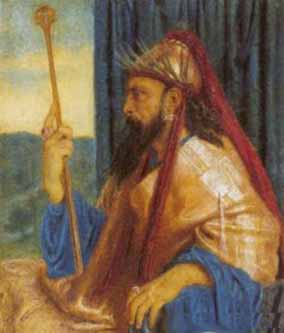
This was the first post in our long running series on King Solomon. It first appeared December 07 2006.Solomon is one of the great characters of the Bible. His name is well known. He had a very important role in the story of God’s people. He is quite familiar to some but ought to be better known to more people. There are many, especially Jews and Christians, who know Solomon’s name but are largely unacquainted with the facts about him. He is a figure to whom certain legends have attached themselves, especially in regard to his vast wealth, his great wisdom and, in particular, the fascinating story of the Queen of Sheba’s visit to him, a subject which has spawned at least one Hollywood film and endless legends.
Why the shortage of studies? However, take a look along the shelves of your local Christian Bookshop or evangelical library and the section marked Bible Biography. What do you find? You will probably see plenty of material on Abraham, Moses, David, Elijah and New Testament characters such as John the Baptist or Paul. You will even find books on Job, Jacob, Elisha or Luke. What you are unlikely to find, however, is a biography of Solomon. Why is that? There seem to be a number of problems. 1. Solomon lived a rather pedestrian life. He was not in the habit of going out to fight wars. He made no great journeys. He had no difficult rebellions to put down and was confronted by few real crises that we know of. As for inner struggles, we know very little about them. On the face of it, Solomon’s life may seem a little dull, a little mundane. It does not seem to be the stuff of adventure or excitement. 2. It is true to say that Solomon’s greatest achievement was probably the building of the Temple that bore his name. Although this was certainly a great accomplishment, unless we have a bent for architectural detail, the descriptions of it in Scripture do not immediately strike most of us as gripping literature. The difference between reading such passages and the narrative, say, of David fighting Goliath or on the run from King Saul or Absalom could not be more stark. It is a little like the difference between the front or back page of the newspaper and the stock exchange listings tucked away in the business section. For most people there is no competition. 3. Another problem for many is the way Solomon presided over what came to be a divided nation. Shortly after his son Rehoboam succeeded, the nation was permanently split into southern and northern factions, precipitating war and idolatry for years to come. Many see the seeds of this destruction in certain of Solomon’s policies and so aspersions are cast with regard to his worthiness to be thought of as a truly great king. 4. The major problem, however, seems to be whether Solomon is a man that we want to encourage people to emulate at all. There is clear evidence that at a certain point he lost his way and fell into idolatry under the influence of his many pagan wives. Evidence of his repentance is not easy to come by and some are convinced that he continued to follow these misguided ways and was never recovered for the truth. With such a black question mark hanging over him many prefer simply to move on to other characters. Abraham, despite his faults, was clearly a man of faith. Moses may have lost his temper with the people but what a man of God. David, for all his iniquity, certainly knew all about repentance. Elijah was a sinner like us but he knew how to pray. As for Solomon, as far as many are concerned, the jury is still out.
Next Chapter