The similar phrase 'Worldly Christianity' is one used by Bonhoeffer. It's J Gresham Machen that I want to line up most closely with. See his Christianity and culture here. Having done commentaries on Proverbs (Heavenly Wisdom) and Song of Songs (Heavenly Love), a matching title for Ecclesiastes would be Heavenly Worldliness. For my stance on worldliness, see 3 posts here.
Showing posts with label Sermons. Show all posts

Day Off Week 40 2024


More like the usual day off pattern on Tuesday, although early on I had to be at the doctor's for a blood test. When I came back I went to my study in the chapel and threw away another pile of sermons. This time it was handwritten ones and that was hard. During the day I read, had a coffee and looked at today's Times (as it had an obituary for Kris Kristofferson). I also tried to make prgress on this project I have to complete in the month or two. In the evening we watched the first episode of Ludwig with David Mitchell and enjoyed it mostly. Then the itv news and sleep.

Day Off Week 37 2024


Last Tuesday was a day of reading and various other things, including further work on a project I have in hand. I am also working on getting rid of my large collection of sermon manuscripts. I threw another large pile away - the last of the print outs hanging around in my study. All these should be on my computer in electronic form so it is not hard to throw them but next the pre-98 handwritten sermons will have to go. There was time for a coffee and some TV in the evening too.

Calvin's Sermons on Titus


Up at the Pastors Academy on Monday for the reading group. The book this time was the recent translation of Calvin's sermons on Titus, published by Banner (by Robert White). About ten of us met to discuss the book, led by Phil Heaps. We agreed that these were excellent and apposite sermons for their time though not without their flaws and idiosyncracies. Next time (January) we plan to look at Matthew Robertson's book Pride.

The Scottish Method


I recently put this on  a blog I have called Sermon Illustrations (See here)
One of the things that all faithful preachers must speak about is sin. It must be done faithfully bit carefully. In his 1969 work The Homiletical Innovations of Andrew W. Blackwood (Studies in Preaching; No. 3) the pastoral theologian Jay E. Adams says that the homiletician Blackwood (1882-1966) advocated the use of the Scottish method in this area. That is to say, you preach against your own sins with the hope that even where people are not tempted in the same way as you they see how they can make a similar application to themselves.
I have heard many preachers do this well. Clearly if you are tempted to murder your kids or run off with the woman next door best to confess that to the Lord and say no more about it. What you want is a sin pr temptation that exposes our shallow and wicked nature but that is easily forgiven by most.
So for example, I heard an American preacher once describing how now that the children have grown up and left the nest he and his wife like from time to time to lie in bed watching TV or something of that sort. He will be sent downstairs for ice cream at some point further enhancing the evening's enjoyment. He then describes how, having filled two bowls he spend the time ascending the stairs carefully weighing up which might be the bigger of the two so he can give the other to his spouse. I think that is a neat way of exposing the greed that lurks in his own heart and in yours and mine too, no doubt.
Another time I heard a minister from the North of England describe how on a hospital visit, as he left the car park, he managed to bump another car. Quite candidly, he described how he seriously considered for some moments simply driving off and saying nothing. But how could he? And so he began to frame a note to put on the car he had hit. Again it is an identifiable way of exposing the selfishness and the lack of love that lurks in all our hearts. My be you would never dream of not opening up but no doubt there are other areas where you would be tempted not to do the right thing.
A third example would be an older Englishman who has ministered all his life in Scotland. I remember him describing how he has set there writing a letter to a grand child and in his head he has congratulated himself on how wonderful he is writing to the child such a wonderful spiritual letter. Again, it makes the speaker look a little silly and exposes his pride and self-regard - something we all share in common.
Each preacher has to think of his own example. The one that comes most forcefully to my mind in this area is the way on a Sunday we will be singing a hymn I have chosen and I will notice how well some of the words fit with what has been preached or is about to be preached, even though I did not choose the hymn for that reason. I imagine others in the congregation thinking "Oh, he's worked so hard on this and found such appropriate words." In truth, I doubt if anyone is thinking such a thing. it still exposes my pride and my willingness to take credit where no credit is due. It is a good example to take as it self-mocks and points to the foolishness and wickedness that lies in all our hearts.

200 Sermons

I am pleased to say that I now have 200 sermons posted on my blog Preached Sermons - see here. I have tried to post sermons on less obvious parts of Scripture and there are series on Ecclesiastes, Job, Ezekiel and I am nearing the end of one on Numbers. Check it out!

CHBC Motto Text 2014

I have made it my practice over the last few years to begin the year with a  motto text. This ear it is Romans 13:12. An mp3 will soon be on the church website and the text of the sermon can be found here on preached sermons.

150 Sermons


I've just uploaded my 150th sermon to my sermon blog Preached Sermons here. There are plenty of audio sermons available on the Internet but nit so many sermon scripts. I began the blog about four years ago and since then there have been over 30,000 hits. Some sermons have had more than a thousand hits. Check it out.

Doddridge Practical Writers 4

Doddridge's final lecture on practical writers (Lecture 4) looks at writers of the established church.
§1(John) Tillotson There is such an easiness in his style and beautiful simplicity of expression as seems easy to be imitated, yet nothing more difficult. He had some puritanical expressions. Sometimes prophetic. His method admirably clear, beyond almost any other man. Many of his sermons contain nothing remarkable, especially his posthumous ones, yet there are some of them equal to any he published in his lifetime. His best pieces are at the beginning of his first and second volumes folio. His discourse on evil speaking is excellent. He made great use of Barrow and Wilkins, with whom compare some of his sermons. There is sometimes great tautology but in controversy no man found such lucky arguments nor represented the sentiments of his adversaries fully, artfully and advantageously for confutation.
§2(Isaac) Barrow The most laconic writer among our divines. He has an amazing number of thoughts, though not always well digested or plainly expressed. He is sometimes excellent in these respects. He attempted to introduce some new words but without success. Many useful scriptures and fine quotations from the Classics and the Fathers, in the margin. Nothing is more elaborate than his discourses, most of them having been transcribed three times over, and some of them oftener. Many of Tillotson's finest sermons were a kind of translation from him, particularly that on evil speaking. The first volume of his sermons is the best, but they all deserve reading.
§3(David) Wilkins His method is very exact but too scholastic. His style is almost as easy and pure as Tillotson's. Many excellent thoughts are thrown together in a very intelligible manner. His Sermons, Natural Religion, the Beauty of Providence, on Prayer, and on Preaching, are his only practical works, and well deserve a reading. Tillotson's Wisdom of being religious is taken in a great measure from him.
§4(William) Beveridge Much like Henry, but not his equal. He discovers great devotion, has many high flights but is sometimes weak. His Private Thoughts the most valuable of his works. Many of his sermons are very low.
§5(Thomas) Scott His style is long and verbose; many inelegant words, and some phrases shocking; yet, on the whole, he is excellent. His reasoning is strong and conclusive, though drawn out to an excessive length. He drives on with great warmth and pathos, yet almost all appears too much forced. His Christian Life is the best of his works, especially the first part. The prayers at the end are absolutely the best I have ever read. Many of his sermons are valuable, especially those in the first volume; the subjects being good, pretty full, and methodically handled.
§6(Robert) South Smart wit, keen satire, sometimes fine language but his arguments are often weak. All his works have the appearance of an ill spirit in controversy. He has many levities entirely unbecoming the pulpit and when most practical seems to write with spleen, and to aim very little at usefulness. The best sermons are in his first volume; though even in them, there is too great an affectation of wit and but little appearance of being in earnest for God amidst all his zeal against Heretics and Schismatics.
§7(John) Norris Excessively affected, pert and verbose, yet some good thoughts. His Sermons on the Beatitudes are most celebrated. He carries matters in general too high. His discourses on the love of God are in the mystic strain. His Sermon on Religious Discourse deserves to be read. He is in general too abstruse and metaphysical.
§8(Richard) Lucas His style is very peculiar, sometimes exceeding free, approaching to conversation; sometimes grand and solemn; and generally very expressive. His method is not clear but his thoughts are excellent. Many of them are taken from an attentive observation of human life. He wrote as being entirely devoted to God, and superior to the world. His most valuable works are his Practical Christianity and his Inquiry after Happiness, especially the second volume.
§9(William) Sherlock Strong arguments and awful representations: exceeding proper for conviction. His style is plain and manly. His best works are those on Death and Judgment.
§10(Walter) Spratt He is the least considerable as a practical writer. His language is always beautiful, but many of his sentiments are very weak. The Ciceronian style is too much laboured. Tully is translated for many sentences together in some of his Sermons, though not mentioned. All his Sermons are in one octavo volume and deserve a reading.
§11(Samuel) Clarke He slipped into very high reputation, chiefly by his peculiarities. His style is quite plain and void of pathos. His thoughts are well ranged, but many of them very obvious and frequently repeated. Scriptures often well explained, though sometimes he takes more pains to collect parallel scriptures than is necessary and with solemn parade explains others that have no difficulty. He takes more notice of grace and the atonement than most of his followers and admirers. Several of his Sermons are on subjects too near akin. He and Tillotson have made great use of the Fratres Poloni (ie Socinians), though they do not make any mention of them.
§12(Anthony) Horneck (originally from Germany) Exceeding pathetic, but not elegant. He is chiefly fit for devotional subjects but his words are too often greater than his thoughts. His best pieces are those on Consideration, and The Crucified Jesus. See his pieces also on the Commandments, on Prayer, Presumptuous Sins, and several Sermons.
§13(Ezekiel) Hopkins (of Derry) His motto, Aut suavitate aut vi (either by gentleness or force) well answers to his works, yet he trusts most to the latter. He awakens awfully; sometimes there is a little of the bombast; he bends the bow till it breaks; an error carefully to be guarded against.
§14(Robert) Boyle His style is very rough and obscure yet some words are highly illustrative by antitheses, he being very careful in the choice of them. He has many lively similes very proper to be quoted, especially in his Seraphic Love and Theodora and Dydimus. Sentences unreasonably long, abounding with parentheses and hard words of his own coining. He has, in short, many faults in his style, but some inimitable beauties.
§15(Henry) Scougal One of the first rank, though he wrote but little. Every page abounds with noble and proper thoughts; clothed with a decent eloquence, suited to the subject. He appears to be the best model of all his class. His Life of God in the Soul of Man and Sermons, should be often read. His early death, at the age of 28, was an unspeakable loss to the world.
§16(William) Law Very recluse. His productions have a severity seldom to be found in this age. His language is generally just and beautiful; very nervous, but sometimes unnatural. He is ready to affect points of wit, and strokes of satire; in which however he does not equal South. Many characters are admirably drawn. In this he comes nearer the Jesuits than any English writer. His Treatise on Christian Perfection is very famous. His Serious Call still better.
§ (William) Fleetwood Surnamed Silver-tongued, remarkable for easy and proper expressions. He considers several cases, which, though often occurring in human life, are seldom taken notice of in Sermons. On this account he may be consulted with advantage. In respect of true politeness he has been equalled by few. His Sermons on Relative Duties are good but his Four Funeral Sermons show the orator much more.
§18(Francis) Atterbury The glory of our English orators. In his writings we see language in its strictest purity and beauty. There is nothing dark, nothing redundant, nothing deficient, nothing misplaced. Trivial thoughts are avoided, uncommon ones introduced and set in a clear, strong light, and in a few words; some admirable similes and more graceful allusions to scriptures than any of this class. On the whole, he is a model for courtly preachers. His Four Volumes should be carefully read. His two last are the best. The chief Sermons are Acquaintance with God, Religious Retirement, Lady Cotes's Character, Propagation of the Gospel, Sufficiency of Revelation, Terrors of Conscience, Curse on the Jews, and Felix Trembling.
§19 (Hugh) Blair A man of plain good sense. A beautiful simplicity and great seriousness run through all his writings. A desire to spare all unnecessary words is very apparent. His Commentary on Matthew is the best extant. He has some excellent and striking similes, which are chiefly taken from the affairs of slaves, planters, or foreign colonies. He lived in Jamaica. He suggests a multitude of excellent things which he does not prosecute at large. He appears to have been a person of the utmost candour, and has solicitously avoided all unkind and contemptuous reflections on his brethren. He guards his hearers against all undue confidence in their immediate relation to, and strict attendance on the established worship, beyond almost any other divine in the Church of England. He has an excellent way of bringing down criticisms to common capacities; and has discovered a vast knowledge of scripture in the suitable application of them.
§20(Thomas) Secker is so remarkable an instance of the laconic style, that the few Sermons he has published deserve an attentive reading, especially that on the Oxford act, which is the wisest I ever read, considered in the view of a Philosophical Essay.
§21Archbishop (Robert) Leighton One of the most eminently devout and pious writers his age has produced. His Sermons indeed are not accurately digested and sometimes contain only hints not fully opened; which is the more excusable, as none of them were intended for the press by the author. His works ought to be reckoned among the greatest treasures of the English tongue. They continually overflow with love to God and breathe a heart entirely transformed by the gospel, above the views of every thing but pleasing God. There is a vast deal of spirit, and charming imagination; multitudes of the most beautiful figures; and scriptures applied with happiest allusions. Metaphors, especially those in the text, are sometimes pursued into allegory; yet very natural. Upon the whole, they are such as none but a very ingenious, learned, religious man could write; and yet, even by such an one, must have been written with great care; not the effect of any laborious efforts for particular discourses, through a habit of speaking and writing; but the guarded overflowings of a copious fountain. This attainment, however, must have been the consequence of a most resolute application both of the head and heart. Few uninspired writers have a greater tendency to mend the world. The disappointment which the learned and polite complained of, when these posthumous works were published, is chiefly to be charged upon their ignorance of the true beauties and use of Theological Writings.

Scandalous


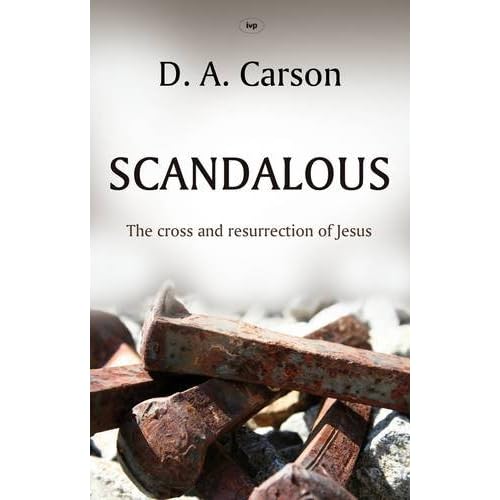
Don Carson's various books are always appreciated. His latest, the seasonal Scandalous The cross and resurrection of Jesus is no exception. Dedicated to his wife, its 170 pages contain a five sermons on New Testament texts, originally delivered at the end of 2008 at the Resurgence Conference in Seattle. They look at Matthew 27:27-51a, Romans 3:21-26, Revelation 12, John 11 and John 20:24-31. Typically they contain careful exposition, interesting background, mature reflection and always application. Inevitably the sermons vary in quality but they tackle big and important themes, such as propitiation, Christ's resurrection and biblical eschatology in an orthodox but fresh way and are all useful. Not all will share Dr Carson's penchant for poetry but a nose for a good illustration and helpfully told background material is appreciated. Unexpected nuggets include his exposition of John 11 (p 131ff) rejecting the common English translation and a slightly tangential exploration of six kinds of doubt (143-148). Clear headings and two indices add to the book's value.

Edwards Sermons

The Jonathan Edwards Center at Yale University has made a sermon index for Jonathan Edwards’ sermons available. More on this here at Feeding on Christ.

DMLJ 02 Whitefield Sermons


SELECT SERMONS BY GEORGE WHITEFIELD
With an account of his life by J C Ryle
FOREWORD
It is a privilege to be asked to commend this volume, and to be associated in any way with two such names as George Whitefield and Bishop Ryle.
Nothing has been sadder in the story of the last fifty years in the church, nor more significant, than the way in which George Whitefield has been neglected, and especially as one considers the very considerable attention that has been given to his contemporary, John Wesley. That was certainly not the position two hundred years ago, and it should not be the case now.
Of all the men of the eighteenth century whom God raised up to do that marvellous work called
'the Evangelical Awakening', none was more remarkable than George Whitefield. Of few men can it be said that their preaching was 'apostolic' in character, but it certainly can be said of Whitefield. His whole career from beginning to His whole career from beginning to end was an amazing phenomenon and his Herculean labours both in Great Britain and America can only be explained by the power of the Holy Ghost.
But Whitefield was not only the greatest preacher and orator of the eighteenth century, he was also one of its most saintly characters, if not the saintliest of all. Certainly there was no more humble or lovable man amongst them. What can be more profitable, next to the Bible itself, than to read something of the life of such a man and to read his own words!
This volume provides an excellent introduction. The famous essay by Bishop Ryle is certainly the best short account of Whitefield that has ever been done, and it is good that it should be thus reprinted. At the same time this volume provides samples of the great preacher's sermons which serve to illustrate the points emphasized by the Bishop. It is a judicious and representative selection.
May God grant that, as we read of the man whom God made so mighty, and the things which he taught and preached, we may be led to long for and to pray for such a revival in our day and generation as God gave in His sovereign grace and mercy two hundred years ago.

February 1958
D M LLOYD-JONES
Westminster Chapel London

An update


The trip back from Aber last Friday was long but uneventful. I came via Newport but just didn't have time to visit my dad. On reflection, I should have been up at 6 am not 7 am. There we are. It was imperative that I got back to London in good time as I had agreed to take the funeral of a lady (Betty Plant) who I knew from the BUPA care home I visit fortnightly. The funeral was at the Marylebone Crematorium in Finchley. There were only a handful of mourners. We wisely chose not to sing. There was a brief tribute by her grandson and a poem then I spoke briefly from Romans 6:23. Refreshments were served back at the grandson's home. One funny things was that I had heard recently that she had been to Lourdes, which made me concerned about whether she would really have wanted the sort of funeral I would do. Anyway, it turned out she was a cricket fan and the trip had been to Lord's! These occasions are not easy and I don't do them often but I feel one can just gently scatter the seed and hope for something. We had the clubs in the evening. Somehow I'd found time to prepare an Autumn quiz. Saturday was mostly taken up with preparations. However, in the morning four us headed up to Golders Green to give out a tract I'd prepared. It was called The power of God for salvation. One man tried to be clever and said he had his own power. As I pointed out that will soon run out though. In the evening we had the older young people around and I spoke from the call to remember your Creator in the days of your youth towards the end of Ecclesiastes. To make things interesting I put up some appropriate little posters, played some music (death by Ravi Shankar, young gifted and black, if I had a little time, etc) and had quizzes on age related diseases and guessing people's ages (I must replicate the latter quiz some time). Sunday was a good day as we carried on with Mark 11 and Romans 1. I had to spend a lot of time preparing in the afternoon a it has been such a busy week. The days following haven't been much less busy. On Monday there were lots of Jews about marking Yom Kippur. I was at LTS for the TSG, looking at Calvin's sermons on Acts (I only had time to read some of these beforehand but it was still worthwhile being present with the other 6 or 7 present led by Jeremy Walker. On Tuesday it was the committee for organising the next Grace Assembly, preceded by a trip to Brent Cross with my wonderful wife for a cuppa in the Krispy Kreme joint there. David Last will chair next May and Gerard Hemmings will be among the speakers. Watch this space. Then to round off Wednesday was another busy day with a trip up to the new library location in Bounds Green to help out with manning the place while the stuff that has been in storage was unloaded. Ian Densham did the lion's share as ever. In the evening we had a good turn out for the midweek meeting looking at Deuteronomy 32 and praying for GBM, etc.