The similar phrase 'Worldly Christianity' is one used by Bonhoeffer. It's J Gresham Machen that I want to line up most closely with. See his Christianity and culture here. Having done commentaries on Proverbs (Heavenly Wisdom) and Song of Songs (Heavenly Love), a matching title for Ecclesiastes would be Heavenly Worldliness. For my stance on worldliness, see 3 posts here.
Showing posts with label Atonement. Show all posts

10 Ancient Testimonies to Limited Atonement


These ten ancient testimonies are given in an appendix at the end of John Owen's The death of death in the death of Christ
I. The confession of the holy Church of Smyrna, a little after the commendation given it by the Holy Ghost, Rev. ii. 9, upon the martyrdom of Polycarpus:
“Neither can we ever forsake Christ, him who suffered for the salvation of the world of them that are saved, nor worship any other.” [It is an extract from a letter of the church of Smyrna to the churches of Pontus, giving an account of the martyrdom of Polycarp.]
II. The witness of holy Ignatius, as he was carrying to Rome from Antioch, to be cast to beasts for the testimony of Jesus:
“This is the way leading to the Father, this the rock, the fold, the key; he is the shepherd, the sacrifice; the door of knowledge, by which entered Abraham, Isaac, Jacob, Moses, and the whole company of prophets, and the pillars of the world, the apostles, and the spouse of Christ; for whom, instead of a dowry, he poured out his own blood, that he might redeem her.” [AD 107]
Surely Jesus Christ gives not a dowry for any but his own spouse.
III. Clemens, “whose name is in the book of life,” Phil. iv. 3, with the whole church at Rome in his days, in the epistle to the church of Corinth
“For the love which he had unto us, he gave his blood for us, according to his purpose, and his flesh for our flesh, and his life for our lives.”
Where you have assigned, 1. The cause of Christ’s death, — his love to us; 2. The object of it, — us, or believers; 3. The manner how he redeemed us, even by commutation. This triple testimony is taken from the very prime of undoubted antiquity.
IV. Cyprian, to Cæcilius, a holy, learned, and famous martyr, AD 250:
“He bare all us, who bare our sins;”
That is, he sustained their persons on the cross for whom he died.
The same to Demetrian
“This grace hath Christ communicated, subduing death in the trophy of his cross, redeeming believers with the price of his blood.”
The same, or some other ancient and pious writer of the cardinal works of Christ. The same author also, in express terms, mentions the sufficiency of the ransom paid by Christ, arising from the dignity of his person “Of so great dignity was the oblation of our Redeemer, that it alone was sufficient to take away the sins of the world.”
V. Cyril of Jerusalem, [AD 350]
“Wonder not if the whole world be redeemed; for he was not a mere man, but the only-begotten Son of God that died. If, then, through the eating of the tree” (forbidden) “they were cast out of paradise, certainly now by the tree” (or cross) “of Jesus shall not believers more easily enter into paradise?” So also doth another of them make it manifest in what sense they use the word all..
VI. Athanasius, of the incarnation of the Word of God [AD. 350]:
“He is the life of all, and as a sheep he delivered his body a price for the souls of all, that they might be saved.” All in both places can be none but the elect; as,
VII. Ambrose or rather, Prosper,  [AD 370]
 “The people of God hath its own fulness. In the elect and foreknown, distinguished from the generality of all, there is accounted a certain special universality; so that the whole world seems to be delivered from the whole world, and all men to be taken out of all men.”
In which place he proceedeth at large to declare the reasons why, in this business, “all” and “the world” are so often used for “some of all sorts.”
These that follow wrote after the rising of the Pelagian heresy, which gave occasion to more diligence of search and wariness of expression than had formerly been used by some.
IX. Augustine, [AD. 420]:
“By him the Mediator, the Lord declareth himself to make those whom he hath redeemed with his blood, of evil, good to eternity.”
“Christ will possess what he bought; he bought it with such a price that he might possess it.”
“He that bought us with such a price will have none perish whom he hath bought.”
“He often calleth the church itself by the name of the world; as in that, ‘God was in Christ reconciling the world unto himself;’ and that, ‘The Son of man came not to condemn the world, but that the world through him might be saved.’ And John in his epistle saith, ‘We have an Advocate, and he is the propitiation for [our sins, and not for ours only, but also for] the sins of the whole world.’ The whole world, therefore, is the church, and the world hateth the church. The world, then, hateth the world; that which is at enmity, the reconciled; the condemned, the saved; the polluted, the cleansed world. And that world which God in Christ reconcileth to himself, and which is saved by Christ, is chosen out of the opposite, condemned, defiled world.” Much more to this purpose might be easily cited out of Augustine, but his judgment in these things is known to all.
IX. Prosper [AD. 440]:
“He is not crucified with Christ who is not a member of the body of Christ. When, therefore, our Saviour is said to be crucified for the redemption of the whole world, because of his true assumption of the human nature, yet may he be said to be crucified only for them unto whom his death was profitable. Diverse from these is their lot who are reckoned amongst them of whom it is said, ‘The world knew him not.’ ”
“Doubtless the propriety of redemption is theirs from whom the prince of this world is cast out. The death of Christ is not to be so laid out for human-kind, that they also should belong unto his redemption who were not to be regenerated.”
“If there be none whom God would not have redeemed, why are not all saved?”
X. Council held at Valence [AD 855]
“The price of the death of Christ is given for them alone of whom the Lord himself said, ‘As Moses lifted up the serpent in the wilderness, so must the Son of man be lifted up, that whosoever believeth on him should not perish.’ ”

Atonement (Book)

Atonement is another in the series that includes Solid Ground reviewed earlier. This one on a very relevant subject  is assembled in the same way, using past sermons at the Philadelphia Conference organised by ACE and edited by Gabriel Fluhrer. The contributors are Packer, with an excellent message on the Necessity of the atonement, Boice (propitiation), Sproul (satisfaction), Gerstner (Limited atonement), Ferguson, De Witt (reconciliation) and Alistair Begg.

10 Characteristics of Scots atonement theologians by Donald Macleod

Good day looking at Smeaton yesterday with the other men at the John Owen Centre. Stumbled across this list from Donald Macleod on Scottish Atonement Theology (Dictionary of Scottish Church History and Theology) here. Such theologians are characterised by

1. A sustained, reverent reflection on the sufferings of Christ. 
2. A perception of the work of Christ in sacerdotal terms.
3. An insistence that the sufferings of Christ were penal.
4. A portrayal of the atonement as a satisfaction to divine justice.
5. The sufferings of Christ were vicarious.
6. The setting of the cross in a covenant framework.
7. The indispensable necessity of the atonement to salvation.
8. The unambiguous portrayal as a fruit and consequence of the love of God [the Father].
9. A prominence for the idea of victory not surpassed in any other Western tradition before Gustaf Aulen.
10. A belief in limited atonement, but stated very carefully.

Smeaton on the atonement

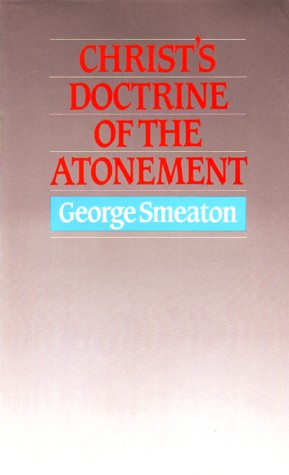
I'm planning to be at the John Owen Centre today where the Theological Study Group will be discussing George Smeaton's book Christ's Doctrine of the atonement. It's been good to read a book that has sat on my shelf unused too long. It is full of excellent insights.

Hymns Pantycelyn 03

This is number 6 and is headed The atonement. I have altered the word 'immerg'd' to 'immers'd' in line 1.

My soul thou art immers'd in Sin,
So deep that none can trace;
Look to the ransom God decreed
To clear the guilty race.

The Atonement made once on the Tree,
Can balance many more
Than all the Sins of Adam's race,
If number'd o'er and o'er.

He paid the mighty sum and died
For Sinners yet unborn;
From men, the works of his own hands,
He suffer'd shame and scorn.

Had I the guilt of all the world,
He's able to forgive:
Why should I fear? The Debt is paid
If only I believe.

Jesus Christ Prince of Thieves

I had this passage in Calvin pointed out the other day. This translation has Prince of robbers but I suppose it could be Prince of thieves
See under comments on Mt 27:33-38; Mk 15:22-28; Lk 23:33-38

Then were crucified with him two robbers. It was the finishing stroke of the lowest disgrace when Christ was executed between two robbers; for they assigned him the most prominent place, as if he had been the prince of robbers. If he had been crucified apart from the other malefactors, there might have appeared to be a distinction between his case and theirs; but now he is not only confounded with them, but raised aloft, as if he had been by far the most detestable of all. On this account Mark applies to him the prediction of Isaiah, (53:12) he was reckoned among transgressors; for the prophet expressly says concerning Christ, that he will deliver his people, not by pomp and splendour, but because he will endure the punishment due to their sins. In order that he might free us from condemnation, this kind of expiation was necessary, that he might place himself in our room. Here we perceive how dreadful is the weight of the wrath of God against sins, for appeasing which it became necessary that Christ, who is eternal justice, should be ranked with robbers. We see, also, the inestimable love of Christ towards us, who, in order that he might admit us to the society of the holy angels, permitted himself to be classed as one of the wicked.

Westminster Conference 06 D

The most substantial session of the conference this year came at the beginning of the second day when (the incongruously youthful looking) Professor Garry Williams of Oak Hill introduced us to the Puritan doctrine of atonement. Once again the focus was chiefly on that Colossus John Owen as his views were presented in contrast chiefly to the Socinians and Hugo Grotius (1597-1645) [see pic] but also some of his fellow Puritans. Dr Williams drew our attention to seven features. Owen was biblical, catholic, systematic, covenantal, polemic, affective and contemporary.
Biblically he used thorough exegesis. An example would be his close sustained reading of Isaiah 53 to refute the Socinians and Grotius. He also used biblical history as when he speaks of the total involvement of all creation in the atonement (from God to the brute creation). Examples were also given of his use of biblical theology.
Though founded on the Bible Owen, like other Puritans, shows definite continuity with Augustine and the Catholic tradition and systematises his thought. Dismissing the common charge of Aristotelianism made against Owen Dr Williams next discussed the question of the necessity of the atonement, something on which Owen changed his mind, first denying and then accepting the view. This put him at variance with the eminent Rutherford and Twisse. The strength of the position, however, is that it accounts for Christ's suffering in a way the voluntarist cannot and secures the relationship between God's nature and his revelation.
Dr Williams went on to discuss the governmental theory of the atonement propounded by Grotius and Owen's response to it making some helpful distinctions and observations. Owen's emphasis on the mystical union of the believer with Christ was brought out helpfully. A great deal else was also said about how Owen opposed Grotius's concessions when arguing with the Socinians. It will be good to see this in print and to peruse it at leisure. It was good to be present, however, and to think through some of the issues regarding the atonement, issues most of us have rarely begun to think about. Perhaps the most interesting thought to arise, something that really came out in the fine discussion that followed, was the idea that we can say with Owen that sin must be punished of necessity whereas reward can only be something that God chooses to bestow. Not all were happy with the idea but it seems sound to me. This was one of the finest papers delivered to the conference in recent years. The subject is of enormous contemporary relevance but there was not time in the paper or in discussion to begin to look at this. Clearly Owen is the man who needs to be refuted, however, if certain modern writers are to make any impact on the evangelical doctrine.