The similar phrase 'Worldly Christianity' is one used by Bonhoeffer. It's J Gresham Machen that I want to line up most closely with. See his Christianity and culture here. Having done commentaries on Proverbs (Heavenly Wisdom) and Song of Songs (Heavenly Love), a matching title for Ecclesiastes would be Heavenly Worldliness. For my stance on worldliness, see 3 posts here.
Showing posts with label the cross. Show all posts

10 or more statements about the cross by John Bunyan

I shall therefore show you, first, what was expected of God in the sacrifice in the type, and then show you how it was answered in the antitype. Secondly, I shall show you the manner of the offering of the type, and so answerable thereto to shew you the fitness of the sacrifice of the body of Christ, by way of answering some questions.
1. God did expect that sacrifice which he himself had appointed, and not another; to signify, that none would serve his turn but the body and soul of his appointed Christ, the mediator of the new covenant, John 1:29
2. This sacrifice must not be lame nor deformed; it must have no scar, spot, or blemish; to signify, that Jesus Christ was to be a complete sacrifice by covenant, I Pet 1: 29
3. This sacrifice was to be taken out of the flock or herd; to signify, that Jesus Christ was to come out of the race of mankind, according to the covenant, Heb. 10:5
But, secondly. As to the manner of it
1. The sacrifice, before it was offered, was to have the sins of the children of Israel confessed over it; to signify, that Jesus Christ must (Isa. 53:4-7, 1 Pet 2:24) bear the sins of all his children by covenant - As for thee, by the blood of thy covenant, in his own body on the tree Zech. 9:10-12
2. It must be had to the place appointed - namely, without the camp of Israel; to signify, that Jesns Christ must be led to Mount Calvary, Luke 23:33
3. The sacrifice was to be killed there; to signify, that Jesus Christ must and did suffer without the city of Jerusalem for our salvation.
4. The sacrifice must not only have its life taken away, but also some of its flesh burned upon the altar; to signify, that Jesus Christ was not only to die a natural death, but also that he should undergo the pains and torments of the damned in hell.
5. Sometimes there must be a living offering and a dead offering, as the goat that was killed, and the scape-goat, the dead bird and the living bird, (Lev. 14:3-6) to signify, that Jesus Christ must die, and come to life again.
6. The goat that was to die was to be the sin offering; that is, to be offered as the rest of the sin-offerings, to make an atonement as a type; and the other goat was to have all the sins of the children of Israel confessed over him, (Lev. 16:7-22) and then to be let go into the wilderness, never to be catched again; to signify, that Christ's death was to make satisfaction for sin, and his coming to life again was to bring in everlasting (Rom. 4:25) justification from the power, curse, and destroying nature of sin.
7. The scape-goat was to be carried by a fit man into the wilderness; to signify, that Jesus Christ should be both fit and able to carry our sins quite away from us, so as they should never be laid to our charge again. Here is grace.
8. The sacrifices under the law, commonly part of them must be eaten, (Exod.12:5-11) to signify, that they that are saved should spiritually feed on the body and blood of Jesus Christ, or else they have no life by him, John 6:51-53)
9. This sacrifice must be eaten with unleavened bread; to signify, that they which love their sins, that devilish leaven of wickedness, they do not feed upon Jesus Christ.
(10) Now, of what hath been spoken this is the sum, that there is a sacrifice under the new covenant, as there were sacrifices under the old; and that this sacrifice did every way answer that, or those; indeed, they did but suffer for sin in show, but he in reality; they as the shadow, but he as the substance.

Yng Nghymru 02

The rest of the family had gone on down to Eleri's sister's in Cardiff and I joined them that evening. The next morning Eleri's other sister and husband arrived and they all trooped off to St Mellon's to hear Ian Parry. I half wish I had gone but having been ill the previous Tuesday I thought it wiser to stay at home and read and prepare myself for the evening. In the evening I was preaching in Bethlehem, Sandfields, Aberafan. I had a lovely time with the minister Jeremy Bailey (who I know through the Westminster Fellowship) and his wife Jenny beforehand chatting about Port Talbot and sundry other things then preached in the evening to about 40 something based on Don Carson's chapter on the ironies of the cross. I then headed back to Cardiff where we stayed overnight before heading back to London the next day.

Scandalous


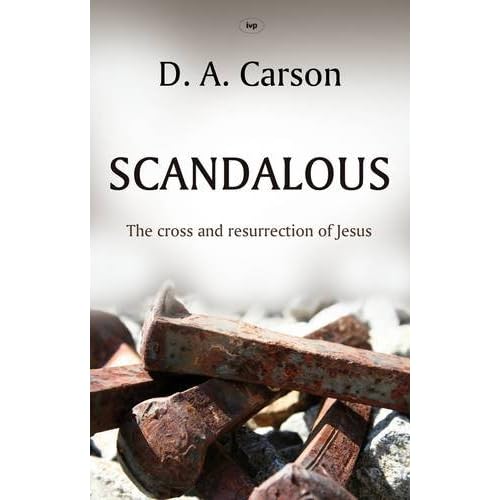
Don Carson's various books are always appreciated. His latest, the seasonal Scandalous The cross and resurrection of Jesus is no exception. Dedicated to his wife, its 170 pages contain a five sermons on New Testament texts, originally delivered at the end of 2008 at the Resurgence Conference in Seattle. They look at Matthew 27:27-51a, Romans 3:21-26, Revelation 12, John 11 and John 20:24-31. Typically they contain careful exposition, interesting background, mature reflection and always application. Inevitably the sermons vary in quality but they tackle big and important themes, such as propitiation, Christ's resurrection and biblical eschatology in an orthodox but fresh way and are all useful. Not all will share Dr Carson's penchant for poetry but a nose for a good illustration and helpfully told background material is appreciated. Unexpected nuggets include his exposition of John 11 (p 131ff) rejecting the common English translation and a slightly tangential exploration of six kinds of doubt (143-148). Clear headings and two indices add to the book's value.

Eccentric Ministers 3

Geoff spoke for the last session on preaching Jesus Christ and him crucified. First he spoke stirringly of Jesus Christ and then of his death - penal, substitutionary, propitiatory and declarative.
Nice trip home with Paul and Richard Bewes.

Hymns Pantycelyn 05

This fourteenth hymn (like the thirteenth) is on the cross.

Ye Sons of Men, lift up your Heads,
The greatest Wonder see,
Jesus the Saviour and the God
Nail'd to the cursed tree.

He brought in life, immortal, pure,
By his redeeming grace,
Pardon and holiness and bliss,
For the believing race.

Grim death here lost its poisonous dart,
By spilling precious blood ;
Hell swallowed up in victory,
Now man enjoys his God.

O Mystery ! That life should spring
From death that mortal foe;
And cruel death to Jesus should
Deliver us from woe.

My God, my God! How couldst thou die
For poor and worthless me ?
I am astonish'd, and must say
That all thy grace is free.

O shall Worms presume to understand
The secrets of his love?
Reason is mute, and all the choir
Of Cherubim above.

Jesus Christ Prince of Thieves

I had this passage in Calvin pointed out the other day. This translation has Prince of robbers but I suppose it could be Prince of thieves
See under comments on Mt 27:33-38; Mk 15:22-28; Lk 23:33-38

Then were crucified with him two robbers. It was the finishing stroke of the lowest disgrace when Christ was executed between two robbers; for they assigned him the most prominent place, as if he had been the prince of robbers. If he had been crucified apart from the other malefactors, there might have appeared to be a distinction between his case and theirs; but now he is not only confounded with them, but raised aloft, as if he had been by far the most detestable of all. On this account Mark applies to him the prediction of Isaiah, (53:12) he was reckoned among transgressors; for the prophet expressly says concerning Christ, that he will deliver his people, not by pomp and splendour, but because he will endure the punishment due to their sins. In order that he might free us from condemnation, this kind of expiation was necessary, that he might place himself in our room. Here we perceive how dreadful is the weight of the wrath of God against sins, for appeasing which it became necessary that Christ, who is eternal justice, should be ranked with robbers. We see, also, the inestimable love of Christ towards us, who, in order that he might admit us to the society of the holy angels, permitted himself to be classed as one of the wicked.

Cain & Christ compared and contrasted

Cain and Christ compared
Here are two men
1. Descended from Adam and spoken of in Scripture. (Cf Luke 3:38)
2. With famous mothers who expected great things of them.
3. Who were firstborn sons but had other siblings.
4. Who became wanderers yet both founded cities. (God condemned Cain to be a restless wanderer on the earth, Gen 4:12, but showed him mercy. He founded a city and named it for his son Enoch. In Lk 9:58 Christ says Foxes have holes and birds of the air have nests, but the Son of Man has no place to lay his head. Yet he founded New Jerusalem, the City of God).
Cain and Christ contrasted
1. Cain is the first real villain in the Bible; Christ its great hero. (1 Jn 3:12 Do not be like Cain, who belonged to the evil one and murdered his brother. 1 Pet 2:20 Christ suffered for you, leaving you an example, that you should follow in his steps 1 Cor 1:11 Follow my example, as I follow the example of Christ.)
2. Cain made a sacrifice to God that was unacceptable; Christ one that was.
3. Cain lacked faith; Christ did not. (Heb 11 speaks of Abel's faith. Cain clearly lacked it. Christ always acted in faith – see eg Matt 17:19, 20)
4. Cain was told to master his sin but failed to do so; Christ was able to master it. (Gen 4:7 If you do what is right, will you not be accepted? But if you do not do what is right, sin is crouching at your door; it desires to have you, but you must master it. Clearly he failed to do that. Sin mastered him. Jesus was the opposite. The Devil could not get him to sin. Jn 14:30 He has no hold on me.)
5. Cain killed his brother and refused to be his keeper; Christ died to make people his brothers. (Gen 4:9 Am I my brother's keeper? Heb 2:1 Jesus is not ashamed to call them brothers.)
6. Cain, full of hatred, was no brother to Abel; Christ, full of love, sticks closer than a brother. (Cf Prov 18:24 A man of many companions may come to ruin, but there is a friend who sticks closer than a brother.)
7. Cain spilt another's blood that cried out to God; Christ spilt his own and it speaks a better word. (Heb 12:24 refers to the sprinkled blood that speaks a better word than the blood of Abel, cf 1 Pet 1:18, 19 ... it was not with perishable things such as silver or gold that you were redeemed from the empty way of life handed down to you from your forefathers, but with the precious blood of Christ, a lamb without blemish or defect.)
8. Cain was angry before he killed; Christ was full of joy before he was killed. (Gen 4:5, 6 Cain was very angry, and his face was downcast. Then the LORD said to Cain, Why are you angry? Why is your face downcast? Heb 12:2 Let us fix our eyes on Jesus, ... who for the joy set before him endured the cross, scorning its shame, and sat down at the right hand of the throne of God.)
9. Cain deserved to die but did not; Christ did not deserve to die but did. (Gen 4:15 But the LORD said to him, Not so; if anyone kills Cain, he will suffer vengeance seven times over. Then the LORD put a mark on Cain so that no-one who found him would kill him. 2 Cor 5:21 God made him who had no sin to be sin for us, so that in him we might become the righteousness of God.)