The similar phrase 'Worldly Christianity' is one used by Bonhoeffer. It's J Gresham Machen that I want to line up most closely with. See his Christianity and culture here. Having done commentaries on Proverbs (Heavenly Wisdom) and Song of Songs (Heavenly Love), a matching title for Ecclesiastes would be Heavenly Worldliness. For my stance on worldliness, see 3 posts here.
Showing posts with label Don Carson. Show all posts

Holy, Holy, Holy: Proclaiming the Perfections of God


This Ligonier book is a collection of ten addresses on the general subject of the holiness of God given at a conference back in 2010 or so. The opening and closing chapters are from the late R C Sproul. Other chapters are from the hands of the usual suspects (Thabiti Anyabwile, Alistair Begg, Don Carson, Sinclair Ferguson, Robert Godfrey, Steven Lawson, Derek Thomas). The chapters inevitably vary in their usefulness. I particularly appreciated Sinclair Ferguson on the holiness of the Father and Robert Godfrey on Isaiah 6. Beautifully presented in hardback once again.

The book ends with a great illustration from Sproul
My favorite illustration of how callous we have become with respect to the mercy, love, and grace of God comes from the second year of my teaching career, when I was given the assignment of teaching two hundred and fifty college freshman an introductory course on the Old Testament. On the first day of the class, I gave the students a syllabus and I said: “You have to write three short term papers, five pages each. The first one is due September 30 when you come to class, the second one October 30, and the third one November 30. Make sure that you have them done by the due date, because if you don’t, unless you are physically confined to the infirmary or in the hospital, or unless there is a death in the immediate family, you will get an F on that assignment. Does everybody understand that?” They all said, “Yes.”
On September 30, two hundred and twenty-five of my students came in with their term papers. There were twenty-five terrified freshmen who came in trembling. They said: “Oh, Professor Sproul, we didn’t budget our time properly. We haven’t made the transition from high school to college the way we should have. Please don’t flunk us. Please give us a few more days to get our papers finished.”
I said: “OK, this once I will give you a break. I will let you have three more days to get your papers in, but don’t you let that happen again.”
“Oh, no, we won’t let it happen again,” they said. “Thank you so, so, so much.”
Then came October 30. This time, two hundred students came with their term papers, but fifty students didn’t have them. I asked, “Where are your papers?”
They said: “Well, you know how it is, Prof. We’re having midterms, and we had all kinds of assignments for other classes. Plus, it’s homecoming week. We’re just running a little behind. Please give us just one more chance.”
I asked: “You don’t have your papers? Do you remember what I said the last time? I said, ‘Don’t even think about not having this one in on time.’ And now, fifty of you don’t have them done.”
“Oh, yes,” they said, “we know.”
I said: “OK. I will give you three days to turn in your papers. But this is the last time I extend the due date.”
Do you know what happened? They started singing spontaneously, “We love you, Prof Sproul, oh, yes, we do.” I was the most popular professor on that campus.
But then came November 30. This time one hundred of them came with their term papers, but a hundred and fifty of them did not. I watched them walk in as cool and as casual as they could be. So I said, “Johnson!”
“What?” he replied.
“Do you have your paper?”
“Don’t worry about it, Prof,” he responded. “I’ll have it for you in a couple of days.”
I picked up the most dreadful object in a freshman’s experience, my little black grade book. I opened it up and I asked, “Johnson, you don’t have your term paper?”
He said, “No”
I said, “F,” and I wrote that in the grade book. Then I asked, “Nicholson, do you have your term paper?” “No, I don’t have it.” “F. Jenkins, where is your term paper?”
“I don’t have it.”
“F.”
Then, out of the midst of this crowd, someone shouted, “That’s not fair.” I turned around and asked, “Fitzgerald, was that you who said that?”
He said, “Yeah, it’s not fair.”
I asked, “Weren’t you late with your paper last month?”
“Yeah,” he responded.
“OK, Fitzgerald, I’ll tell you what I’m going to do. If it’s justice you want, it’s justice you will get.” So I changed his grade from October to an F. When I did that, there was a gasp in the room. I asked, “Who else wants justice?” I didn’t get any takers.
There was a song in the musical My Fair Lady titled “I’ve Grown Accustomed to Her Face.” Well, those students had grown accustomed to my grace. The first time they were late with their papers, they were amazed by grace. The second time, they were no longer surprised; they basically assumed it. By the third time, they demanded it. They had come to believe that grace was an inalienable right, an entitlement they all deserved.
I took that occasion to explain to my students: “Do you know what you did when you said, ‘That’s not fair’? You confused justice and grace.” The minute we think that anybody owes us grace, a bell should go off in our heads to alert us that we are no longer thinking about grace, because grace, by definition, is something we don’t deserve. It is something we cannot possibly deserve. We have no merit before God, only demerit. If God should ever, ever treat us justly outside of Christ, we would perish. Our feet would surely slip.

10 theologians known by their double initial


1. F F Bruce (Frederick Fyvie)
2. D A Carson (Donald Arthur)
3. N T Wright (Nicholas Thomas)
4. B B Warfield (Benjamin Breckinridge)
5. D M Lloyd-Jones (David Martyn Lloyd-Jones)
6. A W Pink (Arthus Walkington)
7. J P Moreland (James Porter)
8. J I Packer (James Innell) 
9. D M Macleod (Donald M?)
10. A A Hodge (Archibald Alexander)

Some books

Recent reading has included these books:
1. One forever, Rory Shiner. This is a nice little book in a series of Guidebooks for life by Matthiasmedia. Seven brief chapters on union with Christ, it is full of good material. I picked up at the Affinity Conference earlier in the year.
2. A little bird told me, Timothy Cross (Focus). This book on everyday expressions from Scripture was a little disappointing in that it doesn't really go into etymological questions. Good fun though with 52 expressions covered, from "The apple of my eye" to "The half has not been told".
3. Jesus the Son of God, Don Carson (IVP). This little three chapter book is typical Carson in  that it is very thorough explanation of the biblical idea of Son of God that later goes into the question of how it should be translated in Muslim cultures.
4. The creedal imperative, Carl Trueman (Crossway). This 2012 book is a well written and convincing argument for the use of creeds and confessions.

Carson on 1 Cor 7:26

Read this today in Carson's For the love of God. Sane and helpful.
 
IN THE COURSE OF HIS treatment of “virgins” (1 Cor. 7:25-38—the word refers to the sexually inexperienced, whether male of female), Paul writes, “Because of the present crisis, I think that it is good for you to remain as you are” (7:26). Thus it is good for the celibate to remain celibate, for the married not to seek a divorce, and so forth. This does not mean, Paul adds, that if a virgin marries, she is sinning. But he does insist that “the time is short” (7:29). What does this mean?
(1) Some have argued that in common with everyone else in the early church, Paul believed that Jesus was going to return very soon, certainly within their lifetime. With so limited a horizon, Paul says that on the whole it is better for those who are celibate to remain unmarried. This reading of the passage means, of course, that Paul and the rest of the early church were just plain wrong: Jesus did not come back that quickly. But there are so many passages in the New Testament that envisage the possibility of long delay that we cannot go along with the notion that early Christians suffered under this particular delusion.
(2) Some have argued that “the present crisis” (7:26) refers to some specially troubling period of persecution. If the authorities are out to get Christians, especially their leaders, it might be an advantage to be celibate: you are more mobile, can hide more easily, and the authorities cannot exert pressure on you by leaning on your family. But this interpretation has two insuperable problems.
(a) It may fit the celibates, but it doesn’t fit all the other people to whom Paul makes application: eg those who mourn should live as if they did not mourn, those who are happy as if they were not, those who buy something as if it were not theirs to keep (7:29-30).
(b) Above all, there is no good evidence that the Corinthians were being threatened with persecution. The entire tone of this letter suggests they were finding life a bit of a lark.
(3) The word rendered “crisis” simply means “necessity” or “compulsion.” What Paul is referring to is neither the return of Christ nor persecution, but the present “necessity,” the present “compulsion,” of living with the End in view. Unlike pagans and secularists, we cannot make our chief joy turn on marriage, prosperity, or any other temporal thing. They all fall under the formula “as if not”: live “as if not engrossed in them. For this world in its present form is passing away” (7:31, emphasis added). There are responsible ways for Christians to enjoy these things, or mourn, or be happy - but never as if these things are ultimate.

Aber Conference 2014 Don Carson 2


This is Don Carson's second sermon - on Paul's prayer in Ephesians 1.

Aber Conference 2014 Don Carson 1


This is Don Carson's first sermon in the series of main morning conference addresses. He has decided to preach from Ephesians. This is from Ephesians 1.

Quotations on election and purpose

Election
Never confuse election with partiality. Partiality is favoritism that is corrupted by a willingness to pervert justice for the sake of the favored few; election chooses certain people out of God’s free decision and nothing else, and even then justice is not perverted: hence the cross.
Don Carson

Man' s chief end
The enjoyment of God is the only happiness with which our souls can be satisfied. To go to heaven, fully to enjoy God, is infinitely better than the most pleasant accommodations here. Fathers and mothers, husbands, wives. or children, or the company of earthly friends, are but shadows; but God is the substance. They are but scattered beams, but God is the sun. These are but streams, but God is the ocean. Therefore it becomes us to spend this life only as a journey toward heaven, as it becomes us to make the seeking of our highest end and proper good, the whole work of our lives; to which we should subordinate all other concerns of life. Why should we labour for, or set our hearts on anything else, but that which is our proper end, and true happiness?
Jonathan Edwards

Jesus unique

Jesus brooks no rivals. There have been, there are, many religious leaders.
In an age of postmodern sensibilities and a deep cultural commitment to philosophical
pluralism, it is desperately easy to relativize Jesus in countless ways.
But there is only one Person of whom it can be said that he made us, and then
became one of us; that he is the Lord of glory, and a human being; that he died
in ignominy and shame on the odious cross, yet is now seated on the right hand
of the Majesty on high, having returned to the glory he shared with the Father
before the world began.
Don Carson

The Don again - on worship

Read this by Don Carson on 1 Chronicles 15 yesterday

Here is a profound lesson. At one level, doubtless God approves childlike praise and enthusiastic zeal. But he expects those with authority among his people to know what his Word says and obey it. No amount of enthusiasm and zeal can ever hope to make up for this lack. Zeal that is heading in the wrong direction never reaches the goal. It must either be redirected in the direction staked out in God’s Word, or however enthusiastic, it is still wrong-headed and misdirected. There is no substitute for faith working itself out in informed obedience.

GBM Meetings

I have spent the day in Solihull at the Renewal Centre joining in the celebrations of the 150th anniversary of the Grace Baptist Mission. GBM usually has its meetings on a Tuesday in London but it was felt that a different approach would be appropriate this time and that was probably right. The missionaries and council have spent most of the week at Clovelly Hall hearing Don Carson, an old friend of GBM. DC was also the main speaker today.
The day was in four sections, two before lunch and two after. In the morning we kicked off with a 200 strong delegates meeting. Like much of the rest of the day it was done at a breathless pace and was much more of a rubber stamping process than usual. We then had a thanksgiving service in the main hall with 1400 present (plus 120 in the overflow). This featured interviews with recently retired missionary to Spain Pat Davies, David and Mavi Rivero now in Madrid and Sam Devenesam who gave a plaque thanking GBM on behalf of Christians in South India. Don Carson then preached from Matthew 25 (the talents) on how to wait for Jesus. That overran by about 20 minutes.

After finding a field to eat some lunch I headed back. Lovely to see lots of familiar faces and lots of unfamiliar ones too. Some are former missionaries. It would be nice to know what they do these days. The first part of the afternoon was a multi-media presentation with projected slides, video, music and choir items giving the history of GBM. A few hitches but not bad, if slightly airbrushed, which is understandable.
The final part of the day was given over chiefly to a service for BBC Radio 4 tomorrow. By using various missionaries to pray and read and a choir from Chertsey Street with Don Carson giving a twenty minute apologia for mission they managed to meet the BBC's craving for variety without losing much really. Trevor Condy is an amazing chairman. I couldn't have done that in a million years. We then had a proper message from Don (at a more human pace) on one of his favourites - Matthew 11 (Portraits - a depressed Baptist, a defended Baptist, an eclipsed Baptist).
After a few retakes for Simon from the BBC we were free to go. So a great day I guess. The one jarring note - no new missionaries. Hopefully we haven't taken our eye off the ball.
Do listen in on BBC Radio 4 tomorrow at 8.10 am or on iplayer in the coming week.

Carson on the three friends

Faithfulness is not dependent upon an escape hatch. They choose faithfulness because it is the right thing to do, even if it costs them their lives.
The courage we need in this anti-Christian age is courteous and steadfast. It never apologises for God. It joyfully believes that God can do anything, but it iscprepared to suffer rather than compromise hearty obedience.

Carson on Psalm 71

But David’s vision is more comprehensive than mere protection. He wants so to live in old age that he passes on his witness to the next generation. His aim is not to live comfortably in retirement, but to use his senior years “to declare your power to the next generation, your might to all who are to come.” That is a prayer eminently worth praying. Should not senior saints be praying for grace to pass on what they have learned to a new generation? Perhaps this will be one on one, or in small groups. Perhaps one of them will take under his or her wing some young Christian or abandoned waif. Perhaps some experienced prayer warrior will teach a young Christian leader how to pray. And when there is too little strength even for these things, we shall pray that God’s grace will so operate in our weakness that God will be glorified in us: perhaps we shall teach younger Christians how to persevere under suffering, how to trust in the midst of pain, and how to die in the grace of God.
From For the love of God Vol

Pastor Scholar Pastor


I've just read the short American book The pastor as scholar and the scholar as pastor by John Piper and Don Carson picked up at the EMA. For the background see here. Given the subject matter I, not surprisingly, found it interesting. 
Both are great communicators and use enough biographical and anecdotal material to keep interest up even where it may seem slightly irrelevant. Good structure helps too. It's the sort of book to get you thinking. One odd thing, in the afterword David Mathis says that both Piper and Carson refer to F F Bruce but only Piper is referenced in the index as doing so. Presumably one of the anonymous people in Carson's paper is Bruce. Which one?

EMA 2011 Afternoon Session 02

This afternoon Adrian Reynolds interviewed Tim Keller for a while, which was interesting. I was struck by a number of things especially the emphasis on prayer.
Later, he carried on with his message on the need to be flexible in our dealings with different cultures while we are careful not to compromise the gospel itself. He took us first to Paul's speeches in Acts and outlined an unchanging content in


  • The epistemological challenge (God)
  • The sin challenge (Law and sin)
  • The Jesus element
  • Repentance and faith
He also drew on a Themelios article by Don Carson that can be found here. In this article he notes different scriptural motives for repentance and faith.
The final section of Keller's paper spoke of the need with cultures we want to reach to
  • Enter
  • Challenge
  • Appeal/Console
By way of illustration he spoke of drilling and blasting being necessary in order to break through and of "A beliefs" and defeaters which Keller fans are no doubt familiar with. Plenty of things to learn here even if one doesn't take it all on board.

Drifting

Read this today
People do not drift toward holiness. Apart from grace-driven effort, people do not gravitate toward godliness, prayer, obedience to Scripture, faith, and delight in the Lord. We drift toward compromise and call it tolerance; we drift toward disobedience and call it freedom; we drift toward superstition and call it faith. We cherish the indiscipline of lost self-control and call it relaxation; we slouch toward prayerlessness and delude ourselves into thinking we have escaped legalism; we slide toward godlessness and convince ourselves we have been liberated.
D A Carson

Carson on Christmas

On John 1:1 Don Carson says
The one who is eventually said to become flesh, the Lord Jesus himself, is called the “Word.” The label is not only intrinsically peculiar, but at first glance is especially odd because it is not taken up in the rest of the Gospel of John. But perhaps that is the first clue. If in this first verse John had used one of the titles ascribed to Christ throughout the book (son of God, Son of Man, King of Israel, Messiah, and so forth), that title would have been elevated to the place of first importance. Instead, John uses an expression that encompasses all of them. He recalls that in the Old Testament God’s “word” is regularly the means by which he discloses himself in creation, redemption, and revelation. “The word of the Lord” comes to prophets; by the word of the Lord the heavens were made; God sends forth his word and heals the people. John finds it wonderfully appropriate: in the eternal “Word” that becomes flesh, God discloses himself in creation, revelation, and redemption. Even the word Word is evocative. We might paraphrase, “In the beginning God disclosed himself, and that self-disclosure was with God, and that self-disclosure was God.”

Translation tradition

In his new book Scandalous Don Carson makes an interesting remark regarding the way all the German translations of John 11:35 he checked went one way (Jesus was angry) and all the English ones another (Jesus was deeply moved). He then says in parenthesis "That fact, I suppose, shows how often there is a controlling tradition even in our Bible translation." I've not really come across that sort of statement before. Are others aware of it or are there other examples?

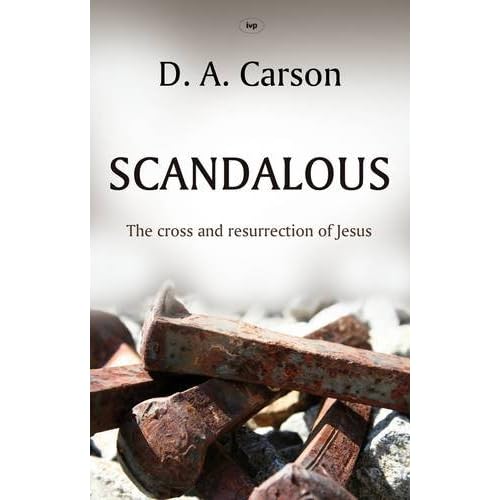
Scandalous


Don Carson's various books are always appreciated. His latest, the seasonal Scandalous The cross and resurrection of Jesus is no exception. Dedicated to his wife, its 170 pages contain a five sermons on New Testament texts, originally delivered at the end of 2008 at the Resurgence Conference in Seattle. They look at Matthew 27:27-51a, Romans 3:21-26, Revelation 12, John 11 and John 20:24-31. Typically they contain careful exposition, interesting background, mature reflection and always application. Inevitably the sermons vary in quality but they tackle big and important themes, such as propitiation, Christ's resurrection and biblical eschatology in an orthodox but fresh way and are all useful. Not all will share Dr Carson's penchant for poetry but a nose for a good illustration and helpfully told background material is appreciated. Unexpected nuggets include his exposition of John 11 (p 131ff) rejecting the common English translation and a slightly tangential exploration of six kinds of doubt (143-148). Clear headings and two indices add to the book's value.