The similar phrase 'Worldly Christianity' is one used by Bonhoeffer. It's J Gresham Machen that I want to line up most closely with. See his Christianity and culture here. Having done commentaries on Proverbs (Heavenly Wisdom) and Song of Songs (Heavenly Love), a matching title for Ecclesiastes would be Heavenly Worldliness. For my stance on worldliness, see 3 posts here.
Showing posts with label Sovereignty of God. Show all posts

Lesser known Toplady Hymn


I came across this Toplady hymn recently. Good for our times and any times. Verse 4 stands out.

Thrice comfortable hope 
That calms my stormy breast; 
My Father's hand prepares the cup, 
And what he wills is best. 

2 My fearful heart he reads; 
Secures my soul from harms; 
While underneath his mercy spreads 
Its everlasting arms! 

3 His skill infallible, 
His providential grace, 
His power and truth that never fail, 
Shall order all my ways. 

4 The fictious power of chance 
And fortune I defy: 
My life's minutest circumstance 
Is subject to his eye.

5 O might I doubt no more, 
But in his pleasure rest; 
Whose wisdom, love, and truth, and power,
Engage to make me blest!

God is king

It was good to be at the Evangelical Library last Monday for the most recent lunch time lecture. Dr Ian Densham gave us a very helpful lecture on the sovereignty of God. We had a good number present too including at least one person who had just turned up at the Library to do some work and found there was a lecture on. Serendipity. I love this quote from Professor John Murray

These are days when international conflict has taken on staggering proportions. Men’s hearts fail them for fear. Barbaric tyranny has brought its cruel heel upon millions of our fellowmen. In words that Calvin wrote four centuries ago, “the turbulent state of the world deprives us of our judgement”. In such days there is inexpressible comfort in the sovereignty of God. The world has not been abandoned to cold and relentless late, nor has it been given over to the totalitarianism of man or devil. God’s counsel still stands and He still does all His pleasure. It is still true, “Surely as I have thought, so shall it come to pass; and as I have purposed, so shall it stand” (Isa. 14:24). Through all the disquieting events of our history there runs the sovereign and holy purpose of the Lord God omnipotent. Justice and judgement are the habitation of God’s throne even though clouds and darkness are round about Him. He fulfils His righteous purpose through the unrighteous wills of wicked men. He holds the reins of universal government and not a sparrow falls to the ground without His knowledge and ordination.
In this let the believer take solace, for it is the secret place of the Most High and the shadow of the Almighty. It is the absolute sovereignty of the eternal God. It is the absolute sovereignty of none other than the God and Father of our Lord Jesus Christ. And it is even with equal universality the mediational sovereignty of the Lord Jesus Christ, the God-man, the incarnate Son, the Saviour-King, the King of kings and Lord of lords
“Alleluia: for the Lord God omnipotent reigneth” (Rev. 19:6). 

Lord's Day August 30 2015


It was good to be preaching in Childs Hill again yesterday. I decided to preach on the sovereignty of God in the morning - a subject we are always in danger of neglecting. I expounded Psalm 135:6. It seemed to me that a good balance would be to preach in the evening on human responsibility. For that I decided to go to 2 Corinthians 5:10 which speaks of the judgement day. It was very stimulating to preach on these texts and I hope that it was a blessing to those who heard. Quite a few were away but there were visitors too. An Iranian man has begun to attend and we are seeking to get to know him. Numbers were rather low in the evening.

Midweek Meeting February 4 2015

Another good session with around 15 present. We just looked at two verses, Philippians 2:12, 13. It is one of those rare places where the sovereignty of God and human responsibility are highlighted in the same place. I took opportunity to quote Jim Packer and others on the subject as well as expounding the text as best as I could. Always lots to pray about on the local and worldwide stages.

Grace Assembly 2010 08


So on our final morning there was another opportunity to hear the inimitable Barry King. I did think at one point this may be ordinary but a ever it was searching and powerful and well worth hearing.
His subject was the sovereignty of God and he spoke chiefly from 1 Chronicles 29. As an assembly we confess to a belief in this but do we really believe it in practice?
After a number of introductory remarks about how to go about the subject, Barry gave us this definition:
God because he is God has the right as well as the might to do whatever he purposes to do whether he chooses to discover the nature of these purposes to us or not
An examination of David's prayer reveals David's view of God -
Who is he? The eternally exalted King of heaven and earth. Who God is - this is something we must see and hold on to.
What does he have? He has greatness and glory, etc.
What can he do? He can do anything (that is morally and logically possible). However, God does only that which he has purposed and decreed. Our problem is usually not with what God can do but what he in fact he does do.
David lists seven things God can do
1. God can give riches and honour to men
God can do this but we are perplexed when he gives it to others and not to his people
2. God can give greatness and strength to men
Similarly we wonder why we do not enjoy more of it
3. God can provide for all his works
"God's work done in God's way will not lack God's provision" (Hudson Taylor). We believe that yet we are perplexed at times at the lack of provision for the Lord's work.
We wonder at our wonder, bewildered at our bewilderment and so we turn inward and nurse our doubts and fears.
4. God can test men's hearts
What about religious charlatans then? Why are we led into ways that are not good for us?
5. God can keep his purposes in the hearts of his people
So why then are so many led astray and why do his people fail so often?
6. God can direct hearts to him
So why does it seem at times that our hearts are going in every other direction
He slipped in that Vance Havner quote
“The church is so subnormal that if it ever got back to the New Testament normal it would seem to people to be abnormal.”
7. God can give our children all they need to obey his statutes and commandments Though God can do everything, he sometimes does not do what he can do. Mother Teresa when asked what would you say to God replied "You have a lot of explaining to do". Are we going to be like her? This is something that the Book of Job deals with. Job is not about "why do the righteous suffer?" If so, it does not answer the question. Rather, it deals with the question of "why the righteous serve?".
Barry then gave a powerful closing illustration of a faithful pastor who had seen no visible fruit yet still loved and served the Lord. The final call was to a full orbed acceptance of God's sovereignty.
He closed in prayer.
Powerful stuff.

Sovereignty Responsibility 06

(Final post in this short series)
So the fact of human responsibility rests on our natural ability, is witnessed to by our consciences and is insisted on throughout the Bible. The ground of man’s responsibility is that he is a rational creature capable of weighing eternal issues and that he possesses a written Revelation from God, in which his relationship with and duty toward his Creator is plainly defined. We can add that the measure of responsibility is different for different individuals. Some have more light (increasing their guilt) and some have less. What we all need to do is to make the use of means and avoid a fatalistic inertia gripping us.
“The same God who has decreed that a certain end shall be accomplished, has also decreed that that end shall be attained through and as the result of His own appointed means. God does not disdain the use of means, nor must I.” (A W Pink, who I have relied on heavily for this message).
*
The example of Acts 27 is often cited. God made known that he was going to save everyone who was with Paul on the ship but Paul did not hesitate to say to the centurion and the soldiers at one point, Unless these men stay with the ship, you cannot be saved.
Perhaps the best text to bring the subject into sharp relief, however, is Philippians 2:12, 13 and I want us to close with this. There Paul writes
Therefore, my dear friends (my beloved), as you have always obeyed - not only in my presence, but now much more in my absence - continue to work out your salvation with fear and trembling, for it is God who works in you to will and to act (or do) according to his good purpose.
He is writing to the Philippians here and urging them to continued godly living. On the one hand, he stresses human responsibility very clearly telling the believers to continue to work out your salvation with fear and trembling. Yet, when he comes to motivation it is all on the other side - for it is God who works in you to will and to act (or do) according to his good purpose.
When a minister wants to encourage believers to live the Christian life and be holy then he must stress their responsibility to do this. He will encourage them, if he can, by noting how they have been obedient in the past, but he will urge them to continue in the right direction and keep working out their salvation with diligence and hard work, making the most of the opportunities they have. He will want to call them to reverence and care not becoming lazy or presumptuous. He will want to keep them from complacency.
I want to stress that. I would say to every believer – are you working hard at being a Christian? Don't get complacent. Fear and tremble before God. Are you taking every opportunity to grow in grace? Are you at the meetings on the Lord's Day and in the week? Do your read the Bible at home? Are you prayerful? Do you endeavour to lead a holy life? What are you doing to let others know about the Saviour?
Yet, at the same time, a faithful preacher will want also to stress the sovereignty of God. He will want to remind every believer that it is God who works in you to will and to act (or do) according to his good purpose. His will is bound to prevail, however weak and wayward we may be.
Again I want to stress that too. Ah, believer, you are aware of many troubles and difficulties but don't forget that God is in control. He is working his purposes out in your life and though some things do not seem to make sense to you – do not be afraid. He is in control. His purpose will prevail.
I think there are at least three great dangers that often beset us as Christians and a right understanding of these doctrines and how they relate will help us to avoid them.
1. Laziness. We can grow lazy about serving God as believers and we can even misuse the doctrine of God's sovereignty to excuse ourselves. We must not make any excuses. Continue to work out your salvation with fear and trembling. It is God's command.
2. If we are not lazy then we face two other obvious dangers. If we work hard and well we can begin to be proud. Whenever that danger comes we need to remind ourselves that it is God who works in you to will and to act (or do) according to his good purpose. Without him we can do nothing.
3. The other danger is the opposite one. When we see how little we have done we are tempted to despair. Once again the answer is to remember that it is God who works in you to will and to act (or do) according to his good purpose. Never forget (1:6) that he who began a good work in you will carry it on to completion until the day of Christ Jesus. We must still fight the good fight and serve him but he will make sure that we complete the task in him.
Amen

Sovereignty Responsibility 05

Four Questions (3, 4)
3. How can God decree that men should commit certain sins, hold them responsible for committing them, then judge them guilty for doing so?
Here we can think of the extreme case of Judas. It is clear from Scripture that God decreed from all eternity that Judas would betray Jesus. The prophecy about the 30 pieces of silver in Zechariah 11:12, for example, shows that. So the next question is, was Judas a responsible agent in fulfilling this decree of God? He was. Responsibility is to do mainly with the motive and intention of the one doing something. This is generally recognised. The law distinguishes between a blow inflicted by accident (without evil intent) and one delivered with malice aforethought. Think of Judas then. What did he design in his heart when he bargained with the priests? He was not conscious of fulfilling God's will. He did not know it. Yet that is what he did. His actual intention was only evil, and so, though God had decreed and directed his act, yet because of his own evil intention he is surely guilty. He himself says afterwards I have betrayed innocent blood.
Something similar can be said about the crucifixion. Again the Bible is clear that Jesus was handed over to his killers by God's set purpose and foreknowledge. The kings of the earth took their stand and the rulers gather(ed) together against the Lord and against his Anointed One. ... Herod and Pontius Pilate met together with the Gentiles and the people of Israel in Jerusalem to conspire against God's holy servant Jesus, whom he anointed. But as the early church confessed to God They only did what God's power and will had decided beforehand should happen (Acts 4:26-28). Yet at the same time the guilt of those who crucified the Saviour is not in doubt. You, says Peter to the citizens of Jerusalem, with the help of wicked men, put him to death by nailing him to the cross.
It is wrong to say then that because these things were pre-ordained by God that the perpetrators are not guilty. That is a false logic. God is never the author or approver of sin in the absolute sense. As Augustine long ago well put it “That men sin proceeds from themselves; that in sinning they perform this or that action, is from the power of God who divides the darkness according to his pleasure.” Proverbs 16:9 is similar In his heart a man plans his course, but the LORD determines his steps.
4. How can the sinner be held responsible to receive Christ, and be damned for rejecting him, when God foreordained him to be condemned?
This question has really been answered but we can identify certain things that we need to keep in mind.
1. No-one in this life can know for certain that he is damned. Such things are hidden in God's secret will. Only his revealed will is known and that is that all men everywhere should repent and turn to Christ. All who do that will be saved.
2. It is the duty of every sinner to search the Scriptures which are able to make him wise to salvation (2 Timothy. 3:15). God blesses the use of means and those who will study God's Word and do what it says have good reason to hope that they will be saved.
3. But people come back and they say but isn't it still true that the non-elect are unable to repent and believe? The answer is yes, of course, but then no sinner has the power to come to Jesus of himself. We're all the same on that score. We not only cannot save ourselves but we do not want to be saved. Nevertheless God commands us to obey him.
This brings us to the question of why God demands from us what we can't do. With Pink, we answer, firstly, that God is not going to lower his standards just because of sin. God is perfect and so he sets perfect standards before us. Further, we are responsible to acknowledge before God our inability and to cry to him for help to find grace.
Pink uses the illustration of a slip on the ice. A man slips and breaks his hip. He is unable to rise but if he remains there he will freeze to death. What, then, should he do? If he's determined to be rescued he will cry out for help. In a similar way, the sinner, unable to get up himself and take the first step to Christ, is responsible to cry out to God for help - and if he does (from the heart), God will hear him. God is not far from any one of us (Acts 17:27). But if we refuse to cry to the Lord, then our blood will be on our own heads.

Sovereignty Responsibility 04

Four Questions (1, 2)
A W Pink helpfully boils the main question down to four subsidiary ones and this is the first
1. How can God bring his power to bear on people in such a way that they are either prevented from doing what they want to do or compelled to do what they don't want to do and yet still hold them responsible?
If God uses his power and exerts a direct influence on a person doesn't that interfere with their freedom? Pink takes us to 3 or 4 OT texts to look at the problem.
In Genesis 20:6 we are told that God spoke to the Philistine king Abimelech with whom Abraham had sought refuge. The King had been tempted to have Sarah for himself because of Abraham's lies. God says Yes, I know you did this with a clear conscience, and so I have kept you from sinning against me. That is why I did not let you touch her. Then in Numbers 22-24 we have the story of Balaam the prophet. He is clearly willing, indeed keen, to accept Balak’s offer of money for cursing Israel, a sin against God and his people. But, he says (22:38) I must speak only what God puts in my mouth. In 23:20 he says I have received a command to bless; he has blessed, and I cannot change it.
So how should we understand things in light of such verses? There is no question that both Abimelech and Balak were still responsible for their actions. God can clearly prevent people from doing things without reducing them to mindless robots. We ask, of course, why didn't he stop Adam sinning? And why didn't he stop Satan tempting Adam or falling in the first place? Such questions cannot properly be answered, however. There is a mystery at least at this point.
An obvious area where God sovereignly overruled and yet allowed freedom within that is the construction of the Holy Scriptures. We teach the children that the Scriptures were written by holy men (yes human beings doing as they intended but) as they were moved by the Holy Spirit. God sovereignly superintended the whole thing from beginning to end.
One of the problems here is a general failure to understand freedom properly. True freedom is not the power to do as you please but to live as you were intended to live. The illustration is often used of a railway engine – true freedom for an engine is found on the track not in a field. That's why it is true to say that the only man who ever lived a truly free life on earth was Jesus Christ, who always did his Father's will. Or think of it this way. Here is a horse in a large field. The owner has constructed a fence around the property on which the horse roams, but the fence can't always be seen because the property is so large. Now, the horse belongs to its owner and is "fenced in" (whether it realises or not!). At the same time, the horse has a great deal of freedom within those parameters. He can run freely from here to there. He can jump or play. He may also choose to attempt to jump over something, miscalculate its height and fall - even be injured. He may choose to wallow in a mud hole for a time. The owner may have granted the horse a great deal of freedom within the parameters of where he has placed the horse. But the horse is still fenced in - this was the owner's choice. All illustrations fail at some point but they can help us.
2. How can the sinner be held responsible for doing what he can't do anyway? And how can he be justly condemned for not doing what he can't do anyway?
As creatures we are all responsible to love God and obey and serve him. Sinners have a duty to repent and believe the gospel. However, sinners in and of themselves are unable to do these things. That is clear from John 6:44 where Jesus says No one can come to me unless the Father who sent me draws him.
By nature our hearts are desperately wicked and left to ourselves we will never come to Christ. John 8:34 I tell you the truth, everyone who sins is a slave to sin. First, by nature, we don't realise our danger, so we are unconcerned about our souls and about turning to Christ. By nature, we are unwilling too to admit that there is nothing we can do to save ourselves. Further, we will not trust in Christ but would prefer what is false and contrary to God. This is why Romans 8:7, 8 says that the sinful mind is hostile to God. It does not submit to God's law, nor can it do so. Those controlled by the sinful nature cannot please God.
But how can God hold a sinner responsible for failing to do what he is unable to do? To answer that we have to be quite clear about what we mean by "unable". It is not, as is sometimes claimed, that people want to come to Christ but are kept away. No, they don't want to come to Christ in the first place. Pink cites Genesis 37:4 where it says that Joseph's brothers hated him and could not speak a kind word to him. They could speak all right and they could have spoken kind words to Joseph but they were unwilling. It was their hatred that drove them.
This is the inability of man then – what makes him sin. He is separated from the life of God and full of darkness and sin. Why can't he come to Christ? Because his wicked heart loves sin and hates Christ. It is because people's hearts are calloused so that they hardly hear with their ears, and they have closed their eyes. Otherwise they might see with their eyes, hear with their ears, understand with their hearts and turn, and Christ would heal them.
Though the sinner is morally or spiritually unable to come to Christ he is nevertheless responsible to do so. Our inability does not absolve us or mean we are not accountable to God. Rather it serves to increase our guilt. If I lose my temper and break something I can't excuse myself by saying "ah but I lost my temper". If I break a law because I'm drunk do you think the magistrate will let me off? He may well take it into account but it will not mean that I am not guilty.
Man's responsibility is clear from Scripture and our own consciences testify to it too. Pink uses an illustration at this point. He imagines a man who owes him $100. The man says he can't afford to pay back what he owes. However, he seems to find plenty of other things to spend his money on. So what's his problem? “I would say” says Pink “that the only ability that was lacking was an honest heart.” It would be unfair to take that to mean an honest heart is what is needed to be able to pay the debt. No; the ability of the debtor lies in his power to write a cheque and this he has. What is lacking is an honest principle. It is his ability to write a cheque that makes him responsible. The fact that he lacks an honest heart doesn't destroy his accountability.
People don't lack what we may call the natural ability to love God and serve him but they refuse to do so. For this they will have to give an account. We may have lost our power to do good but God hasn't lost his right to expect good from us. A drunken servant is still a servant and it is against all sound reason to suppose that his master loses his rights because of his servant’s failure.

Sovereignty Responsibility 03

The Bible's clear teaching
1. On the one hand the Bible teaches plainly God is sovereign (some of you know these texts well)
Isaiah 46:9, 10 ... I am God, and there is no other; I am God, and there is none like me. I make known the end from the beginning, from ancient times, what is still to come. I say: My purpose will stand, and I will do all that I please.
Daniel 4:34, 35 His dominion is an eternal dominion; his kingdom endures from generation to generation. All the peoples of the earth are regarded as nothing. He does as he pleases with the powers of heaven and the peoples of the earth. No one can hold back his hand or say to him: What have you done?
Proverbs 16:33 The lot is cast into the lap, but its every decision is from the LORD.
Ephesians 1:11 In him we were also chosen, having been predestined according to the plan of him who works out everything in conformity with the purpose of his will, in order that we ... might be for the praise of his glory.
Romans 9:15-21 (God) says ... I will have mercy on whom I have mercy, and I will have compassion on whom I have compassion. It does not, therefore, depend on man's desire or effort, but on God's mercy. ... God has mercy on whom he wants to have mercy, and he hardens whom he wants to harden. One of you will say to me: Then why does God still blame us? For who resists his will? But who are you, O man, to talk back to God? Shall what is formed say to him who formed it, 'Why did you make me like this?' Does not the potter have the right to make out of the same lump of clay some pottery for noble purposes and some for common use?
2. Yet on the other hand, the Bible also stresses human responsibility. It is everywhere in Scripture.
The Bible says that everyone who calls on the name of the Lord will be saved.
In John 1:12 it says that to all who received him, to those who believed in his name, he gave the right to become children of God.
When the Philippian Jailer asks how to be saved Paul and Silas say (Acts 16:31) Believe in the Lord Jesus, and you will be saved.
Or what about 1 Corinthians 9:24-27? Do you not know that in a race all the runners run, but only one gets the prize? Run in such a way as to get the prize. Everyone who competes in the games goes into strict training. They do it to get a crown that will not last; but we do it to get a crown that will last forever. Therefore I do not run like a man running aimlessly; I do not fight like a man beating the air. No, I beat my body and make it my slave so that after I have preached to others, I myself will not be disqualified for the prize.
If we are faithful to the Bible there is no denying one or the other. That is why when asked on one occasion how he would reconcile the two, Spurgeon characteristically answered “I wouldn’t try, I never reconcile friends.” Jim Packer reflecting Spurgeon has rightly written, “In the Bible, divine sovereignty and human responsibility are not enemies. They are not uneasy neighbours. They are not in an endless state of cold war with each other. They are friends, and they work together.” But what is the meeting-point of God’s sovereignty and man’s responsibility? How can God assert his sovereignty and exercise the power he does and yet not interfere with man’s freedom, destroy his responsibility and reduce him to a machine?

Sovereignty Responsibility 02

Jim Packer is perhaps in danger of falling into this mystical way of thinking with his introduction of the word antimony (in Evangelism and the sovereignty of God). He defines "antinomy" as "an appearance of contradiction between conclusions which seem equally logical, reasonable or necessary" (18). It "is neither dispensable nor comprehensible ... It is unavoidable and insoluble. We do not invent it, and we cannot explain it" (21). God "orders and controls all things, human actions among them"...yet "He holds every man responsible for the choices he makes and the courses of action he pursues" (22). "To our finite minds this is inexplicable" (23). John Piper has criticised him for this language. It is not, in his judgement, “improper to probe into the very mind of God if done in the right spirit”. Pink agrees.
Certainly those who speak of the mystery involved have a point and we should not suppose that we can simply solve what is no doubt a mystery to some extent. However, it is right that we should prayerfully study the Scriptures and at least try to see how these two Bible doctrines fit together. There are difficulties it is true but we should seek to face them honestly and seek as much light from the Word as we can.
Perhaps Spurgeon gets the balance about right (in his autobiography) when he says, slightly poetically,
“That God predestines, and yet that man is responsible, are two facts few can see clearly. They are believed to be inconsistent and contradictory, but they are not. The fault is in our weak judgement. Two truths cannot be contradictory to each other. If, then, I find taught in one part of the Bible that everything is fore-ordained, that is true; and if I find, in another Scripture, that man is responsible for all his actions, that is true; and it is only my folly that leads me to imagine that these two truths can ever contradict each other. I do not believe they can ever be welded into one upon any earthly anvil, but they certainly shall be one in eternity. They are two lines that are so nearly parallel, that the human mind which pursues them farthest will never discover that the converge, but they do converge, and they will meet somewhere in eternity, close to the throne of God, when all truth doth spring."

Sovereignty Responsibility 01

I want us to consider the subject of God's sovereignty and human responsibility. In his important book on The Sovereignty of God A W Pink wrote, when he came to his chapter on this, that “This is, admittedly, the most difficult branch of our subject. Those who have ever devoted much study to this theme have uniformly recognised that the harmonising of God’s Sovereignty with Man’s Responsibility is the Gordian knot of theology.”
Inadequate proposed solutions
In the face of the apparent problem professing Christians have reacted in different ways.
(1) Some have tried to tackle it by denying God's absolute sovereignty. This has become popular in certain circles in more recent times. They deny that God is all knowing and all powerful and they argue for a certain amount of openness in God. They draw attention to verses that speak of God changing his mind, repenting. But these verses rather speak of God in human terms in order to help us to understand that there is no coldness in God. He is not like some sort of machine. There is so much else in the Bible that opposes the idea of God being anything less than absolutely sovereign that we can't suppose it right to to lessen it. It will rather serve only to denigrate the glory of God.
(2) Then there are other, perhaps less thought through, professing Christians who so stress human responsibility that they are in danger of leaving no room for the sovereignty of God. For them it is all about what we do. Yes, the very fact that they usually have a place somewhere in their scheme for prayer means that they cannot entirely do away with the idea that God is in control to some extent but for all practical purposes, they feel, it is all down to us.
(3) Then at the other extreme to these we have those who so stress the sovereignty of God that there is really very little room in their system for human responsibility. A fatalistic streak binds them so that they have no real place for human effort at all. They end up performing all sorts of mental gymnastics in order to explain themselves.
(4) Still others acknowledge that the Bible certainly does teach both the sovereignty of God and human responsibility but, they say, as to how it they fit together it is simply a mystery, one that we cannot penetrate and so there is little point in our even considering the subject. They would advise us to give up our question now.

SGU Bethersden

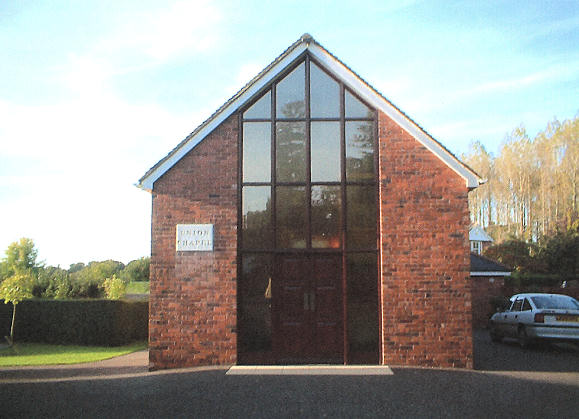
I was speaking for the Kent auxiliary of the Sovereign Grace Union on Wednesday night in Union Chapel, Bethersden. I'd not been there before and had failed to leave myself as much time as I should to cover the distance. There was heavy traffic at the Dartford Crossing. I ended up 10 minutes late for that reason but people were very understanding. About 40 had gathered in the little chapel there. The pulpit is a high one and there is a gallery so the preacher can't necessarily see everyone, not if they sit near the outer walls. I've not preached anywhere like that before.
Most of the people were strangers to me but there were a few I knew, including the young minister at Bethersden Steve Ridgeway, who I have met at the Westminster Fellowship, his fellow elder Andrew Muwowo from Zambia and another Bethersden member, Ian Jemmett. I also know our chairman Tim Field (Tonbridge) who had invited me. He had asked me for a title at the time and in a moment of inspiration had got back to him with "The sovereignty of God and human responsibility". It was only as I prepared properly that I realised what a difficult subject it is. Anyway with the help mostly of A W Pink I managed to put something together that was fairly thorough, not too difficult to listen to, hopefully not overlong (although I'm sure I was at least 50 minutes) and not merely dry and theoretical. Watch this space for more detail.
One of my fears was over just who I might be upsetting but not knowing most of the people I was fairly oblivious. They listened well and made lots of appreciative comments. I think most of the folk were from Bethersden but several other fellowships were represented, some coming from as far as Folkestone. I hope they felt it worthwhile. The doctrine of God's sovereignty is one of the most comforting doctrines in Scripture and the doctrine of our responsibility one of the most challenging.

Spurgeon Sovereignty Responsibility

No video for this one. Spurgeon says (in his autobiography)

That God predestines, and yet that man is responsible, are two facts few can see clearly. They are believed to be inconsistent and contradictory, but they are not. The fault is in our weak judgment. Two truths cannot be contradictory to each other. If, then, I find taught in one part of the Bible that everthing is fore-ordained, that is true; and if I find, in another Scripture, that man is responsible for all his actions, that is true; and it is only my folly that leads me to imagine that these two truths can ever contradict each other. I do not believe they can ever be welded into one upon any earthly anvil, but they certainly shall be one in eternity. They are two lines that are so nearly parallel, that the human mind which pursues them farthest will never discover that the converge, but they do converge, and they will meet somewhere in eternity, close to the throne of God, when all truth doth spring.

Piper Sovereignty Responsibility


This helpful answer was given by John Piper at a recent Desiring God Conference Q&A